 The Good Sign Company
Nonprofit sign planning
Choose the update system before choosing the donor-wall look.
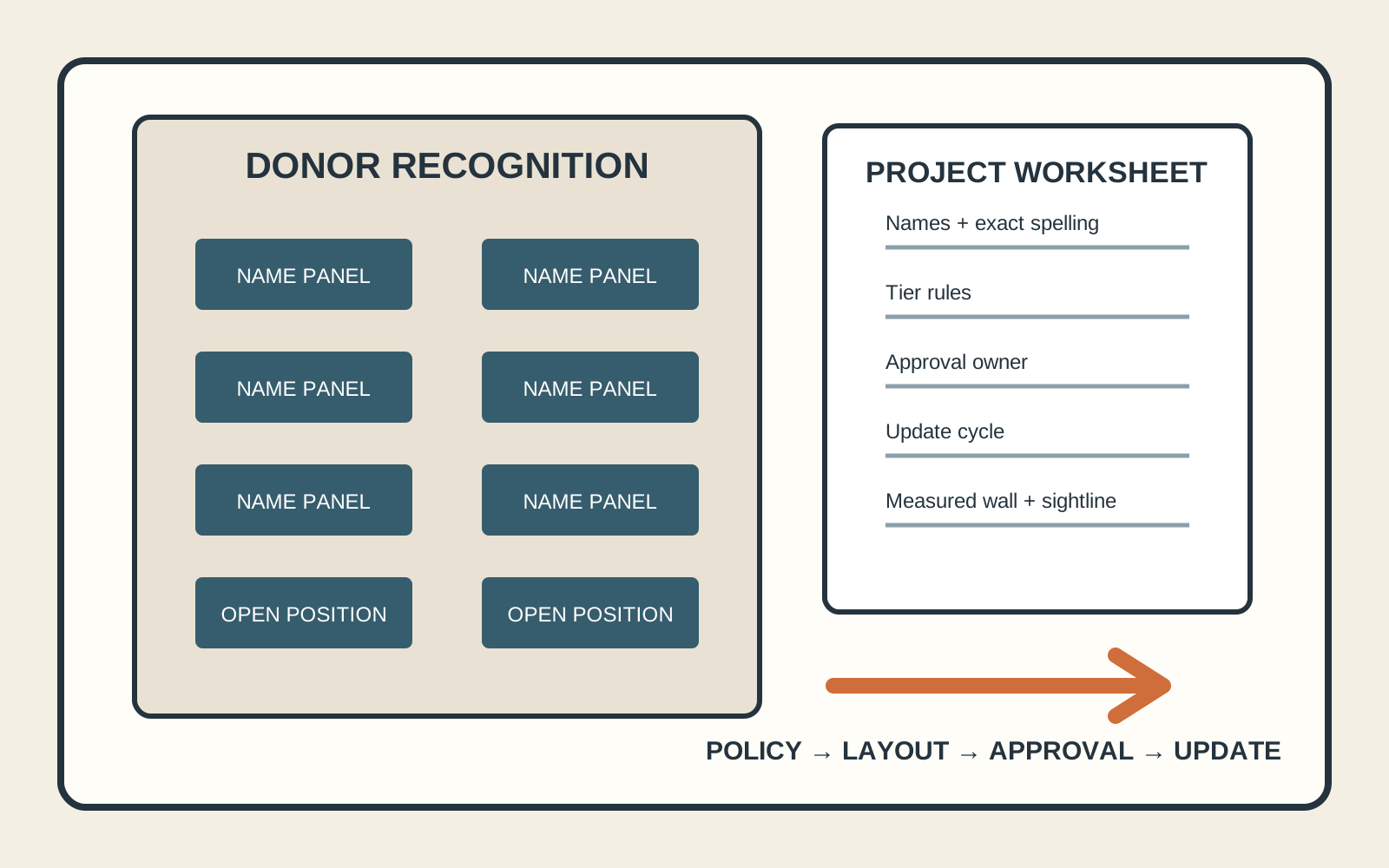
A useful indoor donor recognition wall starts with policy: whose names appear, how they are grouped, who verifies spelling, how often the list changes, and who owns future updates. The visual format should support that workflow rather than lock the organization into an awkward revision process.
Quick answer
Use a fixed display only for a fixed recognition list.
If names may be added regularly, shortlist a format that can accept controlled additions without rebuilding the whole composition. If the list is closed and the story is permanent, a fixed layout may be simpler. In either case, freeze the recognition policy and verify every name before artwork approval.
Start with governance, not materials
Development, leadership, facilities, marketing, and the sign provider each own a different decision. Record those handoffs before design work begins.
- Recognition policy: define eligibility, display order, tiers if any, naming conventions, anonymity requests, and whether amounts or dates appear.
- Source of truth: keep one approved list with exact spelling, punctuation, honorific rules, and an owner responsible for corrections.
- Approval path: name who approves policy, donor data, visual design, wall use, production release, and installed closeout.
- Update owner: assign who gathers additions, sets a cutoff date, approves proofs, and keeps the final record after each update.
The broader custom business sign brief helps capture the audience, message job, site facts, stakeholders, and provider questions around this recognition-specific workflow.
Measure capacity in names, not just square feet
Measure the usable wall width and height, then record the normal approach and closest expected reading position. Also mark doors, switches, furniture, trim, glare sources, and areas that must remain accessible for future changes. These are planning observations, not installation specifications.
Next, count current names and estimate additions only from the nonprofit’s own approved planning horizon. A modular layout needs visible room for those additions; a fixed layout needs an explicit policy for what happens when the list changes.
| List condition | Format direction to investigate | Tradeoff to document |
|---|---|---|
| Closed commemorative list | Fixed composition | Clean unified layout, but later corrections or additions may affect more of the display. |
| Names added on a known cycle | Modular panels or planned add-on zones | Updates are easier to scope, but alignment, inventory, and visual consistency need an owner. |
| Frequent or unsettled changes | Defer permanent production or use a separate changeable recognition format | Less permanence now, but fewer premature remakes while policy and names stabilize. |
Worked capacity exercise (hypothetical)
This example demonstrates planning math; it is not a production specification or a measured project.
A nonprofit has 68 approved names and expects to review additions once per year. Its planning team chooses to test a draft grid with 80 equal name positions: 68 filled and 12 intentionally open. The draft uses five rows of 16 positions, so the team can see whether additions remain balanced instead of appending names unpredictably.
The useful result is not “order 80 plaques.” It is a provider question: can the proposed visual system keep typography, spacing, finish, attachment, replacement access, and future batches consistent within the verified wall and project scope? The sign provider must confirm the physical design.
Compare concepts with the same decision sheet
- Current approved name count, planned open capacity, update cadence, and cutoff date.
- Rules for grouping, sequence, tier labels, recognition copy, and donor anonymity.
- Measured usable wall area, approach photos, reading positions, obstructions, and maintenance access.
- How corrections, additions, removals, and replacement components would be handled.
- Who supplies final files, who proofs every name, and what constitutes production approval.
- What the proposal includes, excludes, or still requires the organization to verify.
Do not compare concepts only by appearance. Compare the current-name capacity, update method, replacement access, proofing responsibility, cleaning guidance, installation scope, and records delivered at closeout.
When to skip or pause a custom donor wall
- Pause when the recognition policy, approved name list, or final decision maker is unsettled.
- Use a temporary display when names will change several times before the next planned review.
- Choose a simpler recognition format when staff cannot own proofreading, updates, cleaning, and records after installation.
- Skip tiers when the organization has not adopted a clear and consistently applicable tier policy.
- Do not release production from an informal spreadsheet, unverified wall dimensions, or a rendering alone.
- Do not treat this guide as compliance or installation advice. The responsible property stakeholders, provider, and qualified professionals must resolve project-specific wall, accessibility, fire, electrical, permit, and code questions.
Take a controlled brief to a commercial sign provider
DaNite Sign Company’s public interior-sign page describes custom interior signage for Columbus businesses, and its homepage lists churches and nonprofits among the industries it serves. Those statements do not establish that DaNite accepts donor-wall projects. If the location and project fit may align, bring the approved name policy, wall information, update plan, and stakeholder list to an initial conversation and ask the provider to confirm scope.
Provider handoff checklist
Send the recognition policy, approved-name file, grouping rules, change forecast, measured wall sketch, approach photos, brand files, approver list, desired update process, known property constraints, and open questions. Ask the provider to identify assumptions and missing site information before the concept is treated as final.
DaNite’s homepage and interior-sign page were independently accessed on October 27, 2026. Its churches/nonprofit page returned HTTP 429 during that review, so it was not used to verify an offering. The accessible sources support only the limited statements above, not a promise that a donor-wall project, material, schedule, budget, location, or installation condition will be accepted. Confirm current project and service fit with DaNite Sign Company.
Sources and evidence boundary
Partner-offering claims were checked against DaNite Sign Company’s public homepage and interior-sign page on October 27, 2026. Primary source URLs: https://danitesign.com/?ref=jtmccord and https://danitesign.com/interior/?ref=jtmccord The page at https://danitesign.com/churches-nonprofit/?ref=jtmccord returned HTTP 429 during independent review and was not treated as verified evidence. Source accessibility does not show that DaNite will accept this project type; the organization must confirm project and service fit directly. The capacity worksheet, governance sequence, skip criteria, and hypothetical example are original planning tools from The Good Sign Company editorial desk. They are not fundraising, donor-policy, legal, installation, engineering, accessibility, permitting, or code advice.
AI-assisted tools helped prepare and reconcile this page. The editorial desk remains responsible for source boundaries, hypothetical labels, and unsupported-claim removal; see our About and editorial process.