 The Good Sign Company
Buyer guide
How to Choose Dry-Erase Erasers for Frequently Updated Sign Boards
The useful eraser is the one that matches the board maker’s care guidance, clears the actual writing area comfortably, and has an obvious storage spot. Compare the format around the staff routine—not around a vague promise of a perfectly clean board.
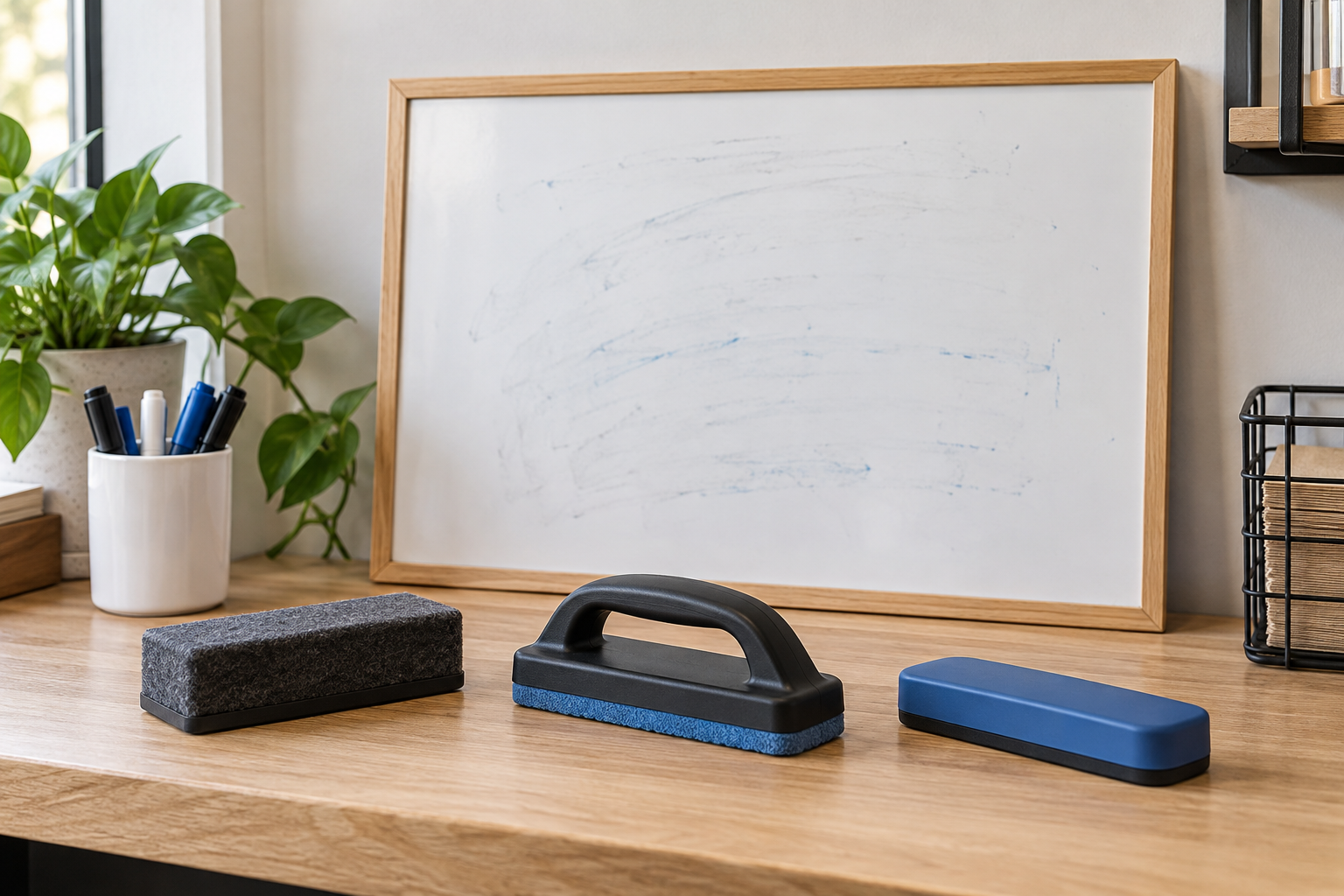
Compare the right eraser format
Start with the board manufacturer’s approved cleaning method, then compare only products whose stated use fits that surface. These tagged category searches are broad starting points; check current dimensions and instructions on the listing.
Quick choice
| Format | Best fit | Check before buying | Skip when |
|---|---|---|---|
| Simple block | Routine full-board resets | Pad dimensions, grip, and storage tray fit | The user needs a raised handle |
| Handled eraser | Repeated broad wiping where grip matters | Handle clearance, total footprint, and pad replacement | The board has little nearby storage |
| Compact or magnetic eraser | Short messages and a dedicated board-side parking spot | Actual magnetic surface, complete size, and pad area | The frame or board is not magnet-responsive |
Measure the job before comparing erasers
Write down the board’s usable width and height, how much text is normally removed, who updates it, and where the tool can live. A small counter message may need only a compact eraser. A weekly schedule grid can make a larger pad or a handle easier to use.
Confirm the writing surface, too. “Dry erase” can describe different finished boards, coated signs, sleeves, or laminated pieces. Follow the sign or board maker’s care instructions. If those instructions call for a particular cloth, cleaner, or method, that guidance outranks a general product-category recommendation.
What separates the useful options
Pad area
A larger pad covers more space per pass but needs more storage room and can be clumsy inside narrow schedule cells. Compare the contact area with the message layout, not just the overall product dimensions.
Grip and access
A low block keeps the package compact. A raised handle may be easier to grasp during repeated resets, but it adds height and can prevent the eraser from fitting a shallow tray or drawer. Check who performs updates and whether gloves, limited hand strength, or tight counter clearance changes the choice.
Storage
An eraser that disappears into a supply drawer slows every update. Measure the existing tray, shelf, hook, bin, or board-side location. A magnetic format is only useful after confirming the exact surface attracts a magnet and the parked eraser does not cover needed content.
Pad upkeep
Look for manufacturer instructions on cleaning the eraser, replacing a pad, or retiring the product. Ink-loaded material can move residue instead of removing it. Do not assume a pad is washable or replaceable unless the current instructions say so.
A practical buying checklist
- Confirm the board or sign surface and its care instructions.
- Measure the writing area and any narrow grid cells.
- Record the available tray, drawer, or board-side storage space.
- Compare pad contact area separately from the complete product size.
- Choose a grip the assigned updater can use comfortably.
- Check cleaning, pad-care, and replacement instructions before ordering.
- Assign one storage location so the eraser is available at update time.
Pair the eraser with the marker and update routine
The eraser cannot compensate for an undocumented surface or the wrong writing tool. Use the dry-erase marker guide to compare surface compatibility, tip width, contrast, and storage. For schedules, start with the dry-erase schedule-sign guide so cell size, reading distance, and ownership are already settled.
Keep routine erasing separate from occasional deeper cleaning. Use only methods supported by the board maker, test any approved method as directed, and replace a damaged or unsuitable surface instead of escalating to improvised solvents.
When to skip a dedicated eraser
Skip the purchase when updates are rare and the board maker already approves a clean reusable cloth you can store with the sign. Also skip it when the surface documentation is missing, the writing is not actually dry-erase, or the real problem is permanent staining or physical wear. Resolve the surface and marker question first.
Bottom line
For broad recurring resets, begin with a simple block or handled format sized to the board and the updater. For a small message, a compact option can be easier to park nearby. Treat magnetism, washability, replacement pads, and surface compatibility as facts to verify on the current product and board instructions—not as category-wide assumptions.
Category routeCompare dry-erase eraser formats (affiliate link)