Tabletop Display Buying Guide
Best foam board stands for tabletop signs.
A useful stand supports the finished board—not just the product photo. Start with the panel's exact width, height, thickness, and orientation, then compare slot fit, rear support, base depth, viewing angle, packing, and the amount of table space the display can actually use.
Disclosure: As an Amazon Associate, we may earn from qualifying purchases and approved partner referrals.
Category route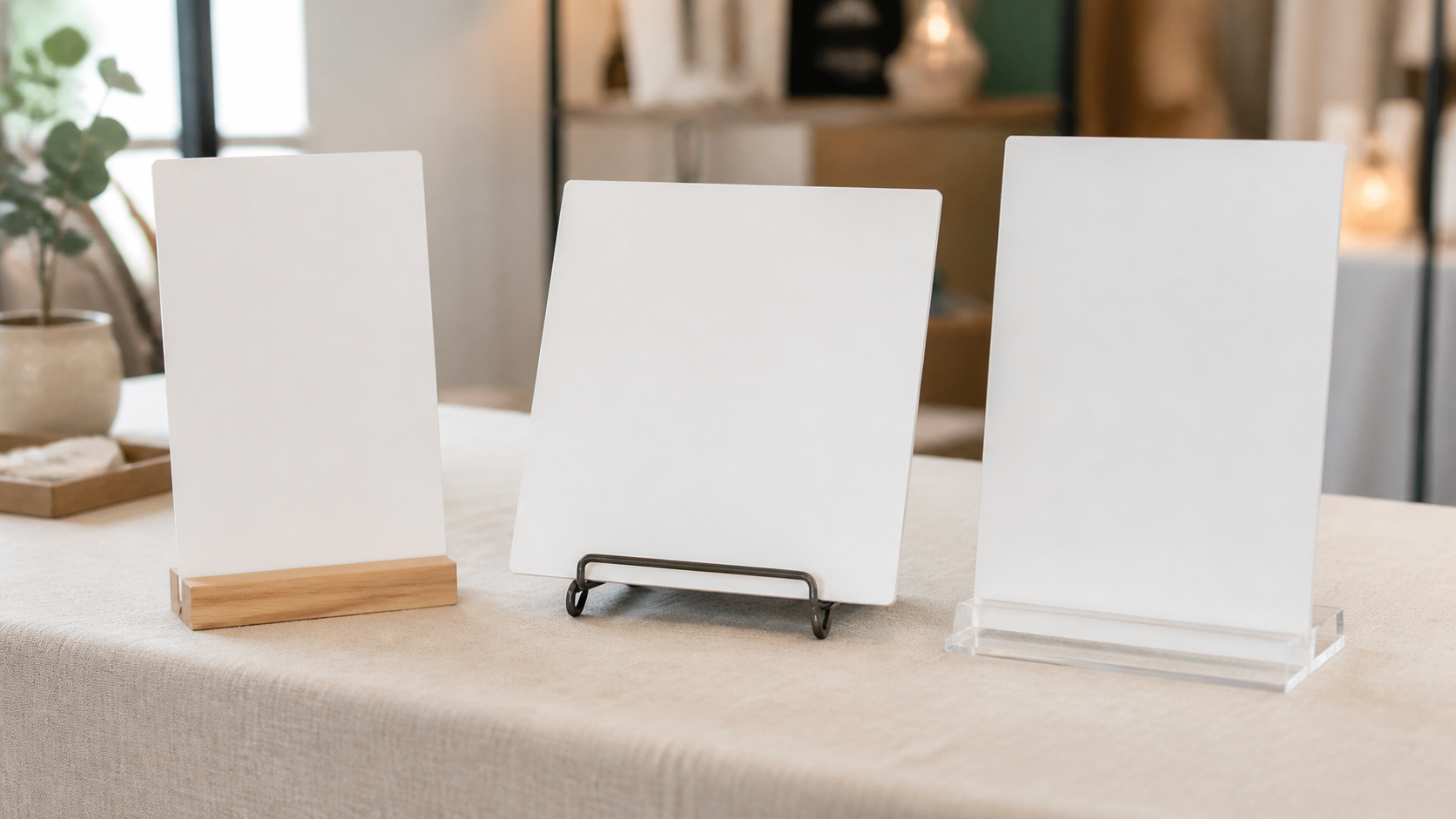
Best starting route
Match the support to a finished sample board.
Foam board is light, but a tall or wide panel can still bow, lean, or turn a compact base into a lever. Cut one sample at finished size and compare listed slot width, lip height, rear support, base dimensions, intended panel orientation, and pack quantity.
Related: see the tabletop sign stand guide or the vendor tabletop sign guide.
How we compare foam board stands
This is a product-category framework, not hands-on testing or a ranking of current named products. Compare candidates in this order:
- Panel fit: use the finished board's thickness, width, height, orientation, and edge condition—not the nominal sheet size.
- Support geometry: check how much of the lower edge and back the stand supports. A shallow lip may let a tall board lean or bow.
- Base footprint: measure depth as well as width, including rear legs that extend behind the board.
- Viewing angle: mock up the display at table height and check readability from the normal approach.
- Indoor stability: compare stated dimensions, construction, assembly, and intended panel size.
- Transport: check whether the stand folds, nests, detaches, or needs padding.
Best format by tabletop setup
Category routeSlotted base: best for a compact, fixed angle
A slot base keeps hardware visually quiet and can use little depth. Verify that the slot accepts the actual board thickness and grips enough of the lower edge without crushing it.
Browse category: Compare slotted bases
Category routeLow display easel: best for changing board sizes
An easel can accommodate more than one width or orientation, but its rear leg and board angle use table depth. Compare lip depth, open footprint, supported height, and folding method.
Browse category: Compare display easels
Category routeChannel-style base: best for a clean front view
A clear or neutral channel puts attention on the graphic when designed for its thickness. Check insertion depth, edge clearance, base width, and change-out method.
Browse category: Compare channel-style bases
Build the display before buying a set
Cut a scrap panel to final dimensions and place it on the real table. Mark the maximum base depth with painter's tape, then add products, payment equipment, menus, tablecloth folds, and anything else sharing the surface. Check the message from the aisle and both approach angles.
If the sample bows, reduce its unsupported span, choose more rear support, or use a smaller panel. If the stand crowds the table, a narrower sign with simpler copy usually works better than squeezing a deep easel behind other items.
Who should skip these stands?
- Skip a narrow slot when finished board thickness is not listed as compatible.
- Skip a shallow lip when the board is tall enough to lean past it.
- Skip a folding easel when its rear leg conflicts with merchandise or cables.
- Skip one center support when a wide landscape panel bows in the mockup.
- Skip an open tabletop stand outdoors, in a breezy entrance, or where guests regularly bump the table unless it is intended for those conditions.
- Skip foam board when the sign needs frequent cleaning, rough transport, or long-term repeated setup.
The practical bottom line
Choose from the finished board backward. A small portrait panel often works in a compact slot base; changing sizes favor a low easel; and a channel-style holder can suit a clean fixed display when its slot matches precisely. Measure the open footprint, test one complete sign, and verify the current listing's dimensions and intended use before ordering multiples. Continue with sign mounting supplies for the broader setup decision.
 The Good Sign Company