 The Good Sign Company
Letter board accessory guide
Best storage cases for changeable letter board pieces
The best storage case is the smallest organizer that gives your most-used letters dedicated, visible compartments without letting pieces cross between sections when the lid closes. Choose adjustable dividers for an uneven character mix, fixed small cells for punctuation and numbers, or two compact cases when one large organizer would be awkward to carry. Count and sort the pieces you already own before shopping.
This is an organization guide for loose indoor letter-board characters, not a generic craft-storage roundup. If the characters themselves do not fit the board, start with the replacement letter compatibility guide.
Disclosure: As an Amazon Associate, we may earn from qualifying purchases and approved partner referrals.
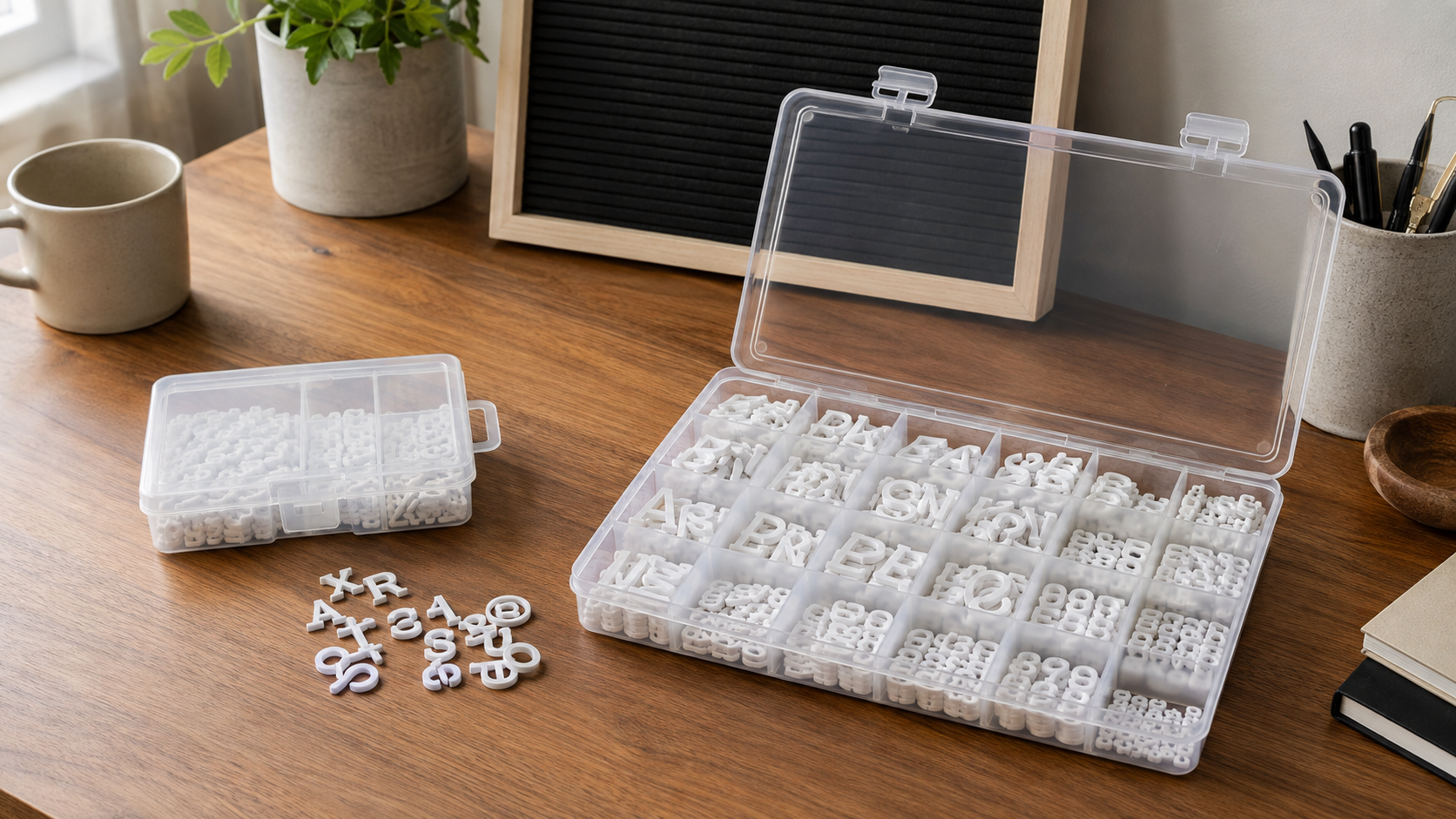
Compare organizers using your real character inventory
Check the complete case dimensions, number and inside size of compartments, fixed or adjustable dividers, lid and latch design, handle or carry orientation, and seller images showing how dividers meet the closed lid. Product photos cannot prove that your particular pieces will stay separated.
Best organizer type by letter-board workflow
These are fit-based categories, not named winners or hands-on rankings.
- Adjustable-divider case: best for uneven letter counts. Give common vowels and consonants wider sections while keeping punctuation in smaller cells. Confirm the divider positions and smallest available compartment from the current listing.
- Fixed-compartment box: best for a stable, modest set. A regular grid makes the sorting plan easy to repeat, but one cell may be too small for wide symbols or a thick stack of common letters.
- Two small lidded cases: best for separating everyday and occasional pieces. Keep letters used in most messages near the board and store numbers, accents, or seasonal symbols separately.
- Shallow clear-lid organizer: best for at-a-glance selection. A single visible layer can reduce digging. Check whether the pieces stand, lie flat, or stack without preventing the lid from closing.
- Portable handled case: best when the board travels. Prioritize a positive closure and a carry orientation that does not turn the character map sideways. Test it gently at home before relying on it for an event.
Inventory the pieces before choosing compartments
- Separate letters, numbers, punctuation, symbols, and decorative pieces.
- Count the deepest stack—often a common vowel—then measure its width, height, and stacked depth.
- Measure the widest piece, including any rear tab or attachment that changes how it lies in a cell.
- Write three messages you regularly display and note which characters you reach for most.
- Create a paper compartment map before assigning one cell to every character.
Total piece count is a weak shopping shortcut. Two sets with the same count can need different layouts because character frequency, size, thickness, tabs, and symbols differ.
Compartment size matters more than case size
Outside dimensions tell you whether the case fits a drawer or shelf; inside compartment dimensions tell you whether it organizes the set. Compare both. Leave finger room around small stacks so you can lift one character without emptying the cell beside it.
Adjustable dividers add flexibility, but only within the case's available slots. A fixed grid is simpler when its cells already match the pieces. If a listing omits useful internal measurements, do not infer them from a staged photo.
Check the lid, dividers, and carry direction together
Loose characters can migrate when a gap remains between the divider tops and the closed lid. Look for a clear side view or manufacturer description showing the internal layout, then keep the organizer level until you have tested it with your own pieces. A latch keeps the case closed; it does not by itself prove that every compartment stays isolated.
For home use, a removable lid or simple box may be enough. For travel, check the documented closure, hinges, handle, and intended orientation. Put the organizer inside a tote if opening in transit would create a difficult cleanup.
Build a sorting map you will actually maintain
- Give A, E, I, O, U, and other frequently repeated characters their own larger cells.
- Pair low-frequency letters only when their shapes remain easy to distinguish.
- Keep punctuation and small symbols away from deep stacks where they disappear.
- Photograph the finished layout so anyone resetting the board can restore it.
- Return pieces immediately after each message change instead of creating a temporary mixed pile.
If the sorting step makes every update feel excessive, reconsider whether a changeable letter board fits your routine. A dry-erase or printed-insert format may be simpler.
Who should skip a compartment organizer?
- Skip it when the original divided tray already keeps the pieces visible and secure.
- Skip a large case when a few labeled envelopes or small lidded cups handle a rarely changed message.
- Skip a fixed grid if the widest symbols or deepest letter stacks do not fit its documented cells.
- Skip a travel case until its closure and carry orientation work with your loaded set.
- Keep loose small characters and their case out of reach where children or pets could access them; an organizer is not a safety device.
Bottom line
Choose around the characters, not the container headline. Inventory the set, measure the widest piece and deepest stack, map the common letters, and verify the inside cells, divider pattern, closure, and storage footprint. The right case should shorten an update without creating a larger object that is harder to store than the board.
Continue with the room decor sign pillar, compare replacement character sets, or review changeable letter-board formats.