 The Good Sign Company
Temporary indoor notice planning
Choose the message system before choosing the glass-door holder.
A temporary closure sign should tell an arriving visitor what changed, when the message applies, and what useful next step exists—without becoming a permanent layer on the door. Define the message life and viewing side first, then select a replaceable format that the operating team can post, check, revise, and remove.
Quick answer
Use a replaceable insert when the closure details may change.
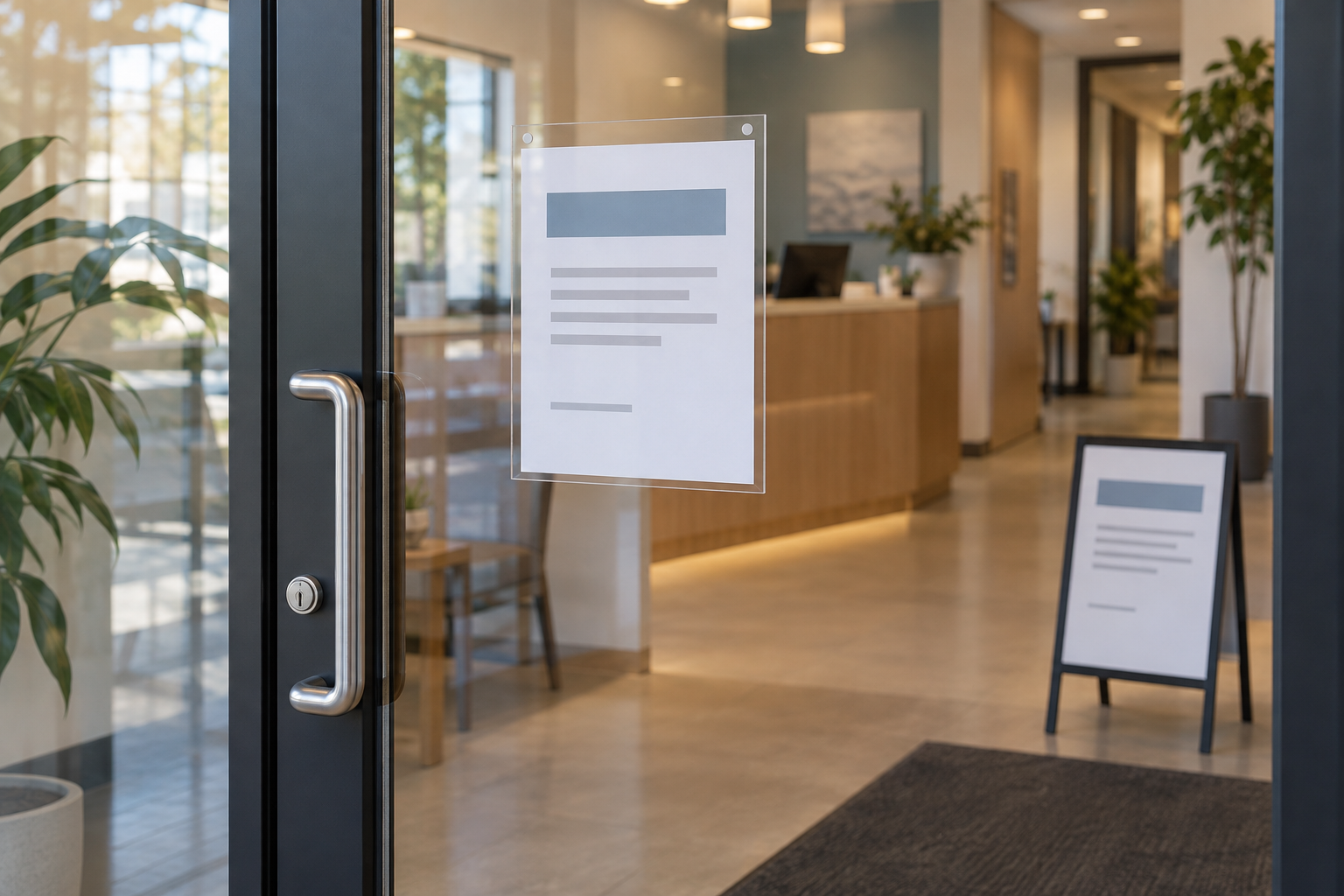
For a short indoor closure, start with a paper mockup and test it from the real approach. A clear holder or sleeve can create a consistent replacement routine when its maker supports the exact surface and installation method. Use a freestanding sign when the glass is unsuitable or the message must intercept visitors before they reach the door. Do not use this guide for emergency, required legal, accessibility, or safety notices.
Separate the closure message from permanent door information
A temporary closure notice has an end date or review point. Permanent hours, room identity, access instructions, and promotional graphics are different message jobs. Keep the closure notice visually separate so staff can remove it without rebuilding the permanent door display.
If the unresolved decision is a stable weekly schedule, use the business-hours sign guide. For a promotion rather than an operating interruption, compare temporary window-sign formats.
Build the message from four controlled fields
| Field | Planning question | Keep out |
|---|---|---|
| Current state | What is unavailable right now? | Unapproved explanations or promises |
| Time boundary | What date, time, or review point governs the notice? | Dates the operator cannot maintain |
| Next step | Is there a verified alternate entrance, contact route, or return time? | Directions that are not currently staffed or usable |
| Owner | Who checks, revises, and removes the notice? | Anonymous “someone will update it” handoffs |
Operations should approve the exact wording and any alternate route. This article does not determine which notices a business is required to post.
Closure-notice preflight worksheet
Complete this before shopping. It is original planning utility, not evidence that one attachment method suits every pane.
| Record | What to capture |
|---|---|
| Message life | Start, expected end, and next review time |
| Viewer approach | Which side of the glass, direction of travel, and measured viewing position |
| Door operation | Handle, swing, frame, and areas the notice must not interfere with |
| Glass facts | Known film, coating, texture, or an explicit “unknown—verify” note |
| Lighting check | Reflections and background contrast at opening, midday, and closing conditions |
| Update method | Who prints or writes the replacement and where the source file lives |
| Removal handoff | Named owner, removal trigger, and storage or disposal step |
Test a paper mockup from both sides
- Print the approved message at the intended size.
- Temporarily position it without applying an unverified adhesive or film.
- Walk the normal visitor approach and check whether the notice is seen before the handle or decision point.
- Check the reverse side: tape, blank paper backs, and mirrored layouts can look unfinished from inside.
- Repeat under the ordinary lighting conditions recorded in the worksheet.
- Revise message or placement before choosing a more finished format.
A readable mockup does not establish glass compatibility. Confirm the holder or media maker’s current surface, installation, removal, and cleaning instructions for the exact product and pane.
Compare formats by update and placement work
- Clear replaceable holder: investigate when staff need consistent paper changes and the complete holder is supported on the known surface.
- Static cling or removable media: investigate only when the maker’s current instructions match the known glass and print method; do not treat “removable” as a universal surface promise.
- Freestanding floor sign: consider when the message must appear earlier on the approach or the glass should remain untouched; measure the complete footprint and operating path.
- Tabletop sign: consider when a staffed position beside the door can reliably intercept visitors.
- Plain paper notice: keep it when the closure is very short, the approved attachment method is known, and a more elaborate system adds no useful update control.
Verify the product facts before ordering
For any candidate holder or sleeve, verify current overall dimensions, supported insert size, loading edge, mounting method, intended surfaces, installation and removal instructions, included parts, and cleaning guidance. Match those facts to the worksheet. A category search is a sourcing route, not a ranking or endorsement of every result.
Browse removable sign holders for glass doors
Who should skip a new glass-door sign
- The wording is still changing: use a controlled paper mockup until operations approves the message.
- The pane is unknown: verify film, coating, texture, and product instructions before applying anything.
- The visitor must decide earlier: use an upstream freestanding sign rather than forcing the door notice to do two jobs.
- The notice duplicates current hours: update the maintained hours system instead of adding a competing layer.
- The notice is required, emergency-related, or safety-sensitive: obtain site-specific professional or authority guidance; this chooser is not approval.
Handoff checklist
Give the posting owner the approved copy, start and review times, mockup, viewing-side notes, exact product instructions, source-file location, replacement method, and removal trigger. Photographing the final placement for the internal handoff can help the next shift verify that the intended notice is present; it is not product testing.
Continue with the small-business sign planning pillar when the closure notice exposes a broader arrival, wayfinding, or permanent sign problem.
Editorial process: The Good Sign Company editorial desk checked this page against the article registry and all three opportunity maps, limited the scope to temporary indoor operational communication, and removed compatibility, performance, safety, and compliance conclusions. AI-assisted tools helped prepare and reconcile the draft and generated illustration. The editorial desk remains responsible for source boundaries, illustration labels, and unsupported-claim removal. See our editorial process.