 The Good Sign Company
Reusable message board comparison
Chalk marker board vs changeable letter board: which update routine fits?
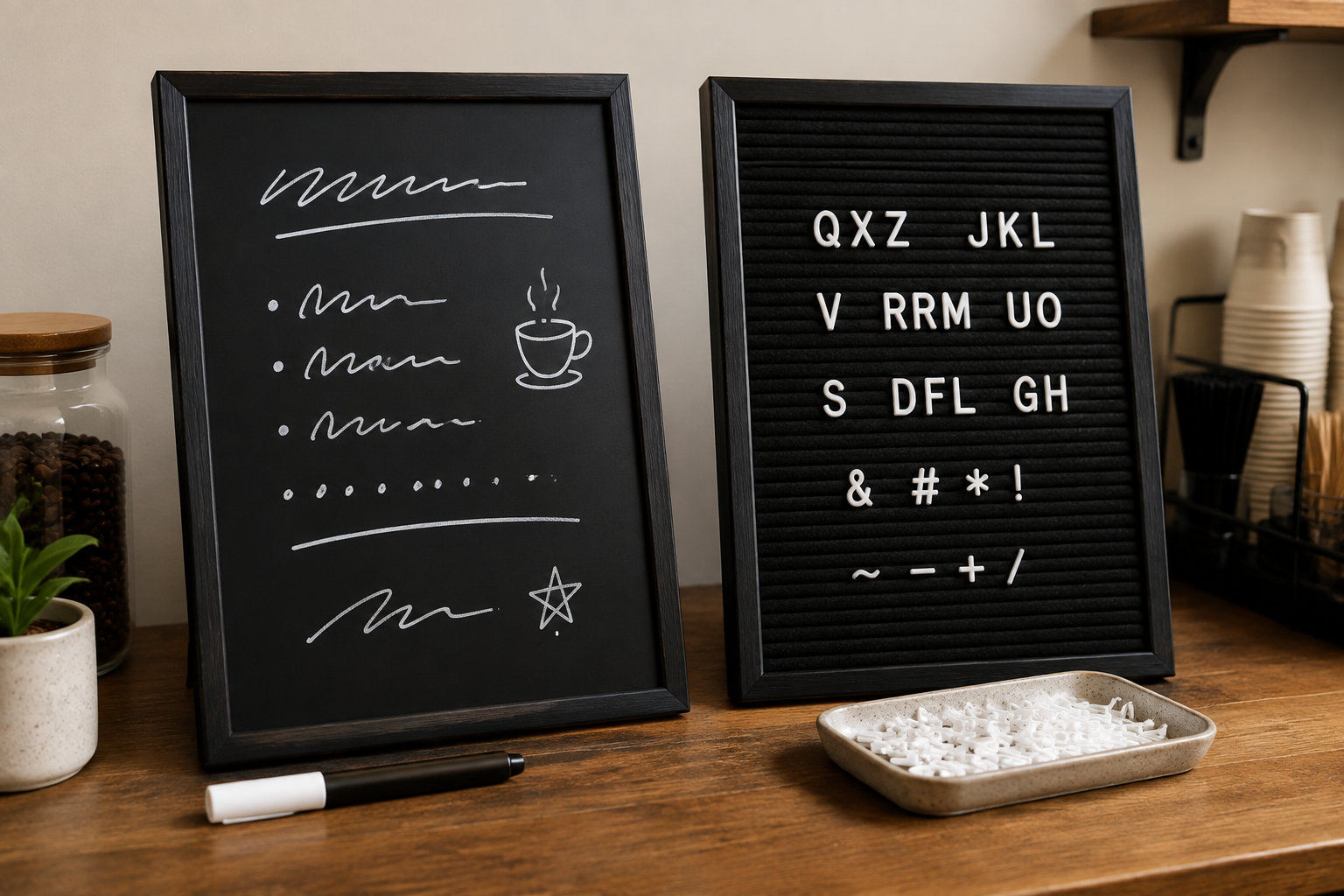
A chalk marker board gives you freehand control over wording, spacing, drawings, and color. A changeable letter board trades that freedom for aligned rows and reusable characters. Choose by the message you actually change, who updates it, how far away it must read, and whether cleaning a surface or sorting loose pieces is the easier routine.
Disclosure: As an Amazon Associate, we may earn from qualifying purchases and approved partner referrals.
Compare the two product routes
Check the listed writing surface or groove format, usable area, included tools or characters, stand or mounting method, dimensions, and care instructions for the exact product.
The short answer
- Choose a chalk marker board when custom spacing, handwriting, small illustrations, or changing layouts are part of the display.
- Choose a changeable letter board when tidy rows, consistent characters, and a short text-only message matter more than freeform design.
- Skip both when the message rarely changes, must carry dense details, or needs to be read before someone reaches the room or counter.
Who each option fits
A chalk marker board fits when
- One person is comfortable lettering and can proof the full message before opening or hosting.
- The layout changes along with the words—for example, a short special, welcome, schedule heading, or decorative home note.
- The manufacturer identifies compatible chalk markers and a cleaning method for that exact surface.
- You have room to store markers and cleaning supplies near the board.
A changeable letter board fits when
- The message uses short words, names, dates, or phrases that work in fixed horizontal rows.
- Several people need a repeatable layout without relying on handwriting.
- A felt, grooved, or track-style face suits the room, desk, shelf, or counter.
- You can sort and store enough letters, numbers, punctuation, and symbols for the normal message.
Tradeoffs that change the decision
Lettering freedom versus consistency
Chalk markers allow variable letter widths, arrows, borders, and simple drawings, but the result depends on the updater's spacing and lettering. A letter board keeps character shapes consistent, yet its groove spacing, character size, and available pieces limit the message. Mock up the longest normal message inside the listed usable area before buying either format.
Readability and viewing angle
Strong contrast and fewer words usually matter more than decorative detail. Check the board from the actual approach and under the room's normal light. A dark writing surface may reflect light differently from felt, while shallow letter-board characters can become harder to distinguish at an angle. Treat readability as a product-and-placement check, not a promise of either category.
Update time
A quick handwritten update can be faster when the layout is simple and the old marks clean away as directed. Letter boards avoid cleaning between ordinary updates, but locating repeated letters and aligning each row takes time. Count the repeated characters in your real message and compare that count with the included set.
Style
Chalk-marker layouts can feel expressive, menu-like, or event-oriented. Letter boards tend to look orderly, compact, and text-forward. Neither is universally more professional: the better fit is the one that supports the room and stays readable without demanding a fussy reset.
Setup and maintenance issues
- Measure the visible writing or letter area, not only the outside frame.
- Mock up the longest realistic message at the proposed character height.
- Check the listed stand, hanging hardware, board weight, open footprint, and writing height.
- For a chalk marker board, verify compatible markers and follow the maker's cleaning directions; do not assume every black board accepts liquid chalk.
- For a letter board, inventory characters before the first use and choose a divided container that keeps small parts together.
- Assign one person and one trigger for removing outdated information.
Keep both formats indoors unless the exact product documentation says otherwise. Protect the face and frame during transport. Do not use a cleaner, marker, adhesive, or mounting method that conflicts with the current product instructions.
Skip criteria and alternatives
- Skip a chalk marker board when consistent lettering is essential, nobody owns the cleaning routine, or compatible tools and care directions are unclear.
- Skip a letter board when messages are long, character counts are tight, pieces will be shared or lost, or graphics are important.
- Use a printed insert and holder when appearance must stay consistent and updates happen only occasionally.
- Use a dry-erase board when the message needs a grid, operational fields, or rapid practical notes rather than a styled display.
- Use a fixed custom sign when the name, room label, or core message should not change.
Choose the next step
Start with the room decor sign pillar when wall scale and visual fit are still undecided. Compare changeable letter-board formats when character capacity and placement are the main questions, or use the chalkboard sign guide for a portable menu or counter display.
If you are really choosing between writing surfaces, read chalkboard vs dry-erase signs. For a business counter, continue with the small-business sign planning guide before selecting a display.
Bottom line
Choose a chalk marker board for freeform layouts and a hands-on writing-and-cleaning routine. Choose a changeable letter board for consistent text rows and a parts-sorting routine. The winning format is the one that fits the full message, normal sightline, available update time, and storage plan without turning every change into a chore.