 The Good Sign Company
Multi-location sign operations
Assign the maintenance handoff before the next sign issue.
A location manager can report what is visible, but should not have to diagnose a sign, authorize work, find historical records, and close the job alone. A stronger program gives reporting, triage, approval, provider coordination, and closeout to named roles.
Quick answer
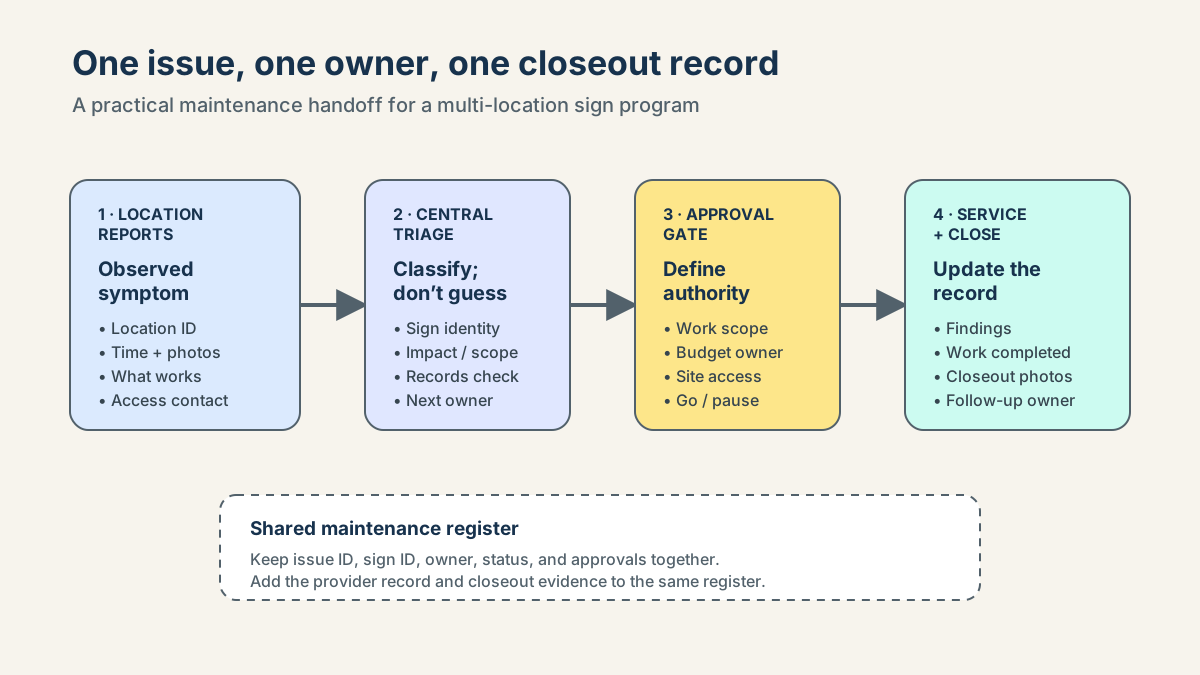
Separate observation, authority, technical work, and recordkeeping.
Let the location report the symptom and operating impact. Give facilities or operations one intake queue and sign register. Name the person who can approve scope and spending. Let the sign provider assess and document the work it accepts. Require completion evidence and a central closeout owner before the ticket is considered finished.
Start with the six decisions every issue needs
A maintenance plan is useful only when it tells people who makes the next decision. Record one accountable owner for each of these jobs:
- Report: who submits the location, sign identifier, observed symptom, photos, timing, and business impact?
- Triage: who checks the record, removes duplicates, identifies missing information, and routes the issue?
- Approve: who can authorize an assessment, work scope, spending, or a pause?
- Coordinate: who confirms site contact, access window, operating constraints, and provider arrival instructions?
- Perform and document: which qualified provider accepts the scope and records its findings and completed work?
- Close: who checks the completion record, updates the sign history, and assigns any follow-up?
Do not combine these roles merely to make the chart shorter. A local operator may report the problem and confirm that the work area is accessible while central facilities owns the provider relationship and procurement retains spending authority.
Use one intake record instead of an email chain
Give every installed sign a stable identifier tied to its location. The initial report should stay factual: what is visible, when it was noticed, whether the condition is constant or intermittent, and what customer or operating task is affected. Avoid asking nontechnical staff to name a cause.
Copyable intake fields: issue ID; location ID; sign ID or exact position; date and local time observed; reporter; straight-on photo; context photo; visible symptom; whether the whole sign or only part appears affected; operating impact; known recent work; site contact; access limits; and status.
That record can support the separate repair, refresh, or replace decision. It does not itself determine which response is technically appropriate.
Build a responsibility matrix
| Stage | Accountable owner | Useful input | Required output |
|---|---|---|---|
| Report | Location operator | Observed condition, time, photos, operating impact | Complete issue record |
| Triage | Facilities or operations | Sign register, prior work, duplicate tickets | Priority, missing facts, next owner |
| Approve | Named budget authority | Requested assessment or documented work scope | Approval, limit, or pause reason |
| Coordinate | Facilities plus site contact | Provider request, access and operating constraints | Confirmed handoff and arrival details |
| Service | Accepted sign provider | Issue record and agreed scope | Findings and work documentation |
| Close | Central register owner | Completion record, photos, open follow-up | Updated history and closed or reassigned ticket |
The role names may differ by organization. What matters is that each stage has one accountable owner, an input, and an output. Procurement can support scope comparison without becoming the site-access coordinator; marketing can review a visible brand change without owning routine intake.
Worked example: three reports, three different routes
Hypothetical planning example—not a diagnosis or service recommendation.
| Report | Triage decision | Owner and next record |
|---|---|---|
| Location A reports that only part of an illuminated sign appears lit after closing. | Record the observed condition and operating window; do not assign a technical cause. | Facilities routes the record to the accepted provider after the appropriate internal authorization. |
| Location B sends a photo showing current branding but an outdated service line. | Separate a message-change request from a reported equipment problem. | Marketing owns approved copy; facilities requests scope only after the content decision is final. |
| Location C reports a routine, nonurgent sign issue but cannot identify which sign on the property is affected. | For this routine request, pause provider dispatch until the position, context photo, and local contact are added. | The location completes intake; the central owner prevents a vague duplicate ticket. |
The exercise prevents every report from becoming the same kind of work order. It also keeps a message decision, a site-information gap, and a provider assessment from being collapsed into one ambiguous request. A suspected immediate hazard is different: follow the organization’s urgent incident escalation to the responsible qualified parties rather than waiting for a complete administrative record.
Compare a provider handoff on scope, not brand familiarity
Send the issue record, sign identifier, relevant history, site contact, access constraints, and the exact question being authorized. Ask the provider to state what information it still needs, what scope it is accepting, what remains excluded or unknown, and what closeout records will be returned. Confirm current geographic and project fit directly.
DaNite Sign Company’s current public site describes commercial sign design, fabrication, installation, and repair, along with planned-development sign packages and multi-location national branding. That makes a maintenance or portfolio conversation a natural next step when the current offering fits the organization’s project.
Bring a controlled issue record to the provider conversation
Share the location and sign identifiers, observed symptom, photos, relevant history, access contact, authorized question, and requested closeout record. Ask DaNite to confirm current scope, geography, site requirements, and service fit rather than assuming the public description covers a particular sign or location.
When to skip or pause this workflow
- Use a lighter record when one owner manages one simple, nontechnical indoor display and there is no repeatable provider handoff.
- Pause a routine, nonurgent request when the location, sign identity, symptom, site contact, or authorization is missing. A suspected immediate hazard follows the organization’s urgent incident escalation to the responsible qualified parties rather than waiting for complete intake.
- Do not dispatch on a guessed cause. Record what is observable and let the accepted provider define its assessment.
- Do not bundle a branding change into maintenance until marketing has approved the revised message and artwork route.
- Do not treat a portfolio workflow as permission or compliance review. Property, electrical, structural, access, permit, accessibility, lease, and code questions remain project-specific matters for the responsible parties and qualified professionals.
Close the loop into the sign register
A closed ticket should identify the sign and location, preserve the provider’s description of findings and work, attach completion evidence, record the close date, and name the owner of any remaining action. For a recurring issue, link the records instead of overwriting the earlier history.
When the organization is still building its broader program, use the small-business sign planning pillar for message, sightline, placement, and stakeholder decisions, then the multi-location specification guide for shared standards and site exceptions.
Sources and evidence boundary
DaNite offering statements were checked against the company’s current public website on October 26, 2026. The site states that DaNite provides commercial sign design, fabrication, installation, and repair and references planned-development sign packages and multi-location national branding. This does not establish fit, availability, geography, timing, price, technical findings, or an outcome for a specific project.
The handoff diagram, intake fields, responsibility matrix, and hypothetical routing example are original planning tools from The Good Sign Company editorial desk. They are not inspections, diagnoses, work orders, safety guidance, or compliance advice.