 The Good Sign Company
Worth-it decision
Is a table-clamp sign holder worth it for a recurring vendor booth?
A table-clamp sign holder is worth considering when a known table edge accepts the complete clamp, tabletop space is repeatedly scarce, and raising a small sign solves a measured sightline problem. Skip it when event tables vary, the edge is covered or obstructed, or a freestanding holder already works without complicating setup.
This guide decides whether the clamp format earns a place in a recurring indoor booth kit. If you already know that it does, continue to the table-clamp buying guide for product-level fit checks.
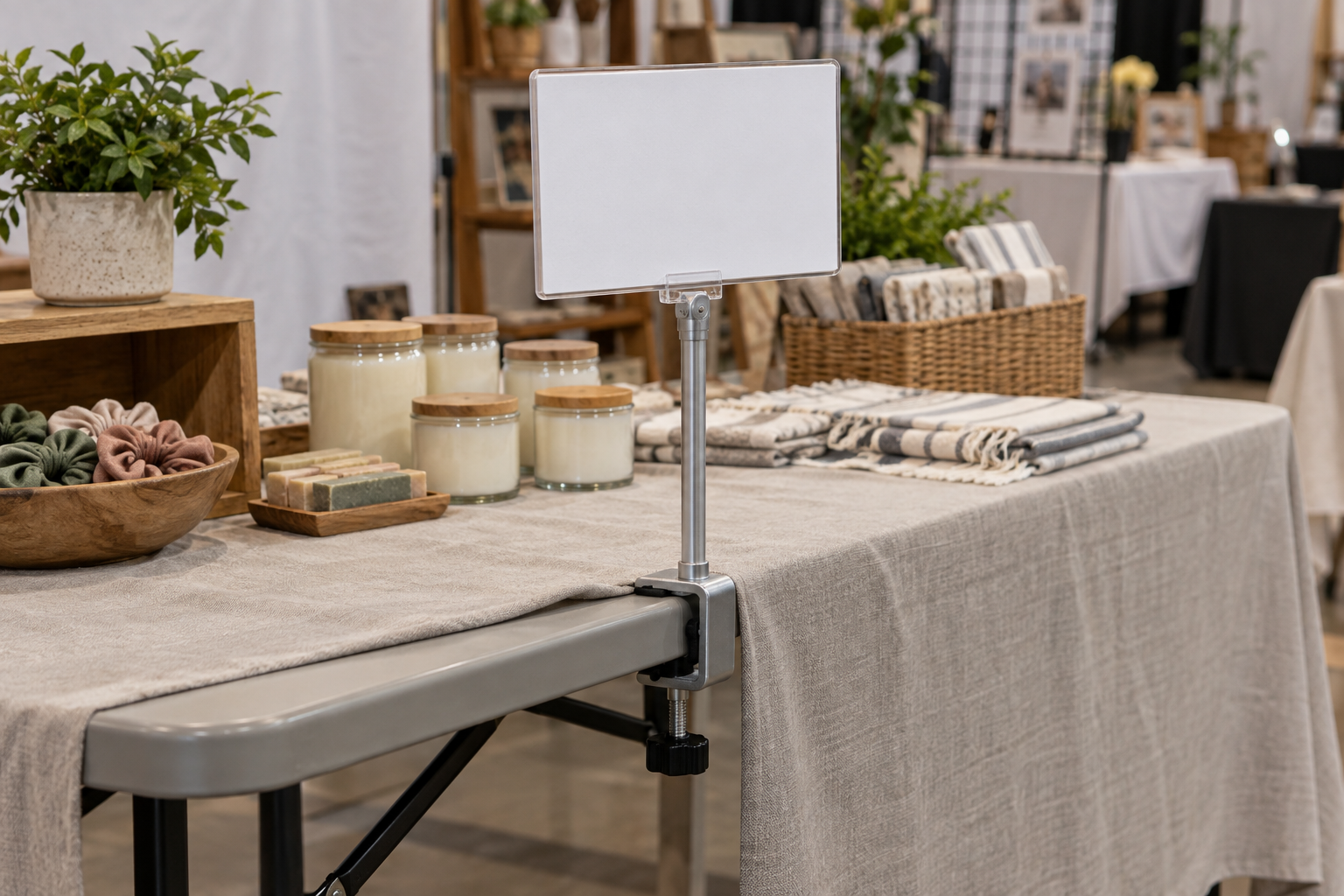
Compare products only after the edge passes the fit test
Check the current listing and instructions for clamp opening, usable jaw depth, pad position, compatible surfaces, pole dimensions, sign attachment, supported sign fit, included parts, and setup sequence. A photograph cannot confirm compatibility with your table.
Quick verdict: buy, skip, delay, or simplify
- Buy: the same compatible table or booth fixture returns at most events, the full sign fits the holder's documented guidance, and reclaiming the traced tabletop footprint materially improves the display.
- Skip: supplied tables change, the underside has an apron or brace, the surface should not be clamped, or the sign needs broader support than the attachment provides.
- Delay: the table edge, finished sign, customer approach, venue rules, or packing routine is still unknown.
- Simplify: move the message, shorten it, rearrange products, or use a compact freestanding holder when that solves the same problem with fewer fit assumptions.
Start with the problem, not the hardware
Trace the footprint of the current sign base on the fully stocked table. Note what would actually use that recovered space: a payment device, product tray, sample area, or clear handoff zone. Then make a cardboard mockup at the proposed clamp height and view it from the normal aisle approach. A clamp is hard to justify when the recovered patch has no defined job or the raised sign remains hidden.
Keep the message suited to a small face. A category name, checkout cue, short offer, or social handle may fit; a long menu or policy usually needs a different format. If the basic sign position is undecided, compare a hanging booth sign with a tabletop sign first.
Run the table-edge fit test
- Measure the top thickness at the exact attachment point.
- Look underneath for a lip, apron, folding brace, cable, leg, or frame member.
- Measure the flat depth available to both jaws rather than relying on maximum opening alone.
- Record the surface finish and confirm the product maker's surface guidance.
- Ask the venue or table owner whether clamping is permitted; keep a freestanding fallback when furniture is supplied.
A tablecloth can hide the edge geometry without changing it. Decide how the cloth and clamp coexist according to the product and venue instructions. Do not assume supplied padding makes every finish suitable or guarantees mark-free removal.
Fit the complete sign assembly
Record the finished sign's width, height, thickness, orientation, and complete weight, including sleeves, frames, clips, brackets, and two-sided faces. Compare all of it with the exact holder's documented sign fit and attachment method. Do not add an improvised adapter or second face because a product photo makes the setup look possible.
Mock up the finished height and check the customer, seller, payment, restocking, and neighboring-booth paths. The sign should remain within the approved booth area and should not force staff to reach awkwardly around products. This page does not determine venue approval or structural suitability; use event requirements and product-specific instructions for the real setup.
Count the repeat-use benefit
A compatibility-dependent fixture makes more sense when the same booth plan returns often enough to document and repeat. Count how many upcoming events use your own table or a confirmed edge, then name who packs, installs, checks, and removes the holder. If the table changes at every event, a base that occupies some surface area may still be the more dependable choice.
| Question | Clamp holder favors | Freestanding holder favors |
|---|---|---|
| Table source | Known, measured edge repeats | Furniture varies or is unknown |
| Surface space | A traced base blocks a defined task | A compact base already fits |
| Sign position | Edge location creates the needed sightline | The sign must move during the event |
| Setup | Parts and fit can be documented | Fast placement matters more than reclaimed space |
| Backup | A second display route is packed | One holder must work across many tables |
Tradeoffs that remain after it fits
- Adjustment: More joints can add height or angle options, but each one adds a product-specific setup and locking step.
- Access: Knobs, jaws, and sign attachments need room for installation and later changes.
- Transport: Keep the clamp, pole, fitting, supplied fasteners, and instructions together so missing parts do not appear at setup.
- Table changes: A booth plan that works on your table may fail on a venue table with a different edge.
- Cleaning: Follow separate maker guidance for the hardware, pads, sign face, and table finish.
- Message changes: Confirm staff can replace the card or panel without disturbing the full merchandise layout.
Red flags before ordering
- The listing omits clamp opening, jaw depth, complete dimensions, attachment details, or supported sign fit.
- The table edge has only been viewed from above, not measured from the side and underneath.
- The plan depends on supplied furniture that the organizer cannot describe.
- The sign requires improvised holes, clips, spacers, or adapters.
- The raised face blocks the seller, projects into a path, or remains unreadable at the aisle approach.
- No freestanding backup is available when edge compatibility is uncertain.
A low-cost trial before you buy
- Stock the table as it appears during an event and trace the current sign-base footprint.
- Measure and photograph the intended edge from above, beside, and below.
- Make a full-size paper sign and cardboard pole mockup at the planned position.
- Walk the customer and staff routes, then test payment, packing, and restocking tasks.
- Compare a clamp only if the test proves a repeatable space or sightline benefit.
Bottom line
A table-clamp sign holder is worth buying for a recurring indoor vendor booth when a measured edge repeats, the finished sign is product-compatible, and the reclaimed tabletop area has a clear operational use. It is a poor bet when furniture varies or a compact freestanding display already works. Prove the benefit with a full-size mockup, then verify the exact holder's current instructions and fit.
Continue with the small-business sign planning pillar, choose among table-clamp holder formats, or review freestanding tabletop alternatives.