 The Good Sign Company
Indoor hanging-hardware comparison
Magnetic Hook vs S-Hook for a Lightweight Indoor Hanging Sign
The host surface decides this comparison. A magnetic hook creates a removable attachment point only on a compatible, verified surface and in a manufacturer-approved orientation. An S-hook needs an existing rail, grid, bar, or eyelet that fits both of its openings. Neither loose hook is a complete hanging plan by itself.
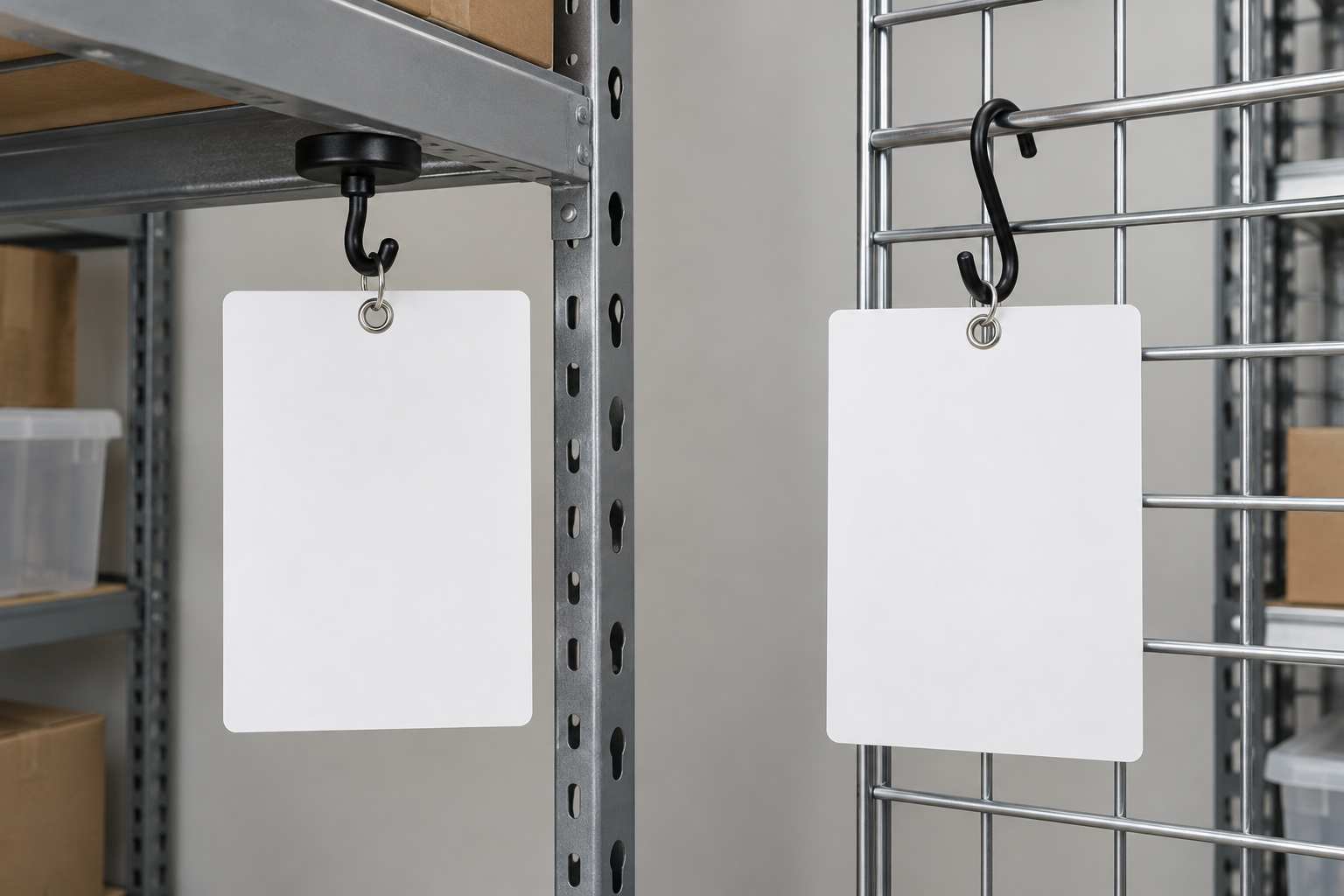
Compare hooks only after documenting the host and sign
Record the host material and orientation, complete assembled weight, sign attachment, hook dimensions, movement exposure, and current maker instructions. Marketing pull-force figures are not a substitute for a documented limit for the assembled setup.
The short answer
Choose a magnetic hook when the exact host is confirmed magnet-responsive, the magnet can sit fully against it in an approved orientation, and repositioning the attachment point is useful.
Choose an S-hook when a suitable rail, grid, bar, or eyelet already exists and both hook openings match the host and sign-side attachment without bending or modification.
Choose neither yet when the host material, orientation, complete assembly weight, sign eyelet, or manufacturer guidance is missing—or when a falling or snagged display could cause harm.
Decision table
| Decision | Magnetic hook | S-hook |
|---|---|---|
| Required host | A verified magnet-responsive surface with enough flat contact area | An existing rail, grid, bar, wire, or eyelet that fits the upper opening |
| Position changes | Moves to another compatible contact point after removal and inspection | Moves among compatible existing supports |
| Critical dimensions | Magnet base, hook opening, projection, and sign attachment | Wire diameter, both openings, overall length, and sign attachment |
| Orientation | Must match the maker's stated use direction and host conditions | Must seat on support and sign without twisting or forced spreading |
| Main mistake | Assuming any metal works or treating pull force as assembled capacity | Choosing by length while ignoring both connection openings |
1. Identify the host before choosing hardware
For a magnetic route, identify the exact shelf, beam, cabinet, or fixture surface. Test magnet response without assuming that a metallic appearance proves compatibility. Paint, coatings, curves, gaps, seams, dirt, and damage can prevent full contact; follow the hook maker's surface and preparation guidance.
For an S-hook, measure the existing rail, bar, grid wire, or eyelet. Check nearby braces and edges that could prevent the hook from seating as intended. Compare the measured profile with the upper hook opening and maker instructions.
2. Check orientation and connection geometry
Magnet performance descriptions can change with load direction and test conditions. Use only the documented orientation and limit that matches the proposed setup, and keep the base fully seated. Do not translate a headline pull-force claim into a safe working limit for a hanging sign.
An S-hook connects two known shapes. The upper curve must fit the host; the lower curve must fit the sign eyelet or approved hanger. Do not bend the hook, enlarge the sign hole, or force a connection unless the relevant maker explicitly permits that change.
3. Count the complete assembly
Include the finished sign, eyelets, any connector, the hook, and attached accessories when comparing the setup with documented limits. The lowest applicable limit in the complete path governs; a strong hook does not validate an unknown support or weak sign attachment.
For two attachment points, measure their spacing and plan matched connections. Confirm the sign hangs level and neither connection carries an unintended share of the load.
4. Plan setup, movement, and maintenance
A magnetic hook is convenient when a team needs to refine position along a confirmed compatible surface. Each move still calls for checking the contact face and host condition. An S-hook is simple to count and pack, but it can only move where a suitable support exists.
Map doors, stock, carts, curtains, cleaning routines, and normal reach around the display. Assign someone to inspect the host, hook, sign attachment, and alignment at the interval stated by the relevant makers and responsible facility team.
Who each option fits
- Magnetic hooks fit retailers, studios, and stockrooms with a confirmed compatible indoor fixture that need a removable attachment point without adding a rail.
- S-hooks fit event and display teams that already have an approved grid, rack, or rail and can match both openings to known connection points.
- A freestanding or wall-mounted sign fits when the overhead host is uncertain, the sign changes locations often, or the message can work at counter or wall height.
When to skip each option
- Skip the magnetic hook when the host is not magnet-responsive, is curved or too small for full contact, conflicts with surface guidance, or requires an unsupported orientation.
- Skip the S-hook when no approved support fits, either opening is incompatible, or the connection requires bending or improvisation.
- Skip both when the finished load, attachment, host condition, documented limits, movement exposure, or inspection owner is unknown.
- Pause for qualified review for overhead locations, occupied paths, public circulation areas, uncertain structures, or projects governed by property, venue, accessibility, egress, or other site-specific requirements.
Buying checklist
- Exact indoor host material, shape, condition, and orientation
- Complete assembled sign weight and dimensions
- Number, spacing, size, and construction of sign attachment points
- Magnet base diameter, hook opening, projection, and stated use direction
- S-hook wire diameter, both opening dimensions, and overall length
- Documented limits matching the proposed orientation and conditions
- Clearance from doors, stock, equipment, and normal traffic
- Setup, inspection, removal, and labeled storage owner
Continue the decision
Use the broader sign mounting supplies guide when the host is not settled. Once a magnet-responsive steel surface is confirmed, compare magnetic hook categories by contact orientation, base and hook dimensions, connector fit, and documented limits. If an existing rail can take either a direct hook or longer drop, compare an S-hook with sign chain. For a complete suspended system rather than loose hardware, start with the indoor ceiling sign hanging kit guide. If the sign does not need to hang, compare a wall-mounted and tabletop sign.