 The Good Sign Company
Recurring indoor event comparison
Printed directional sign set vs changeable-insert system: which fits recurring events?
Choose fixed printed boards when the route, destination names, arrows, and event identity repeat with very few exceptions. Choose changeable inserts when the supports can stay but room assignments, schedules, or arrows move. The important comparison is not print quality versus holder style; it is one complete operating workflow versus another.
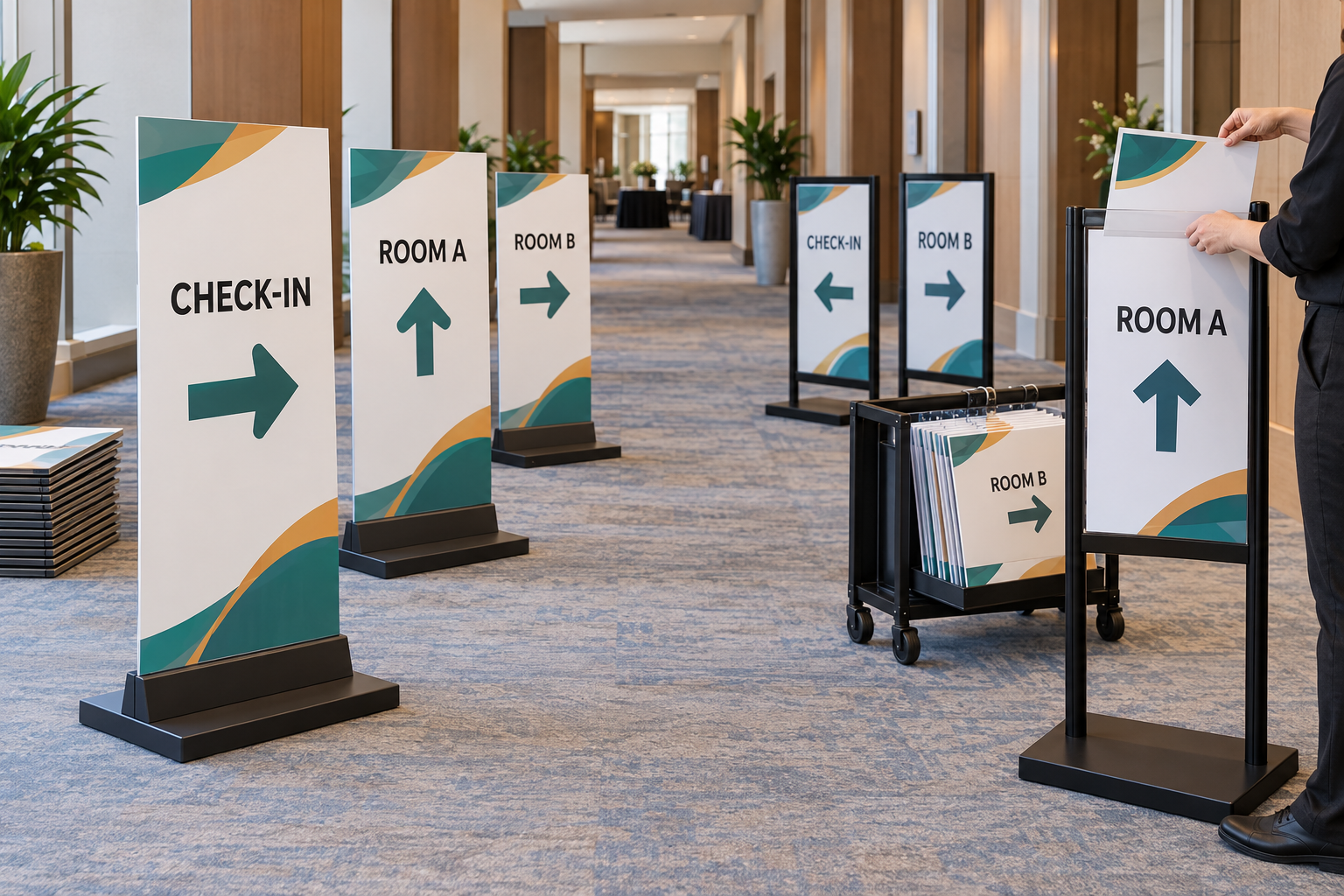
The short answer
| Choose fixed printed boards when… | Choose changeable inserts when… |
|---|---|
| The same route and destination labels return. | Rooms, arrows, times, or sponsors change. |
| Setup staff benefit from one numbered board per location. | One maintained set of supports must serve several layouts. |
| There is protected space for the full board inventory. | Flat inserts are easier to revise and store than complete extra boards. |
| A late content change is unlikely. | The team has a dependable print, proof, and replacement process. |
Pause either purchase until the event team has mapped real decision points, marked which fields change, tested messages at full size, and assigned setup and retrieval. This article covers ordinary indoor event wayfinding; it does not determine emergency, egress, accessibility, venue, structural, or code requirements.
Who each system fits
A fixed printed directional set fits
A venue or event operator may prefer fixed boards when recurring events use the same entrance, registration point, rooms, and walking route. Each board can receive a permanent location number, packing position, and setup photograph. That makes the set straightforward to audit, but a changed arrow or destination normally requires a corrected board rather than a new sheet.
A changeable-insert system fits
A reusable-holder system fits events with a stable visual template but variable content. The frames, bases, or stands remain in inventory while an approved insert set changes for each layout. This shifts work from board replacement to template control, printing, proofing, loading, and removal of obsolete sheets.
Tradeoffs that change the choice
Route stability
Start with the route, not the sign catalog. Mark every place where a guest must choose a direction. If those decisions repeat across events, fixed boards become easier to justify. If the same stand sometimes points left and sometimes right, a fixed arrow creates avoidable inventory and setup risk.
Change control
A fixed set concentrates control before production. An insert system extends control into every event cycle: someone must update the source file, approve the wording and arrow, print at the correct finished size, load the right face, and retire old versions. Flexibility is useful only when that chain has an owner.
Inventory and storage
Count complete stored objects, not only sign faces. Fixed boards may need dividers or sleeves so edges and printed surfaces do not rub. Insert systems need holders plus a labeled current insert packet, spare blanks, and a separate archive or disposal rule. Measure the actual storage shelf, cart, doorway, and vehicle path before choosing either workflow.
Setup and recovery
Fixed boards can be preassigned to locations, but the team must transport every required direction. Changeable systems reduce duplicate supports only if inserts are loaded and checked before deployment. For both systems, photograph the approved view from the guest approach and require a route walk before doors open.
Maintenance
Inspect boards, holders, bases, fasteners, and printed faces before each event. Follow the exact maker's loading, placement, and cleaning instructions. Do not assume a holder accepts nominal paper sizes without checking its stated insert dimensions and visible area, and do not infer stability or suitability from appearance alone.
A two-layout decision worksheet
Use this hypothetical exercise before requesting products. It is planning arithmetic, not field testing or a performance claim.
| Decision point | Layout 1 | Layout 2 | What changed? |
|---|---|---|---|
| Main lobby | Check-in → | Check-in → | Nothing |
| Hall junction | Room A ← | Room C → | Destination and arrow |
| Elevator landing | Workshop ↑ | Lunch ↑ | Destination |
| Room entrance | Workshop A | Breakout C | Room label |
In this four-point example, only one message remains unchanged. That does not automatically make inserts cheaper or better, but it shows why fully fixed faces would create several alternate boards. Repeat the worksheet for actual layouts, then count stable faces, variable faces, supports, inserts, and setup checks.
Setup and maintenance checklist
- Map decision points and write one short destination-and-direction message for each.
- Classify every field as fixed, event-specific, or changeable during setup.
- Test full-size paper mockups from the real approach and under the venue's normal lighting.
- Verify finished dimensions, visible area, loading edge, support footprint, and maker instructions for the exact products considered.
- Number every location and match it to a board or loaded holder on the packing list.
- Assign proof approval, printing, loading, route inspection, retrieval, cleaning, and storage.
- Remove or clearly archive obsolete inserts so they cannot return to the active kit.
Skip criteria
- Skip a fully fixed set when arrows, rooms, entrances, sponsors, or session names move between normal layouts.
- Skip a changeable-insert system when nobody owns the template, print deadline, proof, loading, and old-version removal.
- Skip both when the venue already supplies an approved wayfinding system that solves the route.
- Delay production when the venue has not approved proposed locations or when a full-size message has not been checked from the actual approach.
- Use qualified venue or project guidance for emergency, egress, accessibility, structural, attachment, and code-sensitive signage.
Choose the next step
If the organization has not yet established whether a coordinated kit is justified, start with the custom directional sign set worth-it test. If replaceable floor-level inserts are the likely route, compare indoor directional sign stands by insert fit, visible area, loading, footprint, and storage.
For the wider system, use the interior wayfinding hierarchy guide and the small-business sign planning pillar. These help separate identity, directional, and destination messages before a team selects hardware.
Research and review boundary
The Good Sign Company editorial desk prepared this comparison from the mapped operating differences between fixed and replaceable content. AI-assisted tools helped draft and reconcile the page. No product was tested, no universal size or stability claim is made, and the illustration is not product evidence. Product-specific dimensions, visible area, loading, included parts, placement, and care must be verified in the current manufacturer's documentation for the exact item considered.