 The Good Sign Company
Tabletop Sign Comparison
Table tent vs acrylic sign holder: which fits the message and counter?
A folded table tent combines the printed message and its support in one lightweight piece. An acrylic holder separates those jobs: a reusable rigid holder supports a replaceable paper insert. Choose by how often the message changes, who handles the display, what the counter is used for, and how the format looks from the reader's approach. If the second viewing face is still unproven, first decide whether a double-sided counter sign is worth it.
Disclosure: As an Amazon Associate, we may earn from qualifying purchases and approved partner referrals.
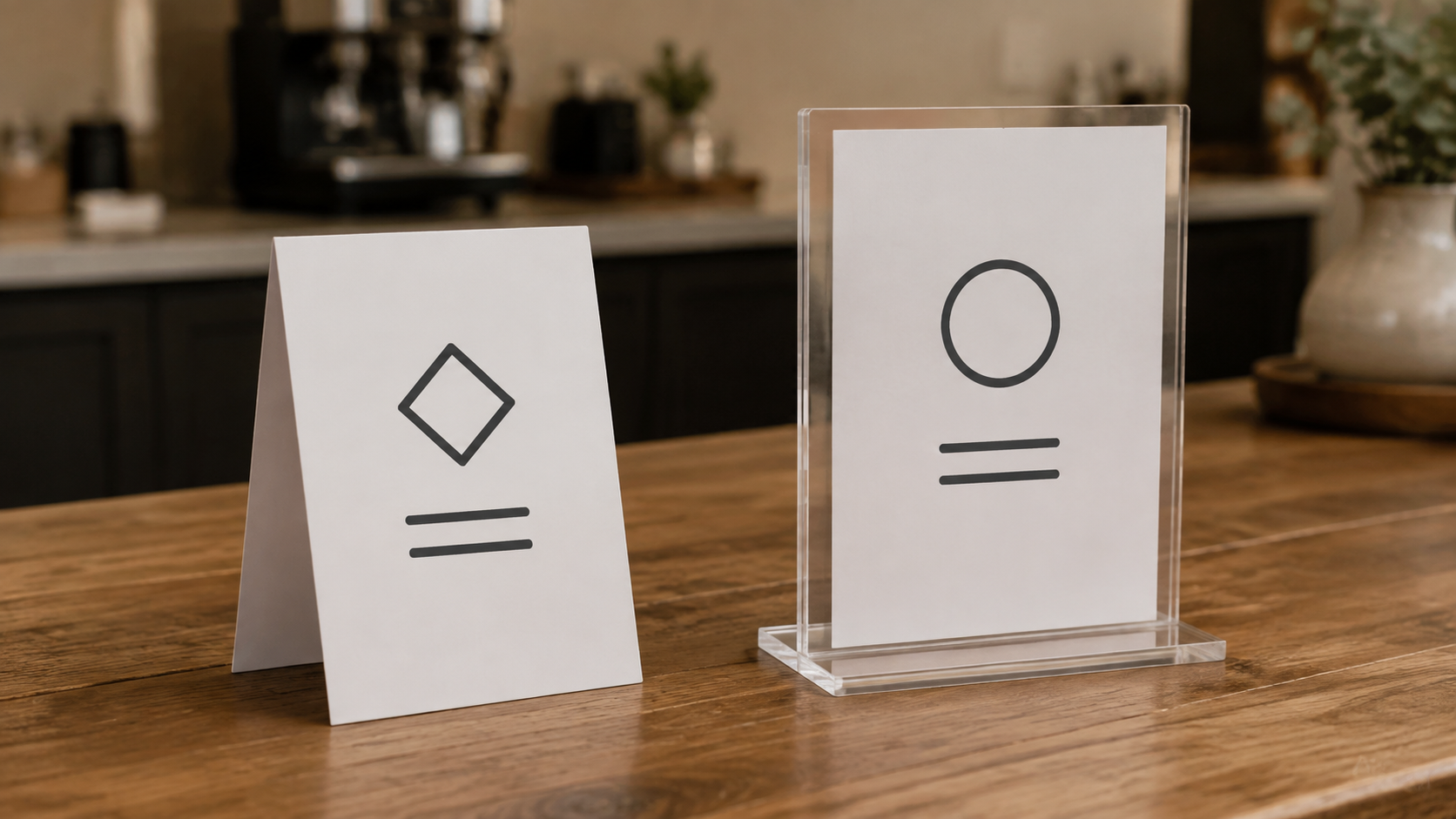
Compare both formats
Mock up the longest message before choosing the holder.
Print the normal message at final size, fold a paper sample, and mark the acrylic holder's full base on the counter. Check readability, loading clearance, reflections, and interference with the counter's main task.
The short answer
- Choose a table tent for a short-run message, compact storage, simple distribution, or a design meant to be read from two opposing sides.
- Choose an acrylic holder when inserts change repeatedly, a rigid reusable display belongs on the counter, and reflections can be controlled.
- Skip both when the message must sit above nearby merchandise, the counter is too active for a loose tabletop display, or the normal sightline is blocked.
Where each format fits
A table tent fits when
- The sign is printed and folded as one piece for a meeting, meal, event, promotion, or temporary counter message.
- Two readable faces help people approaching from opposite directions.
- Flat storage and low replacement complexity matter more than long-term presentation.
- The paper stock, fold pattern, finished dimensions, and printing method are confirmed before producing the set.
An acrylic holder fits when
- A standard paper insert will be replaced while the holder stays in service.
- A single upright face suits the main approach, or a documented double-sided holder suits two approaches.
- The holder's insert size, loading edge, orientation, base depth, and cleaning instructions match the setup.
- A neutral clear surround works with the presentation and normal lighting does not obscure the message.
Tradeoffs that change the decision
Print changes and production
A table tent must be reprinted or relabeled when the message changes. That can be convenient for a one-off run because the support is part of the print, but every replacement needs the correct stock, trim, score, fold, and finished size. An acrylic holder shifts repeat work to paper inserts. Verify the usable insert dimensions rather than assuming a familiar paper name guarantees fit.
One face or two
Many folded tents show a face in both directions. That can help on a shared table, but only if both panels remain readable after folding. Acrylic products may be single- or double-sided and may stand upright or lean. Confirm the exact construction and orient the display for the real traffic pattern; the category name alone does not settle viewing direction.
Stability and footprint
A tent's stance depends on its folds, stock, height, and base opening. An acrylic holder has a fixed base or formed profile, but that does not make every size stable in every location. Compare the complete footprint and finished height on the real surface. Keep either format clear of payment devices, food pickup, doors, fans, and places where hands or bags routinely pass.
Glare, cleaning, and wear
Clear acrylic adds reflective surfaces; move a sample through the main sightline under normal light. Paper has less surface reflection when uncoated, but exposed edges can bend or mark during handling. Follow the holder maker's cleaning instructions and replace damaged paper pieces. Neither format should be described as spill-proof or suitable for an exposure the product maker has not documented.
Storage and repeat use
Unused tents can store flat if their folds allow it, while assembled pieces need space that prevents crushing. Acrylic holders retain their full shape and need separators or sleeves to limit scratching during transport. Count the number of locations, the expected update cycle, and available storage before comparing only the first setup.
A six-step counter test
- Write the longest normal message and print it at the intended size.
- Build a full-size folded-paper mockup and mark the acrylic option's full footprint beside it.
- View both from each real approach; check type size, viewing angle, reflections, and whether nearby objects hide the lower lines.
- Simulate the update: replace the whole tent, then load an insert from the holder's documented opening.
- Move through the counter's normal work and confirm that neither display competes with payment, service, pickup, or conversation space.
- Plan storage, cleaning, and replacement responsibility for the whole set—not just one sample.
Skip criteria
- Skip a table tent when frequent changes would require constant reprinting, the folded piece blocks its own lower content, or the stock will not hold the intended stance.
- Skip acrylic when unavoidable glare hides the message, loading clearance is unavailable, or storage and handling are likely to damage the holder.
- Skip either tabletop format when the available footprint crowds the counter or the message needs a higher sightline.
- Skip a listing when it omits the finished dimensions, insert size, orientation, or construction details needed to verify fit.
- Ask the venue or property contact about placement in controlled public areas; this comparison does not establish accessibility, lease, or code approval.
Choose the next step
For a menu or frequently changed counter message, continue to the acrylic sign-holder guide. If acrylic is settled but the viewing profile is not, compare an L-shaped holder with a T-shaped holder. For numbered seating, compare the holder, sightline, and base decisions in the table-number holder guide.
If this is a customer-facing business display, use the small-business sign planning pillar to simplify the message and map the approach. Event planners can use the small-event directional-sign guide when the message needs to move off the table and into the route.
Verdict
Choose a table tent when the printed piece itself should become a compact, short-run, potentially two-sided display. Choose acrylic when a reusable rigid holder and replaceable standard insert create the cleaner routine. Before buying a set, verify exact dimensions, viewing direction, footprint, lighting, loading, cleaning, storage, and the longest real message.