 The Good Sign Company
Tabletop Display Comparison
Acrylic sign holder vs wooden sign stand: which fits the card and counter?
A clear acrylic holder surrounds a paper insert and makes swapping a same-size sheet straightforward. A wooden slot stand supports a separate card or rigid panel and leaves more of its material visible. The useful choice depends on what changes, how the card is built, what the light does, and how much counter depth is available.
Disclosure: As an Amazon Associate, we may earn from qualifying purchases and approved partner referrals.
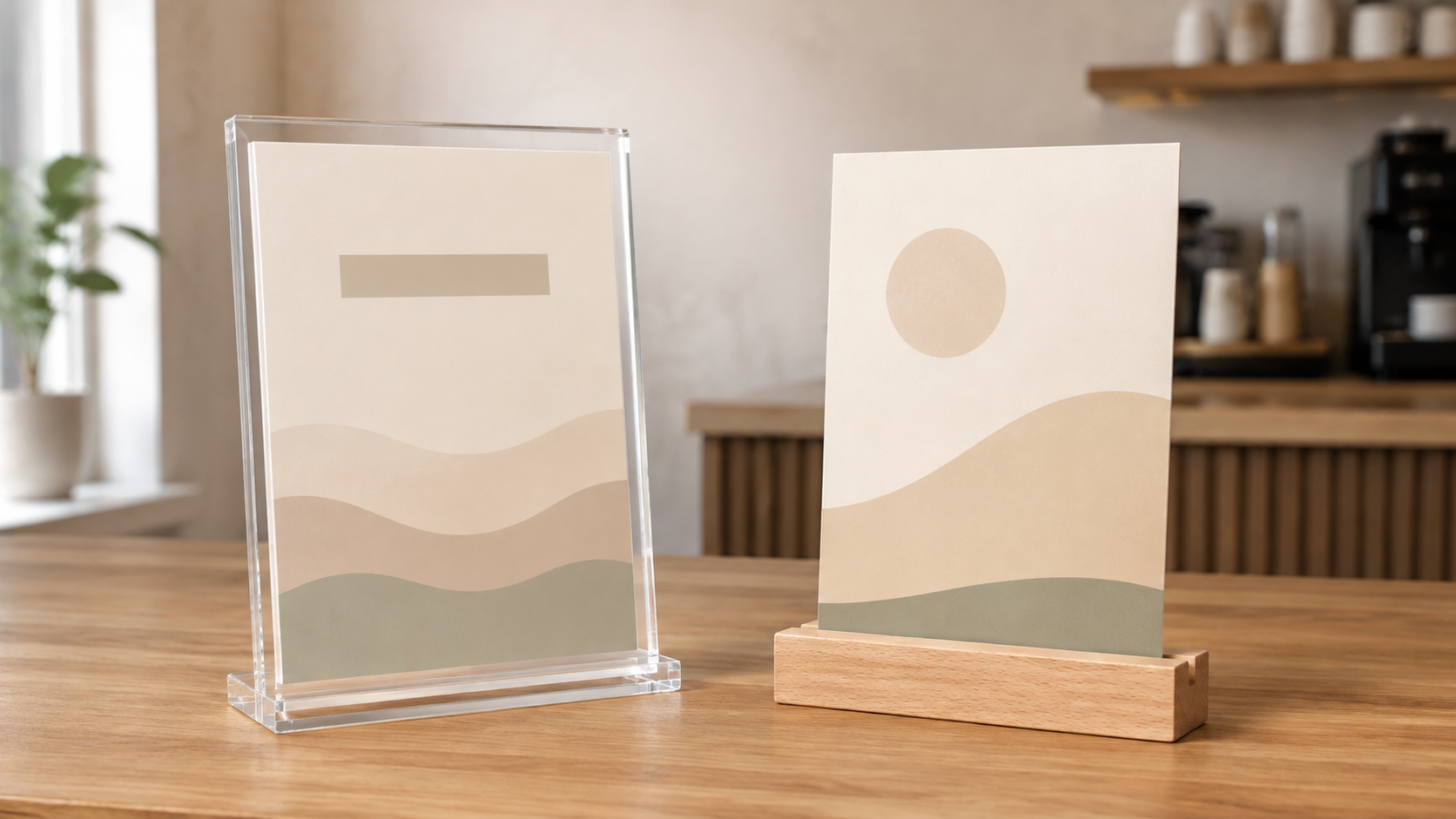
Compare both routes
Start with one finished insert and a measured footprint.
Print the normal message at final size. Compare the holder's stated insert dimensions and loading direction with the wooden stand's listed slot width, slot depth, base size, and supported card format. Product photos alone cannot confirm fit or stability.
The short answer
- Choose an acrylic holder when a standard paper insert changes regularly and enclosing the sheet creates the cleanest update routine.
- Choose a wooden slot stand when the card or rigid panel should remain visually exposed and its thickness is known to fit the slot.
- Skip both when the message needs to sit above nearby products, the surface cannot spare a stable footprint, or the normal sightline is blocked.
Who each option fits
An acrylic holder fits when
- Menus, prices, schedules, names, or instructions are printed on repeatable sheet sizes.
- The insert needs to load from a specific edge without dismantling the display.
- A neutral clear surround suits the counter and reflections can be controlled from the main approach.
- The maker provides insert, orientation, base, loading, and care details that match the setup.
A wooden stand fits when
- The card edge, paper texture, or rigid panel is intended to remain visible.
- The finished card thickness matches a documented slot rather than being forced into it.
- A low horizontal base complements an event table, shelf, desk, or counter.
- The message changes as a complete card and storage can protect loose cards between uses.
Tradeoffs that change the decision
Insert changes and card construction
Acrylic holders are organized around an insert cavity or sleeve: sheet size, orientation, loading edge, and clearance determine whether updates are easy. A slot stand is organized around the finished card: thickness, rigidity, bottom-edge condition, slot width, and seating depth matter. A flexible paper sheet may need a backing before it can stand in a slot; verify the complete format rather than assuming it will work.
Glare and visual character
Acrylic adds clear surfaces that can reflect windows and overhead lights. A wooden base avoids placing a clear sheet over the printed face, but a glossy or laminated card can still reflect light. Test a full-size mockup from the reader's approach under normal lighting. Choose the wood route for its visible material only when that look supports the setting—not because it is universally more readable.
Footprint, angle, and stability
Compare full base width and depth, not just card size. Some acrylic holders lean; others stand upright on a broad base. Wooden slots can hold the card nearly vertical or at a fixed angle. In either format, a tall card changes the center of gravity. Use stated fit guidance, keep the display away from active payment, serving, and pickup zones, and test the finished assembly on the real surface.
Protection, storage, and replacement
An acrylic holder keeps normal handling off much of the insert, but it is not a promise of protection from spills, impacts, or unsuitable cleaners. A wooden stand separates into base and card, which may pack compactly but leaves the card face and edges exposed. Count every piece and plan sleeves or dividers for travel when the display will be reused.
Setup and maintenance issues
- Print the longest normal message at full size and trim it to the intended finished dimensions.
- Mark each candidate base footprint on the counter and check nearby hands, products, equipment, and sightlines.
- For acrylic, verify usable insert size, orientation, loading edge, viewing angle, and the maker's cleaning method.
- For wood, measure the complete card thickness and verify slot width, slot depth, base dimensions, intended card format, and care guidance.
- Place the mockup under normal lighting and look for reflections, curl, lean, hidden bottom content, and type that becomes too small at the reading distance.
- Define who replaces the insert or card and where unused pieces will be stored.
Clean each material only as its maker directs. Do not assume glass cleaner is appropriate for acrylic or that water and general-purpose cleaner suit a finished wooden base. Inspect edges, slots, seams, and the card before each event or service period, and stop using damaged pieces that no longer hold the display as intended.
Skip criteria
- Skip acrylic when unavoidable reflections obscure the message, loading clearance is too tight, or the insert size changes constantly.
- Skip a wooden slot stand when card thickness is unknown, the paper cannot remain flat and upright, or repeated insertion could damage an important finished edge.
- Skip a tabletop display when the message needs a higher sightline or the base would crowd the surface's primary job.
- Skip either option when the listing omits the dimensions or format details needed to confirm fit.
- Pause for venue guidance when the display will sit in a public circulation, serving, or other controlled area; this comparison does not establish venue or compliance approval.
Choose the next step
If the first decision is whether the printed piece needs a reusable holder at all, compare a table tent with an acrylic sign holder. If the message is a menu, use the acrylic menu-holder guide to compare portrait, landscape, loading, and glare decisions. If the finished sign is rigid, framed, irregular, or heavier than a printed card, move to the tabletop sign stand guide.
For a customer-facing counter, simplify the message and map the sightline with the small-business sign planning pillar. For event print styling and reusable frames, continue to the printable party-sign frame guide.
Verdict
Choose acrylic when a repeatable paper insert and quick enclosed update are the main job. Choose a wooden stand when a compatible finished card should remain exposed and the base's material belongs in the presentation. Neither format wins by default: verify the exact insert or slot fit, base footprint, viewing angle, light, cleaning instructions, and update routine before buying.