 The Good Sign Company
Changeable Menu Supply Guide
Best chalk markers for changeable menu boards: choose the surface first, then the tip.
The useful marker is the one the board maker permits, with a line width that fits the real menu and cleanup directions your team can follow. Start by identifying the exact writing surface. Then compare tip shape, stroke width, contrast, cap and storage instructions, and whether the message is rewritten daily or only occasionally.
Disclosure: As an Amazon Associate, we may earn from qualifying purchases and approved partner referrals.
Category starting points
Shop only after checking the board maker's marker and cleaning guidance.
These category routes help compare formats; they are not named winners or hands-on rankings. Check each listing and manufacturer instructions for the intended surface, tip dimensions, ink description, preparation, drying, cleaning, storage, and included colors. Test the chosen marker in a small, inconspicuous area before committing the full menu.
Best Chalk Marker Format by Menu Job
These are fit-based marker categories. A format only belongs on your shortlist when its maker identifies your board surface as compatible.
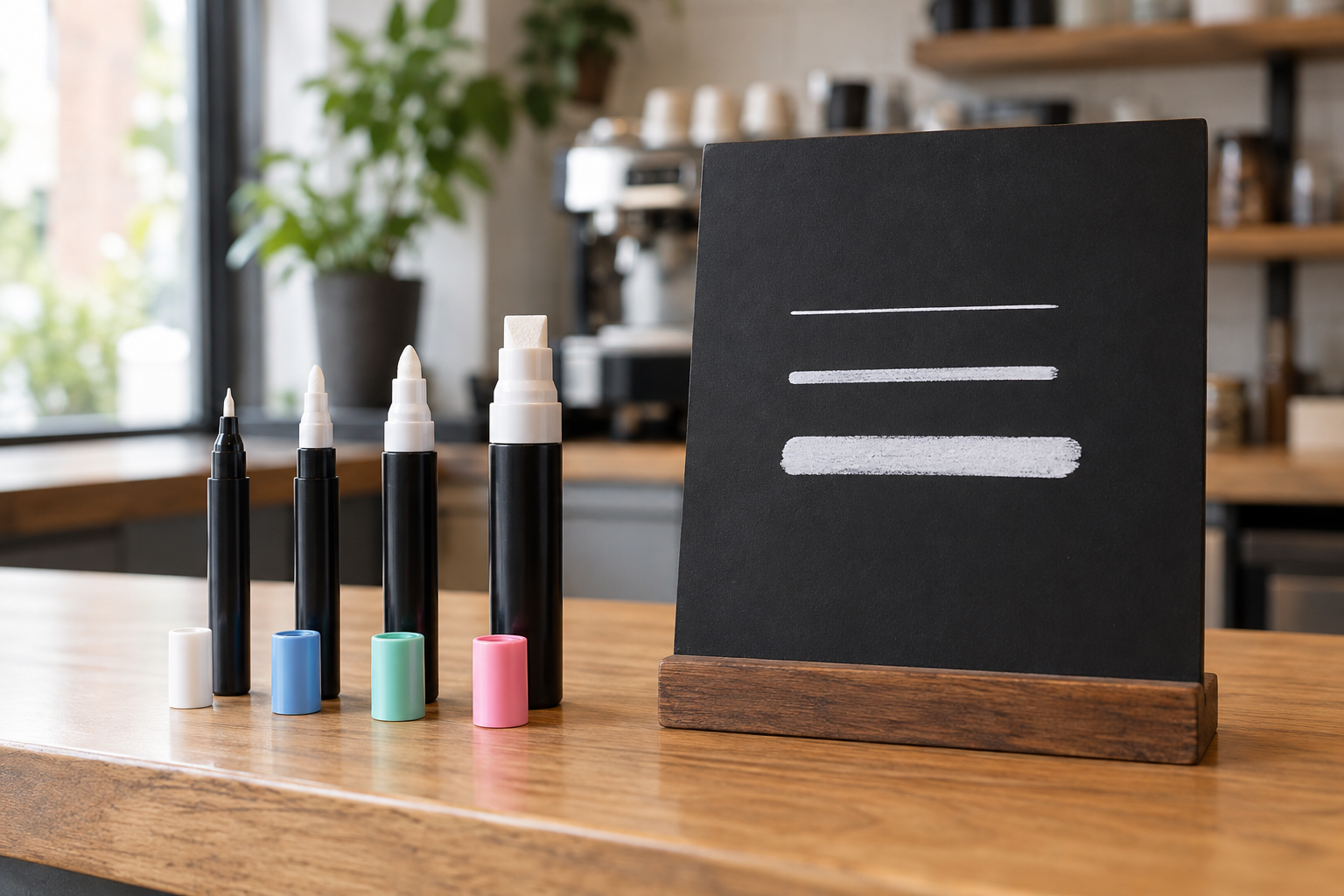
- Medium bullet tip: best starting point for compact everyday menus. A rounded tip makes consistent item lines easier than an oversized nib. Mock up the full menu at the board's usable dimensions before deciding the line is narrow enough.
- Broad or block tip: best for headings and short high-priority messages. The heavier stroke can separate a category or callout, but it consumes writing area quickly and is a poor fit for dense item lists.
- Fine tip: best for close-view details on a compatible board. Use it for brief qualifiers only when customers stand near the sign. Fine writing does not solve a menu that must be read from farther away.
- Reversible-tip marker: best when one tool must cover two planned stroke widths. Confirm the actual nib shapes, how the tip is reversed, and the maker's preparation instructions. Do not assume every reversible marker produces both a detail line and a true headline stroke.
- White-only set: best for a restrained, repeatable menu system. White can simplify restocking and maintain contrast on a suitable dark surface. Add color only when it has a defined job such as identifying one category—not merely because a larger set is available.
- Color set: best for a small, documented hierarchy. Assign colors before buying and check each one on the actual board. Similar-looking hues, decorative accents, and too many categories can make a compact menu slower to scan.
Compatibility Comes Before Color or Pack Size
- Identify the surface, not just its color. A board may be described as chalkboard, chalk-marker, coated, painted, porous, or nonporous. Those labels are not interchangeable instructions.
- Read both makers' directions. Compare the board maker's approved writing and cleaning tools with the marker maker's listed surfaces and use steps. If the guidance conflicts or is unclear, skip that pairing.
- Test a hidden area. Follow the marker's preparation and drying directions, then use the board maker's cleaning method. A small test limits the consequence of an unsuitable combination; it does not guarantee future cleanup.
- Keep the instructions. Store the marker label or product directions with the menu kit so the next person knows how to prepare, cap, store, and clean the tool.
Choose Tip Width from the Finished Message
Measure the board's usable writing area after subtracting the frame and margins. Draft the menu at full size on paper, including headings, prices or short details, and the blank space that separates sections. The menu should establish three levels at most: a primary heading, item or category lines, and limited close-view details.
- Use the broadest stroke for the first decision. Reserve it for a short heading or category rather than writing every line at maximum weight.
- Use a medium stroke for the working menu. It should remain distinct from both the heading and any fine detail at the intended viewing position.
- Remove copy before shrinking it. If the full menu only fits with tiny lettering, move secondary information to a printed insert, handout, or closer-view sign.
- Check the approach path. View the mockup from where customers first need the information, not only from directly in front of the counter.
Plan the Update and Cleanup Routine
- Name an owner: assign one role to confirm the wording, rewrite the board, and return the markers to storage.
- Save a layout: photograph or diagram the approved hierarchy so each update does not restart the design.
- Follow product directions: use only the preparation, dry-time, cleaning, and storage steps supplied for the chosen board and marker pairing.
- Keep incompatible tools separate: label the menu kit if the business uses different markers on dry-erase boards, paper signs, or other surfaces.
- Replace uncertainty with a printed insert: when cleanup instructions are unavailable or the board surface is unknown, do not experiment on the customer-facing sign.
Who Should Skip Chalk Markers
- Skip them when the board maker does not clearly permit the marker type or provide suitable cleaning guidance.
- Skip a handwritten menu when consistent lettering across staff or locations matters more than same-day flexibility.
- Skip a large color assortment when the menu has no defined color system or the replacement colors will be hard to maintain.
- Skip fine-tip detail when the sign must work beyond close counter distance.
- Skip a rewriteable workflow when most of the message stays fixed; a proofed printed insert may be easier to reproduce and archive.
Continue the Menu-Sign Decision
Choose the board before its writing supply with the portable chalkboard menu guide. If the unresolved choice is handwriting versus stored characters, compare a chalk marker board with a changeable letter board. When repeat printing is easier than rewriting, use the printed-insert system worth-it test. Start with the small-business sign planning guide when message length, reading distance, placement, and update ownership still need agreement.