 The Good Sign Company
Reusable Event Sign Accessory Guide
Best protective sleeves for printed event signs: match the insert and display.
A clear flexible sleeve can keep a reusable indoor sign insert cleaner during setup, handling, and storage. The right category depends on the actual print dimensions, how often the insert changes, and whether the sleeved piece must slide into a holder, sit on a stand, or travel flat.
Disclosure: As an Amazon Associate, we may earn from qualifying purchases and approved partner referrals.
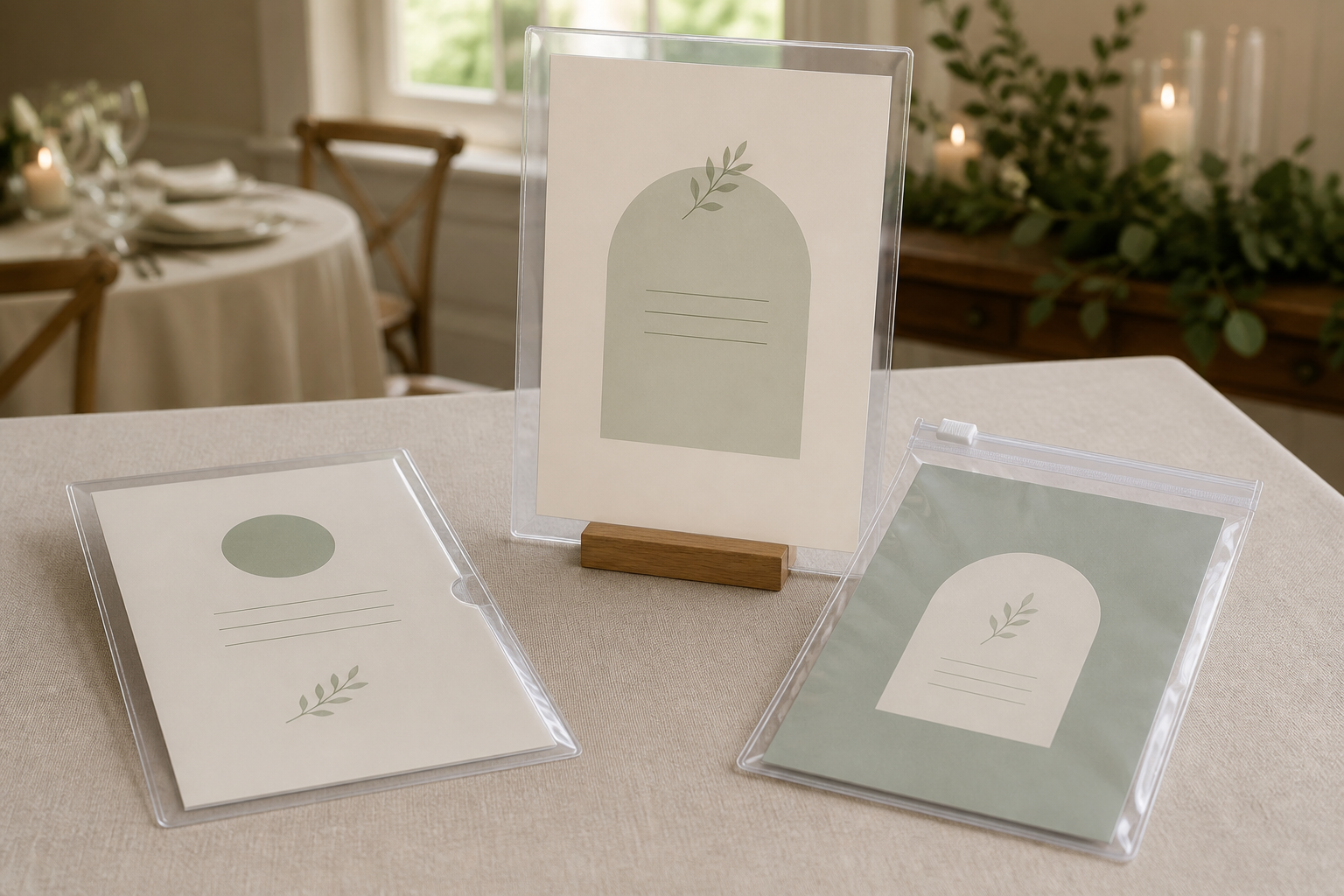
Category starting point
Compare flexible clear sleeves by measured insert size.
Measure the printed piece, then check the sleeve's usable interior dimensions—not only its nominal paper label. Confirm the opening, closure, orientation, and finished outside size against the holder or stand you plan to use.
Best sleeve category by event-sign job
These are use-case categories, not tested winners. Verify current dimensions, materials, and care directions in the listing before buying.
- Top-loading document sleeves: best for quick insert changes. They suit flat signs that stay upright when the open edge remains protected by the display setup.
- Side-loading sleeves: best when top clearance is tight. Check that the opening will not face downward or sit where the insert can creep out.
- Zip-closure document pouches: best for transport and grouped sign sets. The closure adds bulk, so confirm it will not interfere with a stand, frame, or stacked storage.
- Binder-style sheet protectors: best for planning packets and back-of-house organization. Punched margins can look distracting in a guest-facing display.
- Heat-sealed laminating pouches: best when the insert will not change. Lamination is a different, less reversible route; follow the machine and pouch instructions and leave suitable margins.
Selection criteria that matter
- Usable interior dimensions: measure width, height, and cardstock thickness; nominal letter or A4 labels do not prove fit.
- Loading direction: choose a top, side, or closure opening that remains accessible without inviting the insert to slide out.
- Outside dimensions: allow for seams, closures, punched strips, and zipper edges when the sleeve must fit a holder.
- Clarity and glare: inspect the sign under the venue lighting; a glossy sleeve can add reflections even when the print itself is matte.
- Orientation: confirm portrait or landscape use and whether the closure remains visually unobtrusive.
- Cleaning guidance: follow the sleeve maker's instructions and test any cleaner on one spare sleeve rather than assuming chemical compatibility.
- Storage routine: decide whether each sign stays sleeved, whether sets need labels, and how they will remain flat between events.
A practical comparison framework
Make a paper template matching the sign's exact finished dimensions and thickness. Try it in the intended frame, tabletop holder, clip, or stand. Then compare sleeve candidates in this order: usable inner size, loading direction, finished outer size, closure bulk, visual clarity, cleaning directions, pack quantity, and flat-storage needs.
Reject a sleeve if the listing gives only a broad paper-size name and no dimensions you can reconcile with your insert. Also reject any choice whose seams or closure block important artwork, make the holder unstable, or require bending a rigid printed piece.
Protective sleeve vs frame, lamination, or storage bag
- Choose a flexible sleeve for changeable flat inserts that need light handling protection and a separate display support.
- Choose a sign frame when the display needs its own rigid structure and a finished guest-facing edge.
- Choose lamination when the insert is effectively permanent and the laminate, print, and equipment instructions all agree.
- Choose a transport bag when the main problem is moving larger signs, stands, or easels. See the event-sign storage bag guide.
A sleeve may reduce marks from routine indoor handling, but this guide does not treat a generic sleeve as waterproof, spill-proof, archival, outdoor-ready, or suitable for a regulated sign.
Who should skip protective sleeves?
- Skip them when the sleeved insert will not fit the intended frame, clip, groove, or stand.
- Skip glossy sleeves when reflections make a sign harder to read from the guest approach.
- Skip flexible sleeves when the sign must stand on its own without a rigid support.
- Skip a reusable sleeve when a permanent laminated finish better matches an unchanging insert and compatible equipment is available.
- Skip generic office sleeves for outdoor exposure, wet service, heat, food-contact, archival, safety, or compliance-sensitive uses unless the manufacturer specifically documents that use.
The practical bottom line
The best protective sleeve is the one whose usable interior dimensions fit the finished print while its seams and closure still work with the actual display. Start with a measured template, keep glare and loading direction in the comparison, and treat protection claims narrowly.
For the wider setup, compare tabletop sign stands or use the sign mounting and display supply guide.