 The Good Sign Company
Flat Event-Board Transport Guide
Best sign carry sleeves for flat event boards
A fitted soft sleeve can simplify local transport for one or two rigid indoor event boards when the board dimensions, edge depth, opening, and handle position all agree. Measure the finished board—not the artwork file—and compare the sleeve's documented inside dimensions before choosing a format.
Disclosure: As an Amazon Associate, we may earn from qualifying purchases and approved partner referrals.
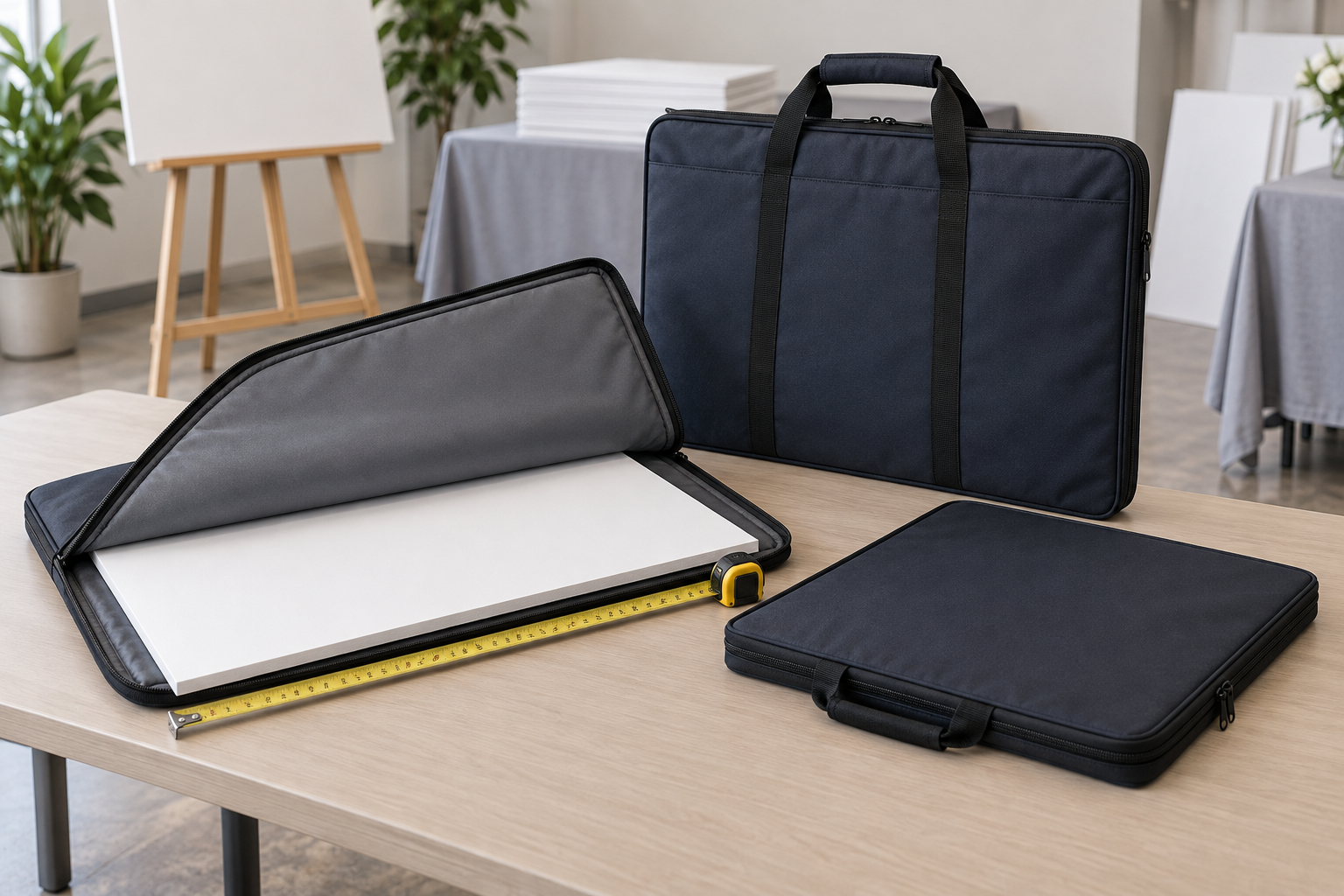
Category shopping route
Shop only after measuring the complete board.
Confirm usable internal width, height, and depth; the real opening; closure path; handle orientation; published material and care guidance; and the complete packed size. A nominal portfolio size or category photo does not establish fit.
The short answer
- Choose a fitted zippered sleeve for one measured rigid board when a full-edge opening and compact storage matter.
- Choose a shallow gusseted sleeve when two compatible boards or a slightly deeper framed edge must fit without forcing the closure.
- Choose a handled portfolio format when the board stays flat and the documented handle orientation supports the planned local carry route.
- Choose a rigid or divided case instead when the kit includes vulnerable finishes, projecting hardware, acrylic, glass, lighting, rolls, rails, or several unlike components.
These are use-based categories, not named winners or hands-on rankings. Current listings vary, so verify every relevant dimension and instruction before ordering.
Compare sleeve formats by the board you actually carry
| Format | Best starting use | Verify before buying | Main tradeoff |
|---|---|---|---|
| Slim zippered sleeve | One unframed rigid board with a measured thickness | Internal dimensions, zipper opening, corner clearance, handle position | Little room for trim, spacers, or a second board |
| Shallow gusseted sleeve | Two compatible flat boards or one board with modest edge depth | Usable depth, separation plan, closure path, packed movement | Extra volume can let boards shift if the listing provides no suitable restraint |
| Handled art-portfolio style | Occasional hand carry between indoor storage, vehicle, and venue | Board fit, handle attachment and orientation, closure, care guidance | A broad portfolio label may describe paper or artwork rather than rigid boards |
| Padded board bag | A compatible board whose maker permits this packing method | Padding construction, seams, usable opening, inside fit, care directions | Padding does not prove impact, crush, weather, or shipping protection |
Selection criteria that matter
- Finished board dimensions: measure maximum width, height, and depth after printing, edge trim, frame parts, or other approved finishing is complete.
- Usable internal fit: prefer stated inside measurements. Do not subtract an assumed seam allowance from exterior dimensions and call the result verified.
- Opening geometry: check whether the widest board edge can pass through the zipper or flap without bending the board or dragging its face across the closure.
- Board compatibility: follow the sign maker's packing directions. Foam board, corrugated plastic, acrylic, framed prints, and composite panels can require different handling.
- Separation: if two boards share a sleeve, confirm an appropriate clean separator and packing method for both finishes. Do not assume a soft divider prevents rubbing.
- Handles and orientation: compare the documented handle layout with the direction the board should remain in during carrying. Include the complete packed weight in your check.
- Closure and loose parts: keep easel hardware, clips, cords, fasteners, and tools out of contact with the board face unless a purpose-made compartment and the makers' instructions support the arrangement.
- Care and storage: follow current instructions for the sleeve and board; a carry sleeve does not establish suitable long-term temperature, moisture, stacking, or cleaning conditions.
A measured packing comparison
- Place the finished board flat on a clean surface and record its maximum width, height, and depth.
- Add only the edge or face protection specified by the board or sign maker, then measure again.
- Draw the candidate sleeve's stated usable interior and opening at full scale with tape or paper.
- Reject any format that requires bowing the board, compressing its edges, scraping the face past a zipper, or guessing at missing dimensions.
- Plan where a second board, separator, or small accessory would sit—if the sleeve is actually documented for it.
- Rehearse the complete local route from storage through the vehicle opening, doorway, elevator, and event setup area.
This rehearsal checks routine fit and handling only. It does not qualify a sleeve for parcel shipping, checked baggage, freight, outdoor exposure, unattended storage, or carrier requirements.
Soft sleeve vs storage bag vs portable case
- Use a fitted soft sleeve for one or two compatible measured flat boards and a simple occasional local carry routine.
- Use the broader event-sign storage bag guide when a compact easel, frame, or separate support is also part of the packing problem.
- Use a portable divided case when rigid panels, rolled graphics, rails, or other unlike booth pieces need a compartment plan.
- Use a sign storage rack when several boards need individual indoor access between recurring events and travel is not the main issue.
Who should skip a soft carry sleeve?
- Skip it when the listing omits usable internal dimensions, opening dimensions, or enough construction detail to verify fit.
- Skip a shared sleeve when the boards have incompatible finishes or can rub, transfer print, or press hardware into one another.
- Skip generic portfolio bags for acrylic, glass, lighted, unusually heavy, framed, or projecting signs unless the sign maker and current product documentation support that packing method.
- Skip any sleeve that makes the packed board awkward for the person, vehicle, doorway, or setup route involved.
- Skip soft local-carry storage when a carrier, rental provider, venue, insurer, or sign maker specifies another case or handling process.
- Skip buying a new sleeve if a clean, documented case already fits the board and does not introduce unnecessary bulk.
Final buying checklist
- Finished board width, height, depth, and packed weight recorded
- Usable interior dimensions and opening verified from the current listing
- Board material and maker's packing guidance checked
- Closure clears every edge without bending or scraping
- Handles suit the required carrying orientation and local route
- Any second board has a compatible, documented separation plan
- Hardware and loose parts travel away from the finished faces
- Sleeve and board care instructions fit the storage routine
- Rigid-case and broader-bag alternatives considered
The best carry sleeve is not the loosest or most padded-looking option. It is the one whose documented inside fit, opening, closure, handles, and care guidance match a known flat board and a repeatable local packing route—without borrowing protection claims the maker does not provide.