 The Good Sign Company
Worth-it decision
Is laminating a counter sign worth it for frequent handling?
Laminating a printed counter sign can be worth it when the message stays unchanged for months, staff or customers handle it often, and the finished sheet still fits its display. Skip it when the wording changes regularly, reflections obscure the message, or a reusable sleeve protects replaceable paper well enough.
This is a format decision, not a promise that laminate makes a sign waterproof, food-safe, archival, or suitable for every cleaning routine. Decide what the sign must do, check the exact machine and pouch instructions, and keep an editable source file for replacement.
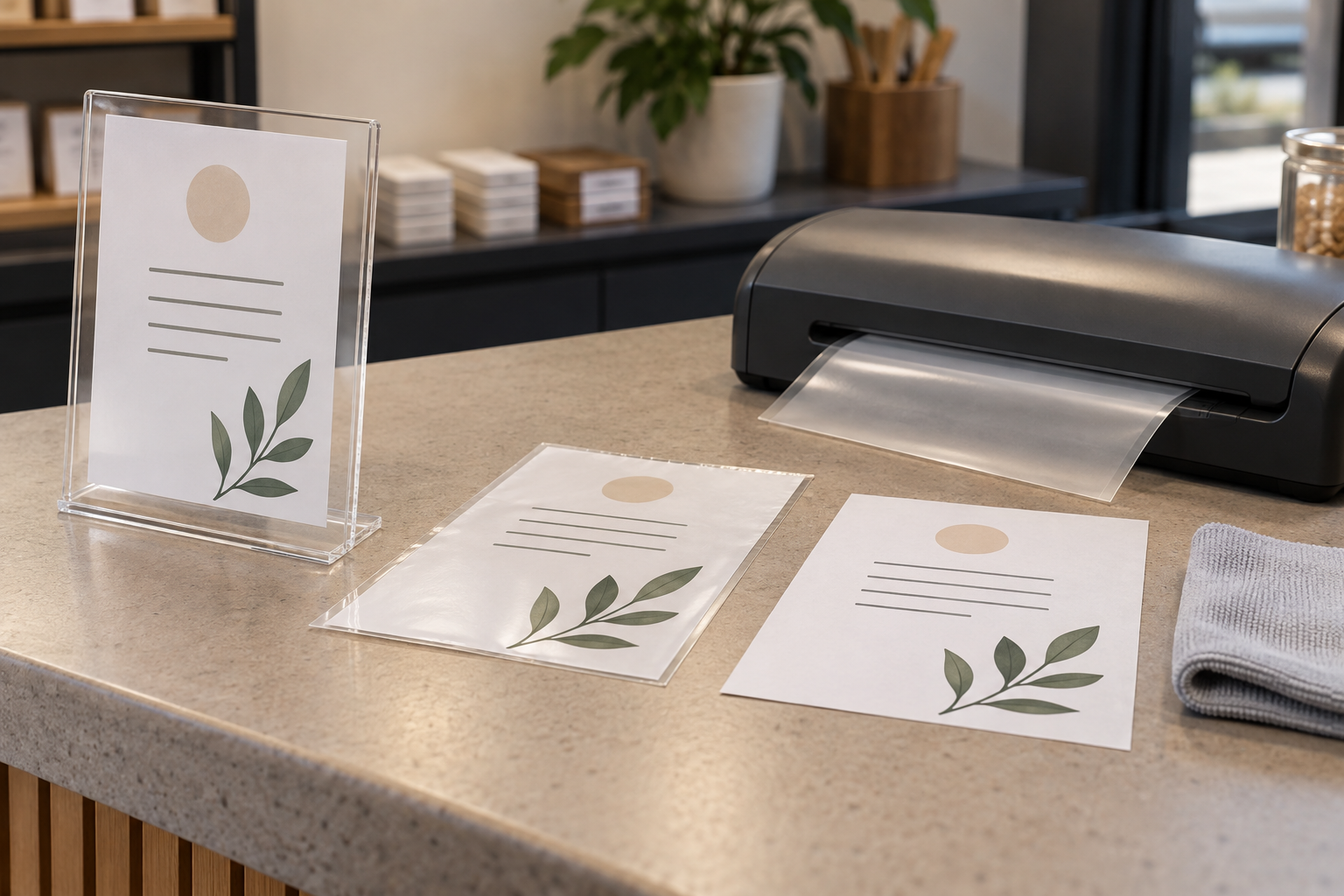
Evaluate the format after the workflow passes the fit test
Confirm the printed sheet size, the laminator's supported pouch sizes and thicknesses, the pouch maker's use instructions, and the finished display opening. Product photos alone do not establish compatibility.
Quick verdict: laminate, skip, delay, or simplify
- Laminate: the approved message is stable, frequent handling is the real problem, glare is manageable at the counter, and the finished piece fits the holder with room for its sealed edge.
- Skip: prices, hours, offers, instructions, or branding change often enough that a fresh paper insert is the normal workflow.
- Delay: the exact display opening, machine compatibility, pouch instructions, viewing angle, or replacement owner is unknown.
- Simplify: use a clear sleeve or insert holder when the paper mostly needs containment and quick replacement rather than a permanent finish.
Count message changes before judging wear
Start with the last six to twelve months of the sign's history. Record each wording, logo, price, policy, date, QR code, or contact-detail change. A sign that looked physically tired after three months may still be a poor laminating candidate if its message also changed twice during that period.
Separate permanent content from variable content. A stable pickup instruction might justify a finished sign, while a weekly offer belongs on a replaceable insert. If one sheet mixes both, redesign it as a stable header plus a changeable lower card before adding a less reversible finish.
Map who handles the sign and why
“Frequently handled” should describe a real task. The sign may be removed for opening and closing, passed across a counter, wiped according to an established routine, carried to events, or swapped between stations. Count those touchpoints for a normal week and identify whether the wear comes from fingers, bending, storage, or repeated insertion into a holder.
Lamination does not solve every cause. A narrow holder can still crease a finished sheet; a rough storage bin can still damage edges; and a sign placed where customers must move it may have a placement problem. Test a paper mockup through the complete staff routine first.
Measure the finished display, not only the paper
- Measure the printed sheet and note its orientation.
- Measure the holder's usable opening, pocket depth, and any corner or edge obstructions.
- Allow for the pouch border required by its instructions; do not plan to cut through a sealed edge unless the maker explicitly allows that treatment.
- Verify the selected pouch size and thickness against the exact laminator documentation.
- Test whether staff can insert and remove a same-size paper mockup without forcing or curling it.
The finished piece may be larger, thicker, stiffer, and less forgiving than the original paper. If the current holder depends on a precise fit, measure before ordering. The laminating-pouch guide covers these product-level checks after the decision to laminate is settled.
Check glare from the customer approach
Clear finishes can change reflections. Print a full-size sample, place it at the actual angle, and view it from the normal customer approach during the brightest and dimmest operating conditions. Compare the sample behind a clear sleeve or holder as well. The useful question is not whether a finish is labeled glossy or matte; it is whether the message remains readable in this placement.
If a reflection crosses the copy, first try changing the holder angle, sign position, type size, or contrast. A different display may solve the problem without committing each update to a laminating step. For broader counter-display tradeoffs, compare a clear menu sleeve with a rigid acrylic holder.
Compare the full operating workflow
| Question | Laminated sheet favors | Replaceable insert favors |
|---|---|---|
| Message life | Approved copy remains stable for a long cycle | Content changes on a known schedule |
| Handling | The same sheet is repeatedly moved or passed | The holder stays put and contains the paper |
| Updates | Reprinting and finishing are acceptable exceptions | Staff need a quick, low-step swap |
| Display fit | The finished border and thickness are verified | The current pocket is sized for plain paper |
| Glare | A placed sample remains readable | The current holder already controls the view |
| Equipment | A compatible machine and documented process exist | No finishing equipment is needed |
Include labor and rework in the decision
The purchase price of a pouch is only one input. Count printing, warm-up and setup where applicable, loading, cooling or handling steps from the instructions, inspection, trimming if permitted, and reprinting when a sheet is misaligned or the copy changes. Assign one role to maintain the editable file and one role to approve replacements.
A small operation with one stable sign may prefer self-sealing sheets or a reusable sleeve over owning another device. A team producing many approved inserts may value a documented finishing station. That separate ownership question belongs in the queued desktop-laminator decision; this page asks only whether this counter sign benefits from lamination.
Red flags before laminating
- The sign includes a price, date, QR destination, offer, policy, or contact detail without a named review schedule.
- The finished dimensions have not been compared with the holder opening.
- The plan depends on trimming through a seal without manufacturer guidance.
- The laminator and pouch specifications have not been matched.
- No placed sample has been checked for glare and readability.
- The team expects laminate to prove waterproofing, sanitation, food-contact suitability, or archival protection.
- The editable source, approval owner, or replacement process is missing.
A low-cost trial before buying supplies
- Print two full-size copies and place one in the intended holder.
- Run the normal opening, customer-service, cleaning, closing, and storage routine for a representative period.
- Log every handling event, message correction, fit problem, and reflection problem.
- Put the second copy in a reusable sleeve and compare the same workflow.
- Laminate only if the stable-message and repeated-handling benefit remains clear after the comparison.
Bottom line
Laminating a frequently handled counter sign is worth considering when the copy is genuinely stable, the finishing system is compatible, the finished piece fits, and a placed sample remains readable. It is not the default answer for every worn sheet. A sleeve, rigid holder, or routinely replaced insert is often the cleaner route when content changes or reversibility matters.
Continue with the small-business sign planning pillar, compare laminating pouches for counter signs, or choose clear sleeves for frequently changed inserts.