 The Good Sign Company
Counter sign format comparison
Laminated paper sign vs acrylic block sign: which fits your counter?
Choose a laminated paper sign when the message may need economical in-house replacement and you already have a suitable support. Choose an acrylic block sign when the message is stable and a finished self-standing object fits the counter. Compare the complete setup: message life, support, base depth, glare, handling, storage, and who owns future changes.
This guide covers compact indoor counter and tabletop messages. It does not establish liquid resistance, scratch resistance, breakage behavior, lifespan, food-contact suitability, or outdoor use for either format.
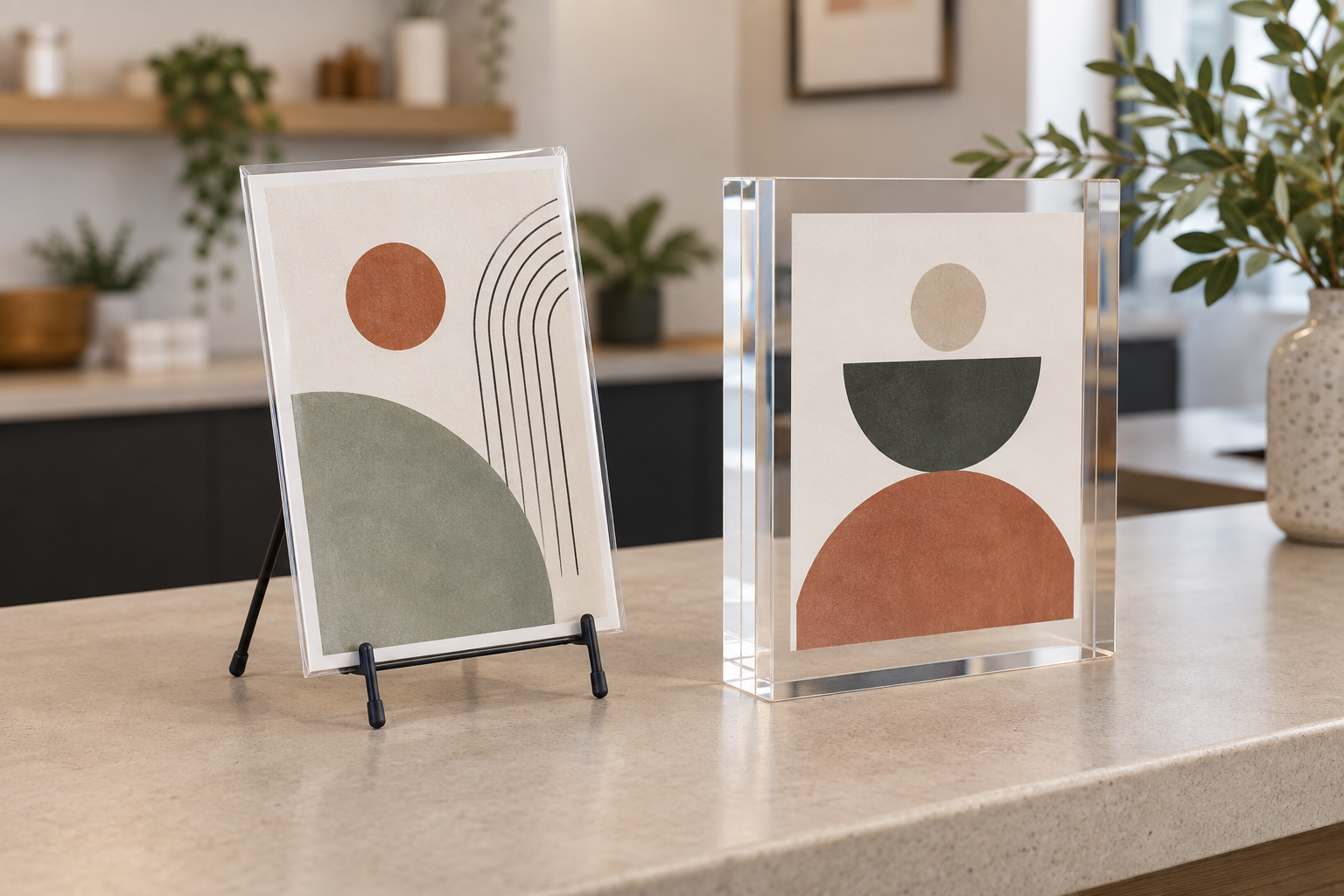
Compare the whole display, not just the printed face
For laminated paper, verify the sheet, pouch or film, sealed edge, finished dimensions, and compatible stand. For an acrylic block, verify the complete width, height, depth, print construction, orientation, care guidance, and stated use from the current listing.
Quick comparison
| Decision | Laminated paper sign | Acrylic block sign |
|---|---|---|
| Support | Needs a stand, clip, slot base, wall, or flat-reading plan | Usually uses its own measured depth as the base |
| Message changes | Can be reprinted and refinished in a compatible workflow | Usually requires a new finished block or maker-supported graphic route |
| Footprint | Set by the complete support, not the sheet alone | Set by the block's full depth and width |
| Storage | Sheet may store flat; support still needs space | Thicker object needs protected shelf or packing volume |
| Skip when | No stable, compatible support fits the counter | The message changes often or depth blocks the work area |
When laminated paper fits
A laminated sheet fits a stable printed message that may still need occasional local replacement: a short service note, event-table instruction, price-free information card, or temporary reception message. It is not a freestanding product by itself. Name the easel, clip, slot stand, holder, or flat-use position before choosing the finished sheet size.
Confirm paper size, finishing method, added edge margin, total thickness, and the support's documented capacity. If lamination itself is undecided, first use the counter-sign lamination worth-it test. If a separate stand is needed, compare mini easels for small signs by ledge, angle, footprint, and sign fit.
When an acrylic block fits
An acrylic block fits a message that should look and behave like one finished object. Its depth can let it stand without a second holder, reducing the number of pieces staff position. That same depth consumes counter and storage space, so mark the full listed footprint rather than judging the face dimensions alone.
Ask how the graphic is incorporated and how a future wording change is handled. Do not assume every block opens, accepts a replacement print, or uses the same cleaning method. When easy local updates are more important than a fixed presentation, compare a self-standing acrylic block with a replaceable-insert holder.
Run a full-size counter test
- Print the actual message. Use the intended dimensions, type size, margins, artwork, and orientation.
- Build both footprints. Add the complete stand behind a laminated sign; model the full block depth for the acrylic option.
- Use the normal approach. Check the sign from where a visitor first needs it and from the staff working position.
- Test representative light. Clear surfaces can reflect windows and fixtures; reposition the mockup before assuming a finish will solve glare.
- Rehearse the update. List the file, printer, finishing supplies, maker handoff, approval, and person responsible for each route.
- Plan storage. Mark where the sign and any separate support go during cleaning, transport, or seasonal removal.
Setup and maintenance tradeoffs
A laminated sheet introduces a multi-piece setup when it uses a separate support. Staff must match the right sign to the right stand and keep the face at the tested angle. An acrylic block simplifies the visible setup but moves more of the update work into the production or ordering stage.
- Follow the exact product maker's care and handling instructions.
- Keep active counter, payment, pickup, and paperwork space clear.
- Check alignment and readability after moving or cleaning either sign.
- Retire outdated copies so staff cannot accidentally return them to service.
- Test reflections in the real location; neither clear surface is universally low-glare.
Who should skip both
- The message changes daily or requires quick handwriting; consider a compatible dry-erase or changeable system.
- The reader needs the information from farther away than the tested face and type size support.
- The counter cannot spare the complete base, loading, and hand-clearance area.
- The use is outdoors, near heat or moisture, or otherwise outside the product's documented conditions.
- The message must face two approach directions; start with the single-sided vs double-sided counter-sign comparison.
- The main need is frequent paper replacement; a clear sleeve or rigid insert holder may be the more direct choice.
Bottom line
A laminated paper sign is the more locally replaceable route, but only after its finishing and support are counted. An acrylic block is the more self-contained finished format, but it commits counter depth and usually makes message changes less immediate. Choose from the real update schedule and complete footprint, not from face appearance alone.
Continue with the small-business sign planning pillar, or compare reception sign formats when reflections are the main constraint.