 The Good Sign Company
Replaceable label comparison
Magnetic sign pocket vs adhesive sign pocket
Choose a magnetic pocket when the exact location passes a magnet test and moving the complete pocket is part of the workflow. Choose an adhesive pocket when the surface is smooth, product-compatible, and the pocket can remain in one deliberate position. Both can make paper changes easier; neither fixes a poor surface match, blocked loading edge, or unreadable label.
This comparison is specifically about clear pockets that hold replaceable paper. For direct-printed signs without an insert, use the broader magnetic sign vs adhesive sign guide.
Disclosure: As an Amazon Associate, we may earn from qualifying purchases and approved partner referrals.
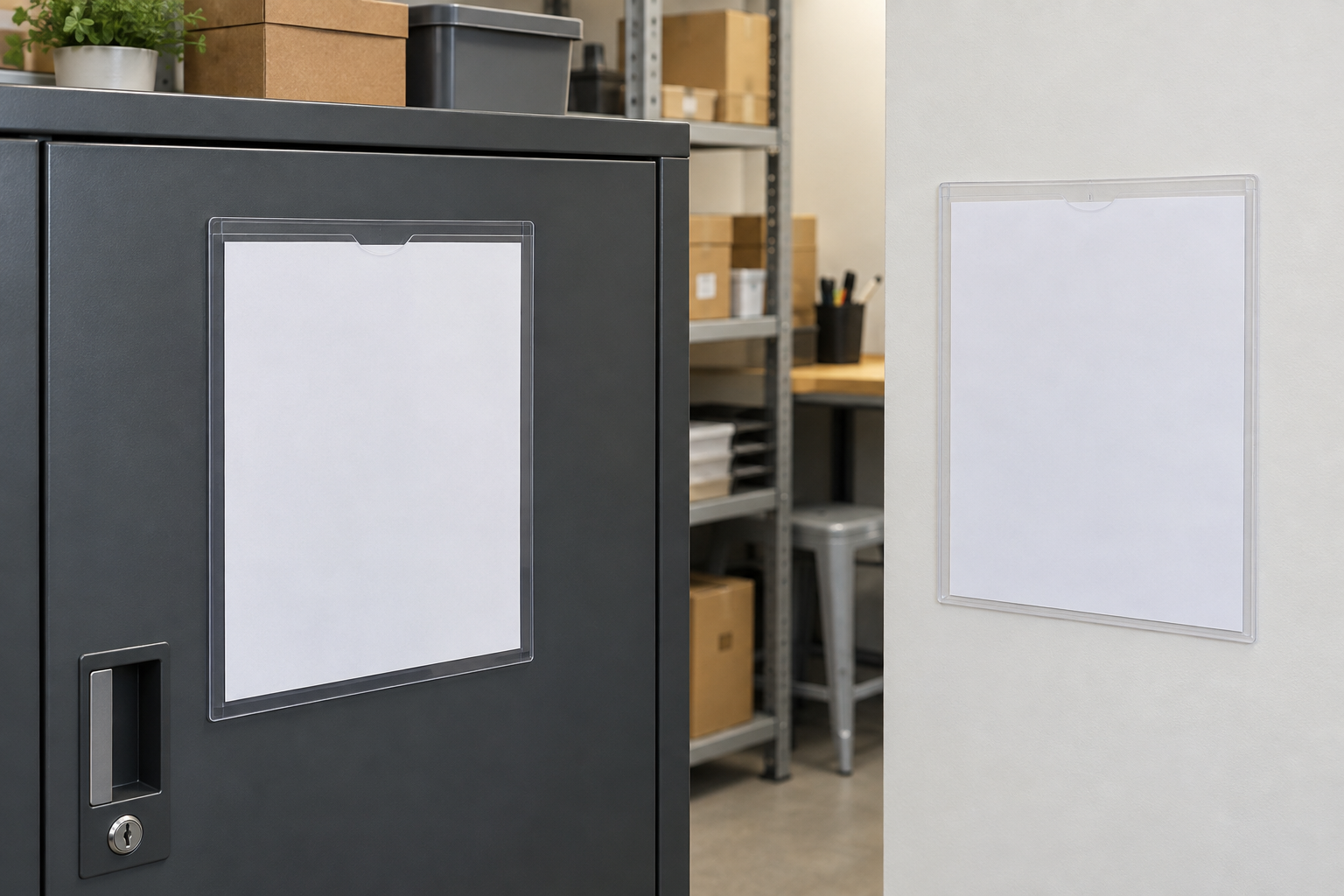
Compare the two pocket formats
Open current listings and verify the insert size, visible area, complete outside dimensions, loading edge, orientation, backing coverage, compatible surfaces, preparation steps, and removal or cleaning instructions.
The short answer
- Magnetic fits stock cabinets, shelving, or equipment panels only when the exact spot is flat and magnet-responsive. It is the more flexible route when locations are reassigned.
- Adhesive fits compatible smooth surfaces where the pocket location is stable and the maker's application and removal directions suit the finish.
- Skip both when the surface is unknown, textured, curved, fragile, frequently exposed to incompatible cleaners, or not approved for attachment.
Side-by-side decision table
| Decision | Magnetic pocket | Adhesive pocket |
|---|---|---|
| First test | Check magnetic response at every intended position | Identify the finish and confirm it in current application guidance |
| Moving the pocket | Usually easier on other compatible flat surfaces | May require removal, cleanup, and new adhesive |
| Changing the paper | Controlled by pocket opening and clearance | Controlled by pocket opening and clearance |
| Placement correction | Can usually be trial-positioned before use | Alignment should be planned before firm application |
| Surface commitment | No adhesive, but contact and trapped grit still matter | Depends on adhesive, finish, preparation, dwell time, and removal method |
| Best general fit | Frequently reorganized compatible cabinets or fixtures | Stable labels on listed smooth indoor surfaces |
Who each option fits
Choose magnetic for a movable labeling system
A magnetic pocket suits a small team that reorganizes storage zones, shifts job labels among steel cabinets, or pilots a label layout before standardizing it. Test the actual door, drawer, or panel: a metal-looking finish does not establish magnetic response, and another part of the same fixture may use different construction.
Choose adhesive for a fixed labeling station
An adhesive pocket suits a recurring label position on a smooth surface that appears in the product's current instructions. It can cover locations where magnets do not work, but that reach is not universal. Record the surface finish, follow preparation directions, and treat removal as a planned step rather than assuming a damage-free result.
Insert fit and loading access are shared constraints
The attachment method does not determine how easily staff can replace paper. Measure the insert, visible window, overall pocket, and loading opening separately. Important words need to stay inside the visible area, while the complete pocket must clear seams, handles, shelf lips, and adjacent labels.
Then rehearse the change. A top-loading pocket needs free space above it; a side-loading pocket needs room at the open edge. If the fixture must be emptied or a nearby object moved for every update, another orientation or holder format may be better.
Setup tradeoffs
- Map the sightline. Place a full-size paper mockup where a person will approach and read it.
- Verify the host. Magnet-test the precise magnetic location, or match the precise adhesive surface and finish to product guidance.
- Check interference. Open doors and drawers and use handles while the mockup is present.
- Standardize the insert. Save one print template with safe margins inside the visible window.
- Pilot one location. Complete several real insert changes before buying a multipack or rolling the system across a room.
Maintenance and cleaning
Clear faces can collect fingerprints and reflect overhead light. Check readability from the real approach angle, and follow the pocket maker's cleaning instructions. Also check the cabinet, wall finish, or fixture instructions; a cleaner suitable for the plastic face may not suit the host surface or adhesive edge.
For magnetic pockets, inspect the contact surfaces before repositioning so debris is not trapped between them. For adhesive pockets, watch the edges during routine cleaning and follow the maker's removal method if the label station is retired. Do not improvise solvents on an unknown finish.
When to skip each format
Skip magnetic when
- The exact spot fails a magnet test or has curves, seams, vents, or trim that prevent full contact.
- The pocket would move into a handle path or a frequently bumped work area.
- The format's value depends on a holding claim that the current listing does not document for the complete loaded pocket.
Skip adhesive when
- The surface is textured, delicate, recently finished, unknown, or excluded by the instructions.
- The label position changes often enough that repeated removal would be part of normal work.
- The surface owner has not approved attachment, or the removal plan is unclear.
Skip both when
- The message is stable enough for a simpler direct label.
- Insert sizes change too often to support one repeatable pocket.
- A clip-on, hook-on, freestanding, or rail-mounted holder matches the fixture better.
- The message is safety-, hazard-, accessibility-, or code-sensitive and needs requirements beyond this general product guide.
A practical buying checklist
- Exact mounting material and finish
- Magnet-test result or listed adhesive-surface compatibility
- Insert size, visible area, and overall pocket dimensions
- Loading direction and required hand clearance
- Backing dimensions and orientation
- Manufacturer preparation, cleaning, repositioning, and removal guidance
- Update frequency and the person responsible
- A non-attached fallback if the surface check fails
Next steps
If magnet response is confirmed but the product case is still uncertain, use the magnetic sign pocket worth-it test. For shelf edges, compare hook-on and adhesive shelf label holders. If neither attachment route is settled, return to the sign mounting supplies pillar and choose by the actual host geometry, update routine, and removal plan.