 The Good Sign Company
Fixture sign-holder comparison
Pegboard Sign Holder vs Gridwall Sign Holder
Choose the fixture before the sign holder. Pegboard hardware engages a pattern of holes in a solid panel; gridwall hardware attaches around an open wire grid. Those host geometries are not interchangeable, even when the finished price card looks identical. Measure the real panel, then compare card support, projection, update access, and packing.
Disclosure: As an Amazon Associate, we may earn from qualifying purchases and approved partner referrals.
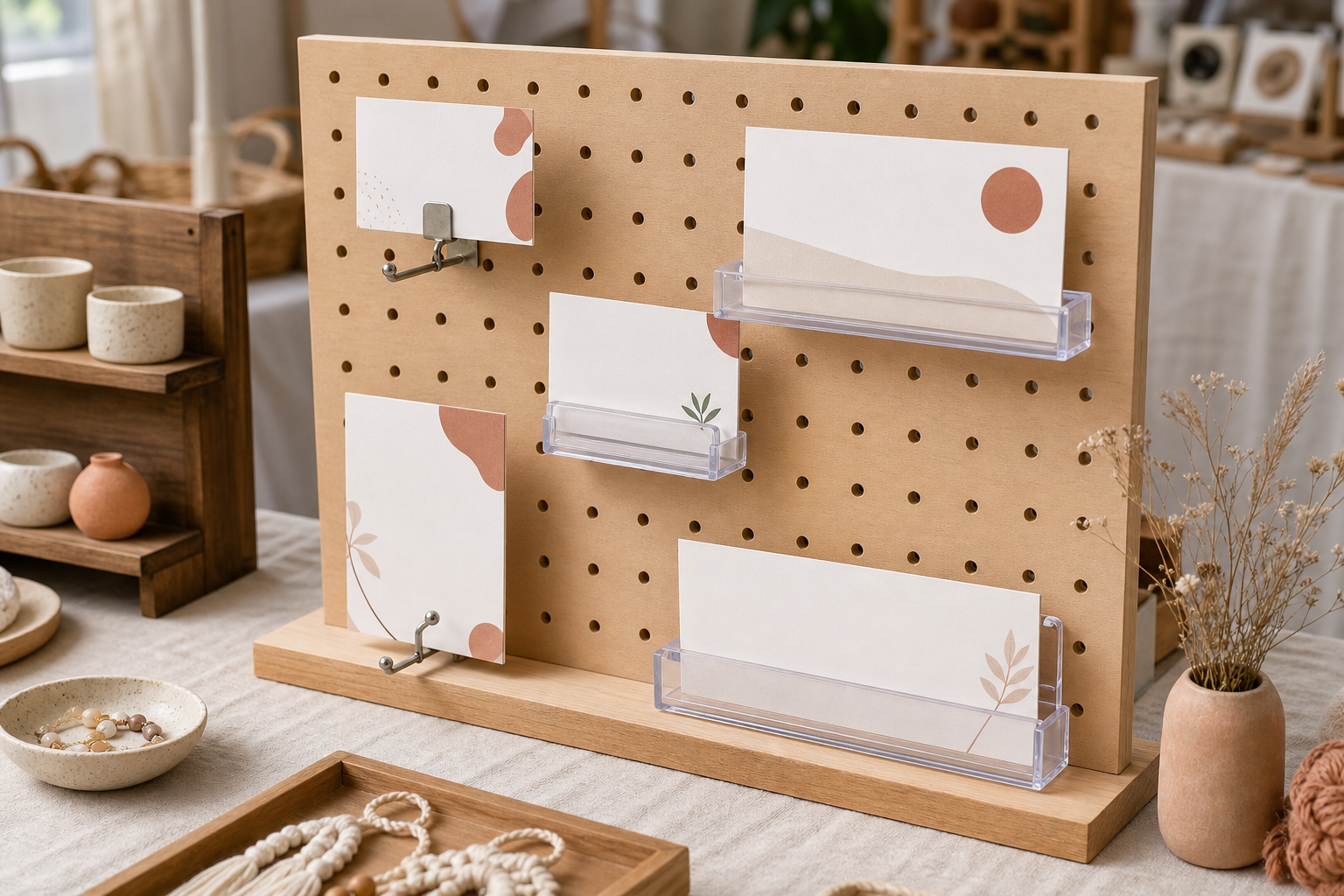
Compare holders for the fixture you actually own
Record the fixture maker when known and measure its attachment geometry. Then verify the current product listing's compatibility, card dimensions, complete projection, included parts, and installation instructions.
The short answer
Choose a pegboard holder when the display is a solid perforated panel and the product documentation matches its hole spacing, hole diameter, panel thickness, and usable space behind the board.
Choose a gridwall holder when the display is an open wire panel and the attachment is documented for its wire diameter, opening dimensions, and mounting orientation.
Choose neither when the fixture cannot be identified or measured, the card would project into a customer or merchandise path, or a shelf-edge, tabletop, or larger booth sign would create a clearer message.
Decision table
| Decision | Pegboard holder | Gridwall holder |
|---|---|---|
| Host fixture | Solid panel with a repeating hole pattern | Open panel made from crossing wires |
| Measure first | Hole spacing and diameter, panel thickness, rear clearance | Wire diameter, clear opening width and height, intersection position |
| Attachment check | Prongs, pegs, screws, or hooks must suit the board system | Hooks, clips, or brackets must seat on the stated wire geometry |
| Layout effect | Holder positions follow the hole pattern | Holder positions follow wires and intersections |
| Packing issue | Projecting hardware may need removal before panels stack | Small clips and brackets can be separated or lost in transport |
| Main mistake | Assuming every perforated board uses the same standard | Assuming similar-looking wire grids accept the same attachment |
1. Identify the attachment geometry
For pegboard, measure center-to-center hole spacing, hole diameter, panel thickness, and the open depth behind the panel. Note frames, stands, braces, or a wall that could block a prong from entering and rotating into position.
For gridwall, measure the wire diameter and the clear opening in both directions. Record whether the holder sits on one horizontal wire, at an intersection, or across multiple wires. Compare these measurements with current maker instructions; a product photo alone does not establish fit.
2. Match the holder to the finished card
Start with the message, not the accessory. Print a full-size sample and measure its width, height, thickness, orientation, and required visible area. Check whether the holder grips a bare card, accepts an insert inside a pocket, or carries a separate frame.
Long product names may need a wider card, while prices near small merchandise may work on a compact insert. Keep the item and its label visually connected; a holder that fits the panel can still be wrong if the card appears to describe the neighboring product.
3. Compare projection and usable display space
Measure from the face of the fixture to the outermost edge of the installed holder and card. Include stems, clamps, pockets, fasteners, and any viewing angle. Test that outline with paperboard while the display is stocked.
Pegboard shelves and hooks can compete with sign hardware for the same holes. Gridwall baskets and hanging merchandise can occupy the same wire intersections. Leave clearance for restocking and for the normal customer approach; do not infer holding capacity or safe placement from the fixture type.

4. Plan changes, setup, and maintenance
For frequent message changes, compare the loading edge, card-retaining method, and access after merchandise is installed. Standardize insert dimensions and keep the editable card file with a fixture reference so replacements do not require fresh measuring.
Before transport, follow the fixture and holder makers' instructions. Remove projecting parts when required, protect clear pockets from abrasive hardware, and group small fittings by display location. Clean the card holder and fixture only with methods suitable for their stated materials and finishes.
Who each format fits
- Pegboard fits a craft booth, counter display, or small retail panel already built around a confirmed perforated-board system, especially when merchandise and cards need a compact shared layout.
- Gridwall fits an indoor market or retail display already using a confirmed wire-grid system, especially when holders need to move among measured wire positions.
- A different format fits when the fixture is temporary, undocumented, overfilled, or too far from the normal sightline for a small card to work.
When to skip each option
- Skip pegboard-specific hardware when the hole pattern, thickness, or rear installation clearance cannot be verified.
- Skip gridwall-specific hardware when the wire geometry or required attachment position is uncertain.
- Skip either projecting holder when it conflicts with merchandise, bags, hands, or the setup and packing path.
- Skip small fixture labels when the message must be read across a room or explain the whole display; use a larger header, tabletop sign, or booth sign.
- Do not improvise a cross-fit by bending or modifying hardware unless the maker specifically documents that use.
Buying checklist
- Fixture type, maker, and system name when available
- Pegboard hole spacing, diameter, thickness, and rear clearance
- Gridwall wire diameter, clear openings, and attachment position
- Finished card size, orientation, thickness, and visible area
- Holder attachment geometry and included parts
- Complete installed projection and neighboring clearance
- Insert-loading access and update owner
- Removal, cleaning, storage, and packing instructions
Continue the decision
If the fixture is already fixed, use the detailed guides to compare pegboard sign-holder categories or gridwall sign-holder categories. If gridwall is being compared with another retail wall system, continue with gridwall versus slatwall sign holders. Use the small-business sign planning guide to connect card hierarchy, viewing distance, ownership, and installation constraints.