 The Good Sign Company
Small sign holder comparison
Spring clip vs alligator clip sign holders: which fits the card and fixture?
Start with a broad spring clip when you need more contact area on a compatible card or fixture. Start with an alligator clip when a narrow bite point, compact hardware, or precise placement better fits the display. The name alone does not establish jaw range, holding force, or safe use.
This is the clip-mechanism decision for lightweight indoor price cards and product labels. If you are still choosing between attaching to a fixture and using an independent base, begin with the clip-on holder vs weighted-base comparison.
Disclosure: As an Amazon Associate, we may earn from qualifying purchases and approved partner referrals.
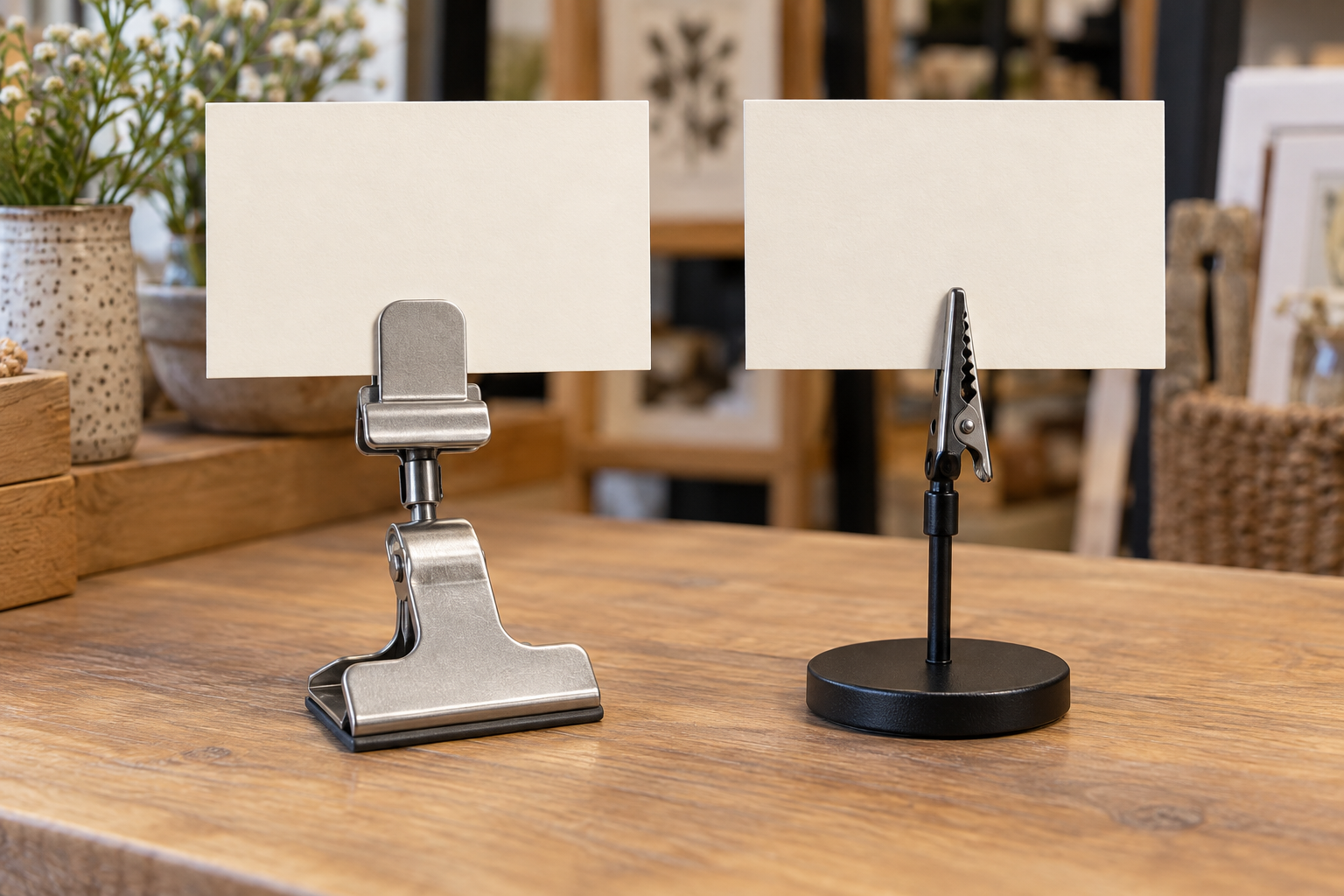
Compare complete holders, not clip names
Check the current listing for the jaw range and contact surfaces at both ends, supported card guidance, stem length, joints, rotation, attachment geometry, included pieces, and intended use. Product photos are not substitutes for dimensions.
Quick comparison
| Decision | Broad spring clip | Alligator clip |
|---|---|---|
| Contact area | Typically broader, depending on pad and jaw design | Typically narrower and more concentrated |
| Card face | May cover more of the card edge | May cover less width but leave a more concentrated impression |
| Attachment fit | Useful only when the stated opening and pad shape match the support | Useful only when the stated opening and tooth shape match the support |
| Alignment | A broad face can provide a larger visual reference for alignment | A narrow jaw can make precise placement easier to see |
| Best first use | Cards or fixtures that benefit from distributed contact | Small cards and attachment points where compact contact matters |
Choose a broad spring clip for more contact area
A broader jaw can spread contact across more of a paper card, laminated label, basket edge, or tabletop lip. That can be useful when a narrow jaw would land on type or artwork. Smooth pads may also suit finishes that should not meet visible teeth—but only when the maker describes the pad material and compatible use.
The broad face occupies more room. Measure how much of the card it covers and whether the lower line of copy remains visible. At the fixture end, check the actual jaw opening, pad angle, and available landing area. A large clip is not automatically a stronger or safer clip.
Choose an alligator clip for a narrow bite point
An alligator-style jaw can fit a compact card edge or a small attachment point when its stated opening matches. Its narrow shape can help position several labels close together, and the exposed jaw makes the contact point easy to inspect during setup.
Teeth or concentrated edges can mark soft paper, thin coatings, painted surfaces, or delicate finishes. Do not assume a protective pad is included. Check both sides of the mechanism and use a sacrificial sample card before placing the clip on a finished sign or fixture.
Inspect both ends of the holder
Many products combine a card clip, stem, pivot, and a second clip or base. A suitable card jaw does not make the attachment end suitable. Record the minimum and maximum opening, jaw depth, pad or tooth shape, stem length, and any stated rotation at each connection. Then compare those dimensions with the actual card and fixture.
For wire shelves and market racks, the wire-display sign clip guide focuses on rod geometry, jaw fit, angle, and repositioning. For solid shelf edges, compare magnetic and clip-on shelf label holders.
Run one card-change test
- Print the real card. Use the final stock, finish, dimensions, orientation, and longest normal message.
- Mark the contact zone. Keep essential type, codes, borders, and artwork clear of the jaw.
- Measure the support. Include edge thickness, curves, seams, wires, liners, and nearby merchandise.
- Attach without forcing. Follow the current product instructions; a clip that must be overstretched is not a verified fit.
- View from the customer path. Check alignment, card curl, reflections, product visibility, and reach clearance.
- Change the card once. Note whether the holder stays aligned and whether the contact point leaves a mark.
Who should skip both
- The card is heavy, tall, valuable, powered, or top-heavy and the listing does not state a compatible use.
- The fixture has no permitted, dimensionally compatible attachment point.
- The sign sits outdoors, overhead, in a circulation path, or where repeated contact is expected; generic indoor card clips are not automatic wind, weather, or public-placement solutions.
- The message needs broad paper support or protection from handling; compare an acrylic card holder with a wire stand.
- Either jaw covers essential information, damages the sample card, or marks the supporting finish.
Bottom line
Choose by verified geometry at both ends. A broad spring clip is the better candidate when distributed contact and a larger pad suit the card and fixture. An alligator clip is the better candidate when a narrow, precise contact point fits without damaging the insert or support. Test one complete holder in the real indoor display before ordering multiples.
Continue with the small-business sign planning pillar, the tabletop sign stand guide, or the farmers-market product sign guide.