 The Good Sign Company
Portable Sign Holder Comparison
Clip-on sign holder vs weighted sign base: which fits the display?
A clip-on holder borrows support from a basket, shelf, rack, or table edge. A weighted-base holder brings its own support but uses valuable surface space. The better choice starts with the actual attachment point and complete footprint—not the holder style in isolation. This comparison stays with portable indoor displays; check venue rules and the exact product instructions before setup.
Disclosure: As an Amazon Associate, we may earn from qualifying purchases and approved partner referrals.
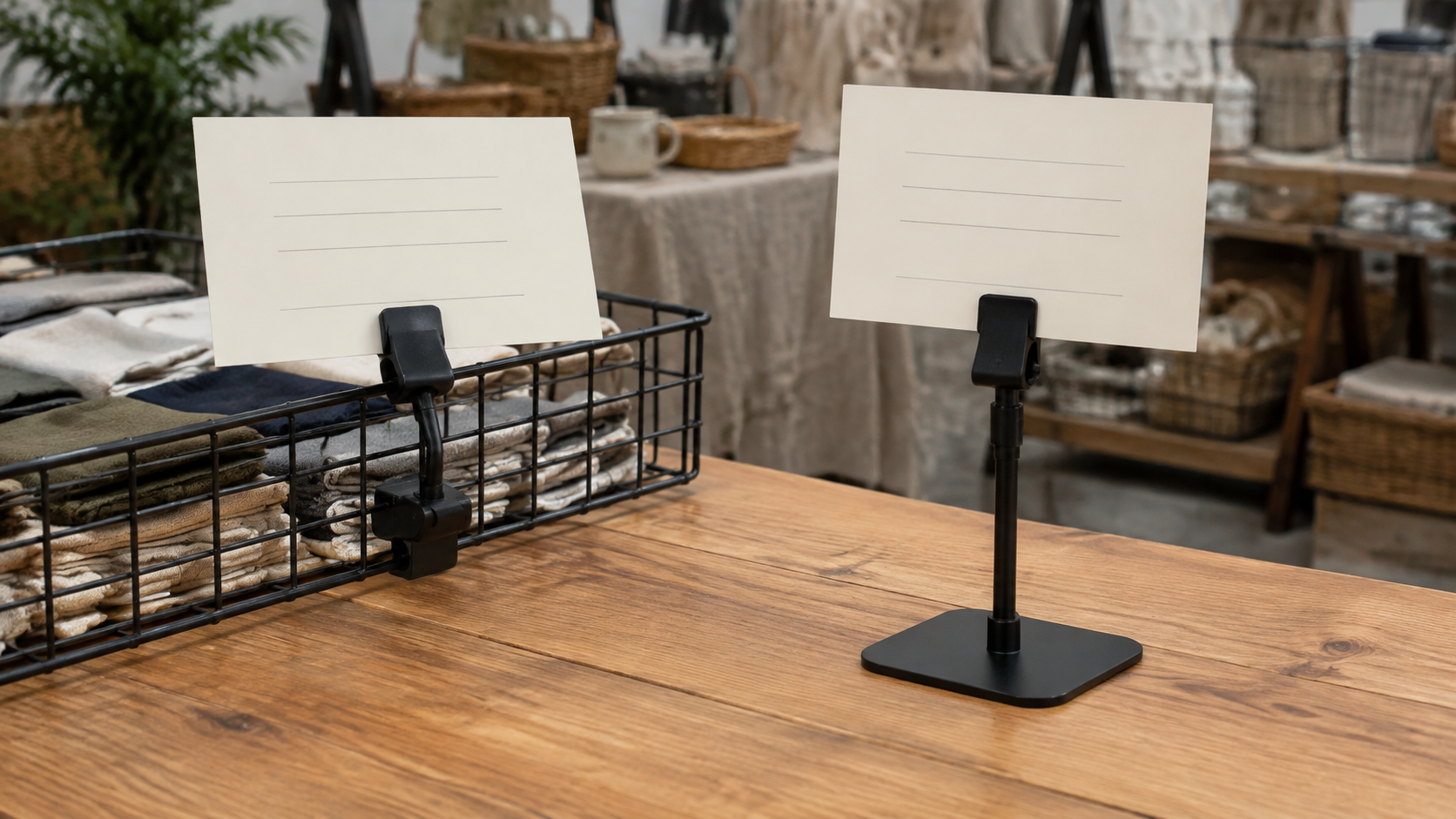
Compare both holder formats
Test the attachment and footprint with a full-size card.
Measure the card, stem, jaws, and base—not just the listed height. Mock up the longest normal message, then place it where customers approach and where the seller reaches.
The short answer
- Choose a clip-on holder when the display provides a compatible, permitted attachment edge and preserving table space matters.
- Choose a weighted base when the sign must stand independently and the surface has enough clear room for its full base and normal handling.
- Skip both when the card needs a longer sightline, the setup is repeatedly bumped, or neither format can sit clear of products, payment, service, and reach paths.
The gate: what can support the sign?
A clip needs a verified attachment
Check the jaw opening, grip surfaces, pivot, stem, and card clip against the exact basket rim, shelf edge, rack wire, or panel. A product photo showing a clip on one fixture does not establish fit on another. Avoid attaching it where the jaws can mark packaging, deform a light container, obstruct a lid, or interfere with customer access.
A base needs a reserved footprint
Measure the whole base and trace it on the table. Include the card overhang and any stem adjustment. A broad or heavy-looking base is not proof that the assembled holder will suit every card, height, or busy location; use only the maker's documented dimensions and limits, then test the complete setup in place.
Tradeoffs that change the choice
Table space and product visibility
A clip can move the support off the tabletop, but the card may still cover merchandise. A base consumes surface area yet can stand in a deliberate gap between product groups. View both from the customer side and confirm that the lower lines, products, and prices remain visible.
Height and reading angle
Compare the card center—not only total holder height—with the shopper's likely pause point. Flexible arms and pivots can help aim a card, but more joints also add setup variables. Confirm how each joint locks or holds position from current product instructions.
Contact and movement
Simulate routine stocking, browsing, bagging, and checkout without striking or grabbing the sign. A clip transfers movement from its supporting fixture; a base reacts to contact on the table. Neither format should be described as tip-proof. If ordinary use repeatedly moves the sign, choose a lower position, a shorter card, or a different display location.
Card fit and updates
Verify the card holder's usable width, thickness range, orientation, and edge overlap. Test the longest message at final size. If cards change frequently, note whether the holder can remain in place during an update or must be removed and realigned.
Packing and repeat setup
Clips can be compact but include jaws and joints that need protection from bending. Weighted bases add bulk and packed weight. Count every stem, connector, clip, base, and card, and plan a divided container that keeps matching parts together.
A seven-step booth test
- Choose the one message each holder needs to carry and print it at final size.
- Measure the card, complete holder height, clip opening, base footprint, and card overhang.
- Confirm that a candidate clip matches the real attachment geometry, or mark the weighted base on the actual surface.
- View the sign from the normal approach and check type size, angle, blocked products, and overhead-light reflections.
- Run the normal seller and customer motions around it: stocking, browsing, payment, pickup, and bagging.
- Change the card once and note which parts must be loosened, removed, or realigned.
- Pack the complete quantity with spare cards and the maker-recommended care supplies.
Skip criteria
- Skip a clip-on holder when there is no compatible attachment, the fixture moves during normal use, the jaws interfere with goods, or current specifications omit the fit details you need.
- Skip a weighted base when its marked footprint crowds merchandise, payment equipment, samples, service space, or a customer's reach path.
- Skip tall cards on either format when a full-size mockup hides products or catches routine contact.
- Skip an unverified listing when dimensions, included parts, card fit, adjustment method, or intended indoor use are unclear.
- Ask the venue before attaching hardware to supplied fixtures or placing signs in controlled paths; this guide does not determine venue, lease, accessibility, or code approval.
Choose the next step
Use the farmers-market product-sign guide when the card must identify an item or variety, and the craft-fair price-sign guide when price is the main changing message. If a freestanding holder will sit near a frequently opened indoor door, compare weighted sign bases by complete-system fit and footprint. If an exposed counter edge competes with a smooth indoor partition as the attachment point, compare a clamp-on holder with a suction-cup holder. If the sign needs to rise above the table rather than sit within the product display, compare hanging booth signs and confirm the venue's attachment rules.
For the wider message, placement, and buying-path decision, continue to the small-business sign planning pillar.
Verdict
Choose the clip when a verified edge can support the exact holder and card without sacrificing product access. Choose the weighted base when independent placement is more useful than saving tabletop area. Before buying multiples, test one full-scale setup for attachment, footprint, sightline, routine contact, card changes, and packing.