 The Good Sign Company
Indoor Portable Sign Base Guide
Best weighted sign bases for breezy indoor entryways
The best weighted base is the one documented for the complete holder and sign panel—not simply the heaviest-looking base. Near a frequently opened indoor door, compare pole or frame compatibility, full footprint, panel dimensions, floor contact, assembly, and the maker's stated limits. If ordinary door movement repeatedly shifts the assembled sign, relocate it or choose a different display system.
This guide covers portable signs fully inside a business, studio, or event entrance. It does not provide a wind rating, certify a sign as tip-proof, approve a walking-path location, or make an indoor product suitable outdoors.
Disclosure: As an Amazon Associate, we may earn from qualifying purchases and approved partner referrals.
Category starting point
Compare the assembled holder, not a base in isolation
Bring the intended sign width, height, thickness, and mounting pattern to the listing. Verify included parts, compatible pole or frame, base dimensions, total assembled dimensions, intended indoor use, and current setup instructions.
Best base formats by indoor display job
These are fit-based categories, not named winners or hands-on rankings.
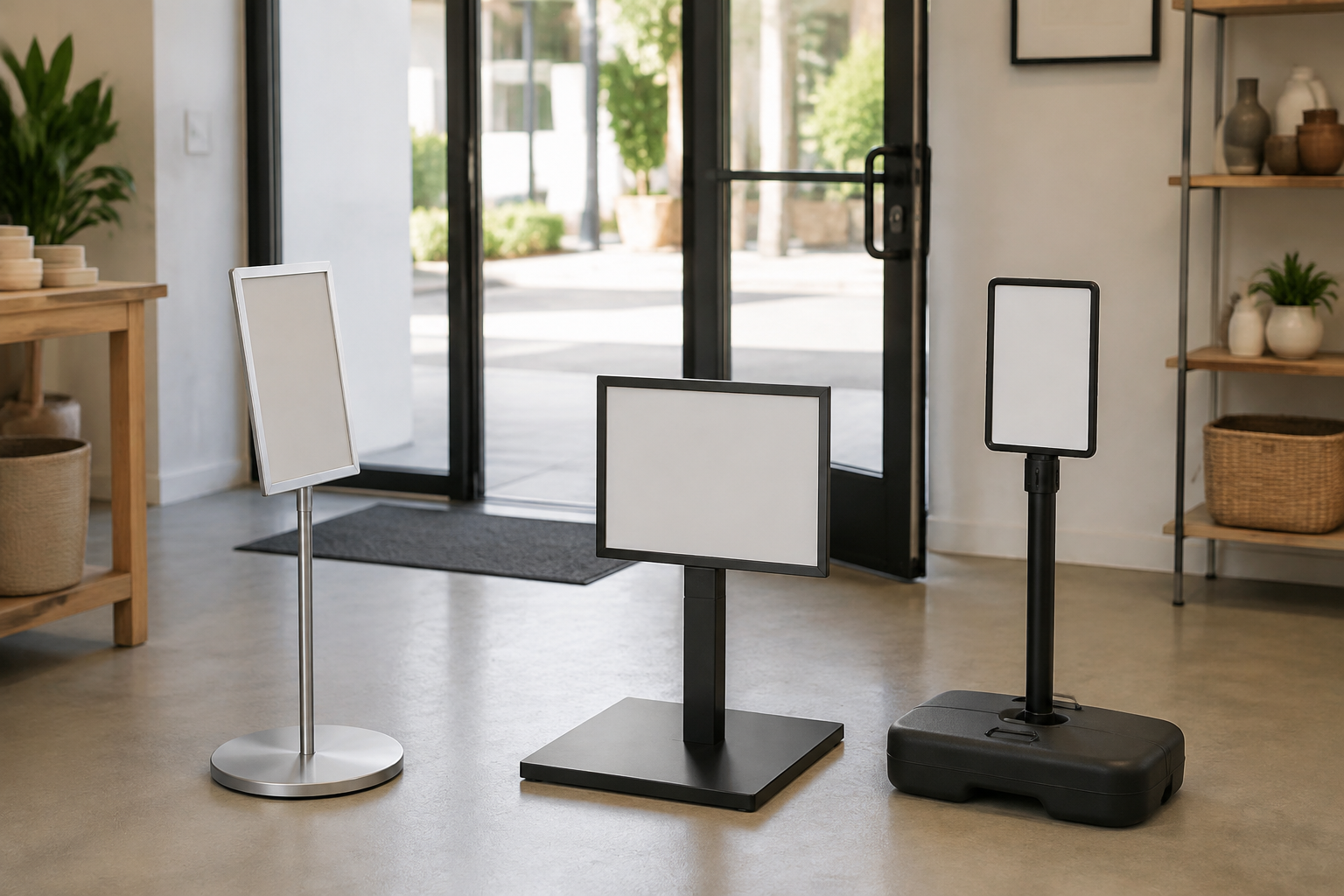
- Low-profile round bases: best for a compact, repeatable footprint. Compare the complete diameter, stem connection, panel limits, and floor-contact surface. A small footprint does not establish stability for a taller or wider sign.
- Broad rectangular bases: best when the panel orientation benefits from a wider stance. Check which way the base is meant to face, how the upright attaches, and whether the marked footprint leaves a generous route around the display.
- Fillable bases: best when setup and pack-down justify a separate filling step. Confirm the approved fill material, fill and drain method, cap, filled and empty handling instructions, and whether the complete model is intended for the indoor use you have planned.
- Integrated poster stands: best when one documented system is easier to verify. A matched base, upright, and frame can reduce compatibility guesswork. Verify insert size, overall height, orientation, loading method, and every included component.
Seven checks before buying
- Map the doorway effect. Place a paper or cardboard mockup well inside the entrance and observe it through several normal door cycles at the busiest relevant time.
- Measure the complete sign. Record panel width, height, thickness, attachment pattern, upright height, base footprint, and any panel overhang.
- Verify compatibility. Treat a base, pole, frame, and panel as a system. Do not assume matching thread labels, pole diameters, or product photos establish fit.
- Read documented limits. Look for the manufacturer's panel-size, assembled-height, weight, orientation, and indoor-use guidance. Skip a listing that omits information needed for your setup.
- Inspect the floor contact. Check the specified feet or pads, floor condition, thresholds, mats, slopes, and cleaning routine. Do not improvise friction claims.
- Reserve the whole footprint. Mark the base and panel projection on the floor, then keep it out of the door swing and ordinary customer, staff, delivery, and cleaning paths.
- Test one complete unit. Assemble one candidate exactly as instructed, insert the real sign, run normal door and work routines, and reassess placement before buying multiples.
What “weighted” does—and does not—tell you
“Weighted base” describes a product feature, not the performance of every possible assembly. A taller upright, larger panel, offset attachment, floor condition, or frequent contact can change how the system behaves. Compare only current documented specifications for the complete model, and avoid substituting an unlisted sign panel.
If airflow is noticeable at the preferred location, moving the sign farther from the door is often the cleanest first test. A wall-mounted notice, window message, lower counter sign, or sign attached to a compatible indoor fixture may remove the freestanding-base decision entirely.
Who should skip this category
- Skip a freestanding sign when its complete marked footprint narrows or complicates the normal route through the entrance.
- Skip an unverified base-and-pole combination when the connection, panel fit, or documented limits are unclear.
- Skip a tall panel when a lower message at a counter or wall remains readable for the actual approach.
- Skip the proposed location when routine door movement, stocking, deliveries, cleaning, or customer contact repeatedly moves the test setup.
- Skip general indoor products for exterior, emergency, accessibility, electrical, or other regulated sign duties; confirm those requirements with the responsible authority or qualified provider.
Related choices
If a rack, shelf, basket, or permitted counter edge can support the sign, compare a clip-on holder with a weighted base. For a full-height indoor directional insert, consider whether a floor sign stand is worth its footprint. Continue with the small-business sign planning guide to match the display to its message and sightline.
The practical bottom line
Start by moving the sign farther inside, then compare only complete holder systems with enough documentation to match the intended panel. The right base earns its space by fitting the pole or frame, preserving a clear route, and remaining practical through observed door, customer, and cleaning routines—without relying on an unsupported wind or stability promise.