 The Good Sign Company
Worth-it decision
Is a floor sign stand worth it for an indoor event?
A floor sign stand is worth it when guests must see a short message before they reach a table and the venue can confirm a suitable place for the complete base. Borrow or rent when the need is occasional. Use a tabletop sign when people already stop at a staffed surface. Delay buying until you know the insert size, approach path, packed dimensions, and who will transport and set up the stand.
This is an ownership and format decision, not venue approval or a finding that a stand is appropriate for every route. If you already need several arrows, use the small-event directional sign guide. If the display should be a decorative welcome panel, compare floor easels for welcome signs.
Disclosure: As an Amazon Associate, we may earn from qualifying purchases and approved partner referrals.
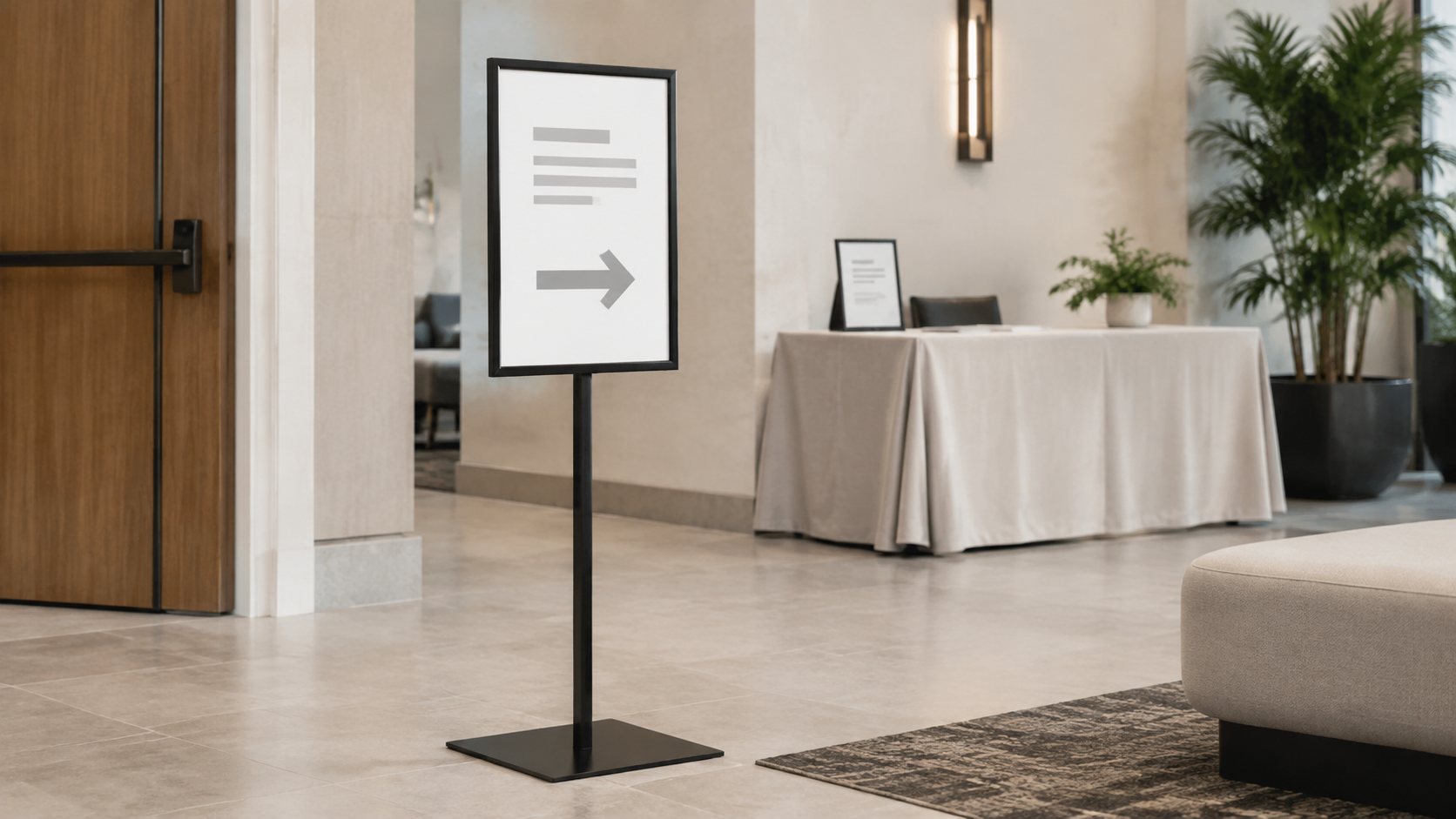
Compare stands only after measuring the route
Check the listed insert orientation and visible area, overall height, base dimensions, product weight, assembly, packed size, and manufacturer indoor-use instructions. The display face and support are one footprint.
Quick verdict: buy, borrow, skip, or use tabletop
- Buy: recurring indoor events use a compatible insert, the placement is confirmed, and you can store and transport the stand.
- Borrow or rent: the event is occasional, the venue has compatible stands, or the required format varies by location.
- Skip: there is no clear approach sightline, no suitable approved base location, or no setup and retrieval owner.
- Use tabletop: guests already reach a staffed check-in, gift, information, or registration table before they need the message.
The distance test comes before the product search
Walk the guest route from the entrance toward the first decision point. Mark where the message must become readable and the last place it can still change a guest's direction. A floor stand can lift a message above low furniture, but height does not rescue small type, weak contrast, glare, or a stand hidden behind people.
- Write one destination or action and one arrow only if a direction is needed.
- Print a rough insert at the planned size and mount it on cardboard at the listed display height.
- View it from each real approach under event-time lighting.
- Mark the complete base footprint on paper; place the mockup only with venue permission.
- Ask the venue to confirm the location and setup restrictions rather than assuming an open patch of floor is available.
Floor stand vs tabletop sign
Choose a floor stand when the message must work before a guest reaches furniture, the intended sightline is farther away, or a table would sit in the wrong place. Choose a tabletop sign when guests naturally pause at check-in, the message is close-view, and the table has measured clear space. A sign beside a volunteer can rely on that person to clarify details; an unattended floor sign needs a shorter, more self-contained message.
For the close-view option, compare a paper table tent with an acrylic holder. For a portable sign face that may sit on a counter or rack, the clip-on holder vs weighted-base guide separates attachment fit from tabletop footprint.
Costs beyond the stand itself
- Inserts: verify the exact visible opening, orientation, thickness range, and loading method before printing.
- Transport: compare the longest packed component with the vehicle, cart, elevator, stairs, and storage used in the real workflow.
- Setup: identify every assembly step and keep the maker's instructions and required parts with the stand.
- Storage: reserve a dry indoor location where the face, hardware, and base will not become separated.
- Updates: keep dates, room names, and arrows in replaceable inserts when those details change.
- Retrieval: name the person who checks, collects, and packs the stand after the event.
When borrowing is the better answer
Ask the venue or organizer whether stands are available and request the current insert opening, orientation, visible area, pickup procedure, and setup rules. Borrowing removes a storage problem but can create a late fit problem if artwork is prepared from a nominal paper size instead of the actual holder. Make the insert only after the stand is identified.
Renting can make sense when you need multiple matching supports once, provided the current rental terms, pickup window, packed dimensions, assembly responsibility, and return process fit the event plan. This article does not estimate pricing or availability; compare local terms directly.
Red flags before ordering
- The listing shows poster size but omits visible area, complete base dimensions, or overall product weight.
- You chose a stand before the venue confirmed where it may be placed.
- The copy is a schedule or paragraph that cannot be scanned from the approach.
- The insert changes often, but the holder is slow to open or needs tools you will not bring.
- The assembled stand fits the room, but the packed parts do not fit the transport or storage plan.
- No one is responsible for setup, periodic checks, and retrieval.
Indoor scope and venue review
Use a floor stand only within the maker's stated conditions. Ask the venue about placement, guest flow, accessibility routes, emergency information, and site-specific requirements. Do not infer permission, egress suitability, tip resistance, or accessibility from a product photo, base shape, or marketing label. Outdoor and windy conditions require a separate product- and site-specific decision.
Bottom line
A floor sign stand is worth owning when repeated indoor events create the same early sightline problem and the stand has a confirmed footprint, compatible insert, transport plan, storage location, and setup owner. Borrow or rent for a one-off need. Stay tabletop when guests already stop at the message. Before spending, mock up both the face and base, walk the route, and verify current product instructions and venue rules.
Next, map the route with the small-event directional sign guide, compare a floor easel with an insert-based poster stand, browse floor easels for decorative welcome signs, or choose a close-view format with the tabletop sign comparison.