 The Good Sign Company
Indoor product-label holder comparison
Card spike vs clip sign holder: which fits the display you already use?
Choose a card spike only when the product arrangement or display has a suitable place for its stem and the maker's instructions support that use. Choose a clip when a measured basket, tray, shelf, or fixture edge gives the jaw a compatible grip. If neither attachment is verified, use a freestanding holder instead.
This comparison is for lightweight indoor product-name, variety, and price cards. It does not establish food-contact suitability, holding capacity, or safe use in aisles, overhead positions, or other public-placement conditions.
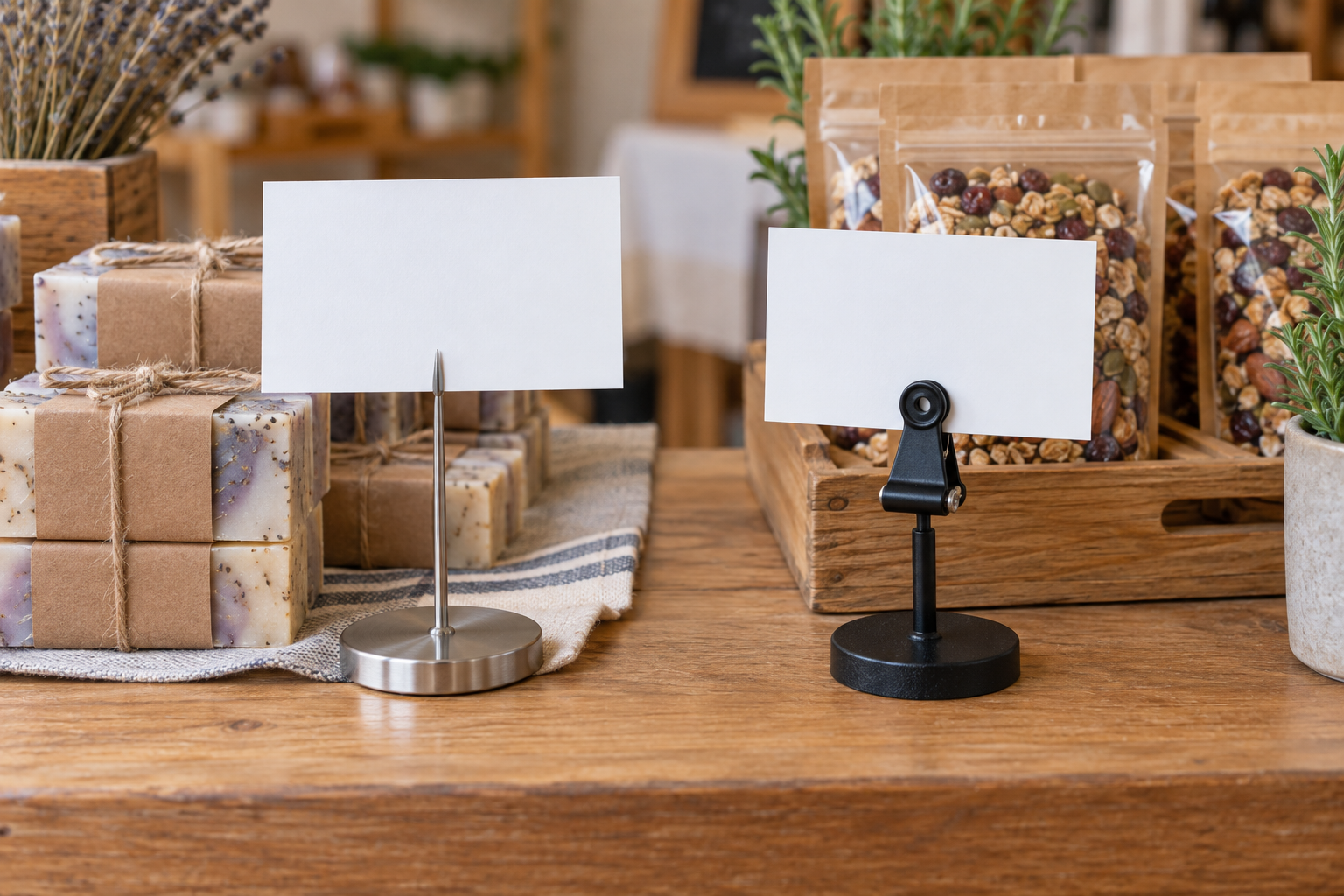
Compare the attachment before the finish
Check current listings for the intended use, complete dimensions, card capacity, spike or jaw geometry, adjustment points, included guards or bases, and setup instructions. Do not infer fit from photos alone.
Quick comparison
| Decision | Card spike holder | Clip sign holder |
|---|---|---|
| Required host | A maker-approved material, base, or arrangement that accepts the stem | A measured edge or rail within the stated jaw range |
| Counter footprint | May avoid a separate base when the host is compatible | May avoid a separate base when a compatible edge exists |
| Repositioning | Requires removing and reinserting the stem | Requires opening and reseating the jaw |
| Main fit check | Stem length, insertion point, card height, and any supplied guard | Jaw opening, jaw depth, contact surface, edge shape, and card support |
| Skip when | No approved insertion point exists | No permitted edge matches the jaw geometry |
Choose a card spike when the host is part of the plan
A spike can position a small label close to a grouped indoor display without adding a freestanding base. That only helps when the specific holder is intended for the host you plan to use. Check the stem dimensions, insertion guidance, card attachment, finished label height, and whether a protective part is supplied for storage or transport.
Do not push a generic spike into merchandise, packaging, food, finished furniture, or an improvised surface merely because it appears penetrable. The current manufacturer's instructions—not the product name—should define appropriate use. If the intended insertion point is ambiguous, skip this format.
Choose a clip when the fixture provides a compatible edge
A clip makes more sense when a basket rim, tray, shelf, or display component offers a permitted gripping point. Measure that point at its thickest section and note curves, seams, lips, liners, coatings, and nearby merchandise. Compare those measurements with the stated jaw opening and jaw depth.
Inspect the contact surfaces before placing a clip on a finished fixture. Teeth, narrow edges, or concentrated pressure may leave marks. A pad shown in a photo may not be included, and a larger jaw does not establish greater holding ability. If the clip route is clear but the jaw style is not, use the spring clip vs alligator clip comparison.
Test the label as a complete display
- Print the real card. Use the final dimensions, orientation, stock, finish, and longest routine message.
- Map the attachment point. Record the host material and dimensions, then confirm the listing describes a compatible use.
- Assemble one holder. Follow the current instructions without forcing, bending, or improvising the attachment.
- Set the viewing angle. Check readability from the customer approach and make sure hardware does not cover the message or merchandise.
- Change the card and location once. Note setup time, alignment, marks, loose parts, and whether the arrangement still fits the selling routine.
- Plan packing. Separate pointed or clamping hardware from printed cards and other display finishes.
Who should skip both
- The label is heavy, tall, powered, valuable, or outside the holder's documented use.
- The display offers neither a maker-approved insertion point nor a measured, permitted gripping edge.
- The holder would sit overhead, outdoors, in an active aisle, or where customers repeatedly contact it; generic indoor label holders do not establish suitability for those conditions.
- The card needs broad face support, protection, or its own stable tabletop position; compare an acrylic card holder with a wire card stand.
- The attachment would damage packaging, merchandise, a finished fixture, or the printed card.
Bottom line
A card spike is the better candidate only when the intended host and instructions clearly support insertion. A clip is the better candidate only when its jaw matches a permitted edge without covering the label or harming the fixture. When neither interface is clear, choose a freestanding holder and accept the extra footprint.
Continue with the small-business sign planning pillar, the farmers-market product sign guide, or the clip-on holder vs weighted-base comparison.