 The Good Sign Company
One-day indoor event decision
Is a foam board sign worth it for a one-day indoor event?
A printed foam board can be worth it when one freestanding message must look deliberate, read from several steps away, and arrive ready to place. It is usually unnecessary when a paper insert in an existing frame, a venue-provided holder, or a small tabletop notice can do the same job.
Disclosure: As an Amazon Associate, we may earn from qualifying purchases and approved partner referrals.
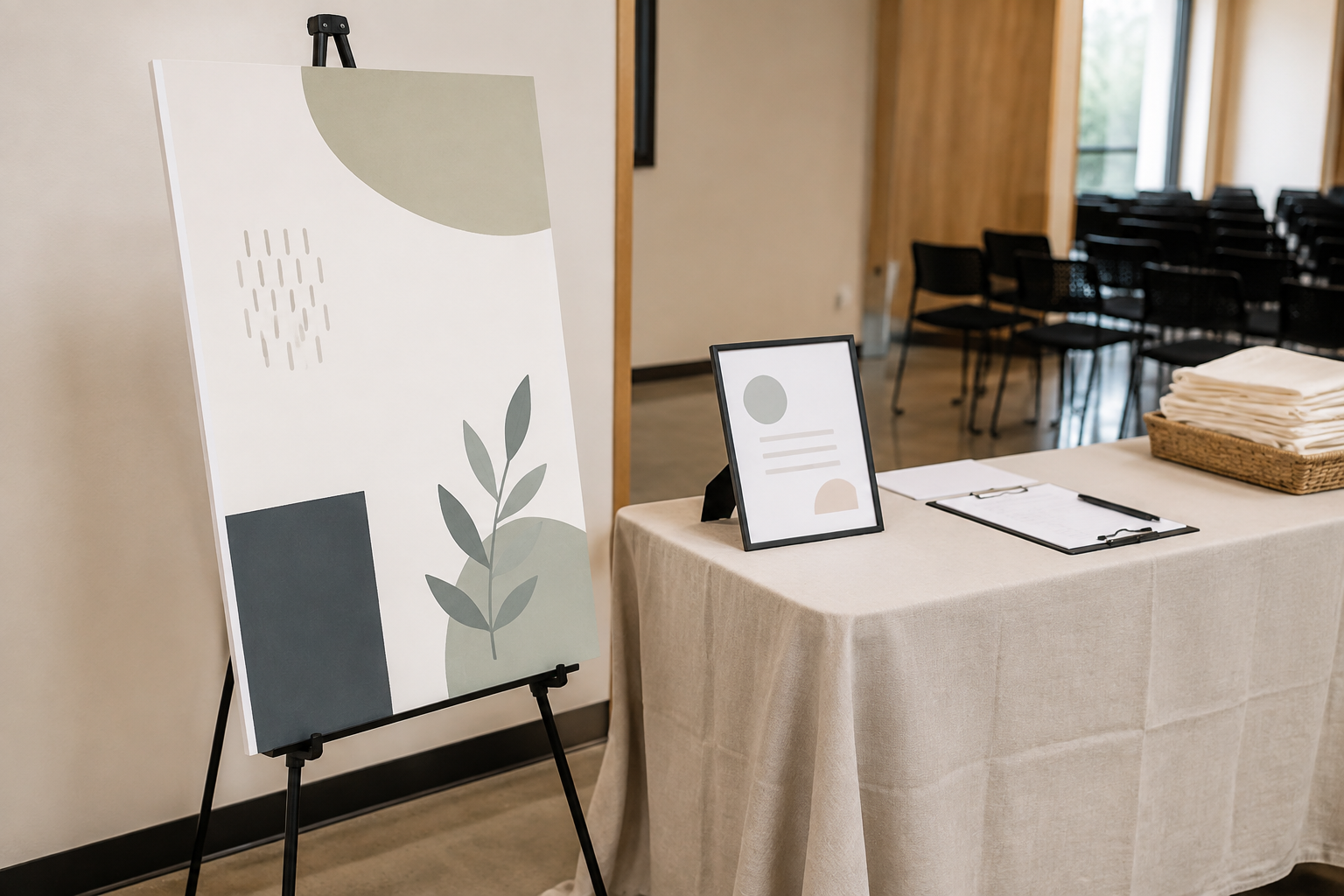
Start with the complete display, not the board alone
Measure the intended board and confirm that the chosen support accepts its width, height, thickness, and weight. Product instructions—not the event photo—should decide compatibility and setup.
Quick verdict
- It is more likely worth it when the message guides many arrivals, needs a clear freestanding presence, and will not fit comfortably in a small frame.
- It is less likely worth it when the sign repeats information a staffed table already communicates or when a printer-and-frame setup is available.
- It becomes a poor rush purchase when the wording, final dimensions, print cutoff, support, or transport route is still unresolved.
- It should be skipped if the venue has not approved the placement or the display would interfere with circulation.
The five-question worth-it test
| Question | A foam board earns its place when… | Choose a simpler display when… |
|---|---|---|
| What job does it do? | It marks an arrival point, schedule, room, or photo area that guests must recognize without asking. | It is decorative filler or duplicates a person, screen, or existing venue sign. |
| How far away is the decision? | The sign needs more face area than a small tabletop frame provides. | The reader is already standing at a staffed counter or seated at the table. |
| Is the message settled? | Names, time, arrows, and wording have been approved before the printer's stated cutoff. | Late changes are likely and an insert can be reprinted locally. |
| Does the support fit? | The finished board matches the stand maker's documented fit and setup guidance. | The easel, ledge, frame, or tabletop footprint remains a guess. |
| What happens afterward? | The board will be kept as a display or memento, or its one-day communication value is sufficient. | A reusable frame, letter board, or replaceable insert will serve future events better. |
Decide the message job before choosing a size
Write one sentence describing what the sign must make a guest do: stop here, enter here, check in here, find this room, or recognize this table. If the answer is only “make the setup feel finished,” test a smaller framed print first. A rigid board is easiest to justify when it reduces uncertainty at a real decision point.
Make a full-size paper mockup or tape an outline where the board would sit. Walk back to the point where a guest first needs the message. Check whether the main line wins the first glance and whether the stand keeps the important copy above table linens, flowers, or people.
Confirm printing and support as two separate deadlines
Ask the printer for current artwork requirements, finished dimensions and thickness options, proofing steps, and the order cutoff without treating a quoted timeline as guaranteed. Then verify the display separately. Record the stand's accepted panel dimensions, ledge depth, retention method, setup instructions, and placement guidance.
A floor setup needs a different footprint from a small counter display. Compare floor easels for welcome signs or tabletop foam board stands before ordering the panel.
Plan the trip from printer to event
- Measure the vehicle opening, doors, elevator, stairs, and storage spot along the route.
- Keep the printed face and corners separated from easel hardware and other cargo.
- Assign one person to receive, inspect, carry, place, and retrieve the sign.
- Bring the printer's care guidance and the stand instructions rather than improvising with tape or extra hardware.
- Recheck placement with the venue, including walking clearance and the event's actual room layout.
When a framed paper insert is the better buy
Paper in a reusable frame is often the more flexible answer for a small schedule, menu, check-in instruction, QR destination, or frequently changing name. It can be revised without replacing a whole rigid panel, and the frame can return for another event. The tradeoff is smaller visual presence and dependence on the frame's viewing angle, cover glare, and tabletop space.
A digital screen may suit information that changes during the day, while a changeable letter board can suit short recurring messages. Neither alternative removes the need to test legibility and placement.
Foam board versus a reusable rigid sign
This worth-it decision asks whether the event needs a rigid printed board at all. If the answer is yes and material choice is still open, continue to the separate foam board versus acrylic event-sign comparison. That guide covers presentation, glare, handling, and reuse rather than repeating the one-day buy-or-skip threshold here.
Who should skip it?
- Skip it when the board has no specific communication job or duplicates a staffed welcome point.
- Skip it when wording can change after the print cutoff; use a replaceable insert instead.
- Skip it when no verified support fits the finished board or nobody owns transport and setup.
- Skip it when placement could obstruct the route or conflict with venue instructions.
- Keep this guide to indoor event planning; it is not advice about outdoor exposure, accessibility, egress, fire rules, or code compliance.
The bottom line
A foam board sign is worth buying for one indoor event when it solves an arrival or wayfinding problem that a smaller insert cannot, and when the artwork, print timing, support, transport, and placement are all settled. If the message is small, changeable, or already explained by staff, reuse a frame and spend the setup effort elsewhere.