 The Good Sign Company
Indoor event-sign comparison
Printed foam board vs acrylic: which event sign fits?
Choose printed foam board when low carry weight, a short message life, and easy replacement matter most. Choose acrylic when the clear or polished material is part of the presentation and the sign has a realistic reuse plan. Neither choice is complete until the panel, stand, route through the venue, and storage method work together.
Disclosure: this page includes an approved partner link. We may earn from qualifying referrals.
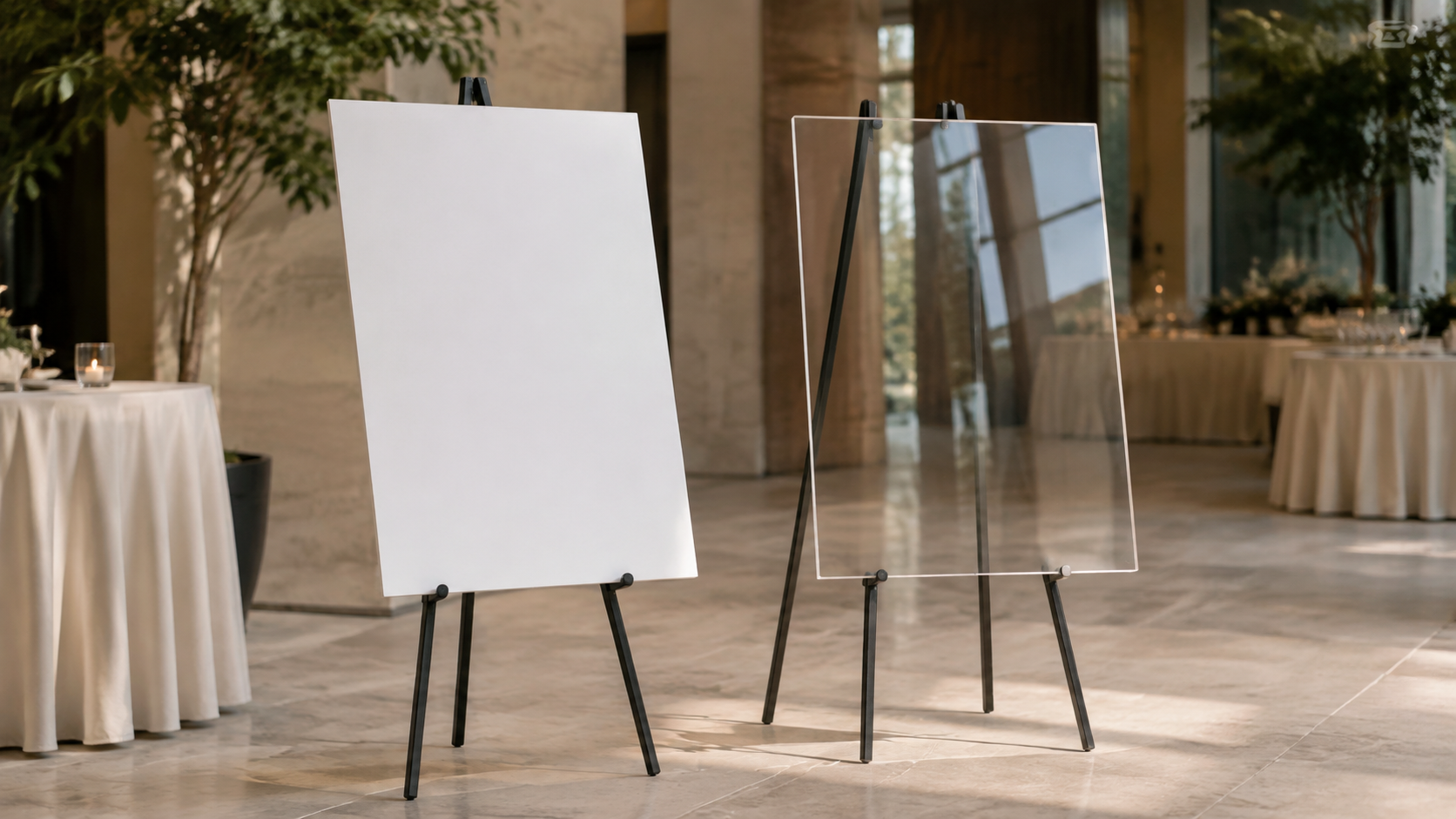
Start with the message life and display plan
Send the exact wording, finished dimensions, venue photos, expected reuse, stand details, and storage constraints when discussing a custom sign. Ask the maker to identify the proposed construction, finished weight, artwork proof, care guidance, and compatible support rather than assuming those details from the material name.
Quick decision
- Lean toward printed foam board for one event or a frequently changing message, especially when staff must carry several signs and the design benefits from an opaque white background.
- Lean toward acrylic when the material itself supports the visual concept, the wording is stable enough to reuse, and protected transport and storage are already planned.
- Use a temporary mockup first when size, contrast, glare, stand fit, or the arrival sightline is uncertain.
- Skip both when a framed paper insert, reusable letter board, or venue-provided display solves the message with less handling.
The practical differences
| Decision | Printed foam board | Acrylic sign |
|---|---|---|
| Background | Usually supplies an opaque field, making the layout less dependent on the room behind it. | Clear faces allow the venue background to show through; printed, frosted, or backed areas change that effect. |
| Handling | Often chosen for lightweight portable graphics, but corners and faces still need protection. | A rigid panel can be awkward to carry; its surface, edges, holes, and applied graphics need a handling plan. |
| Glare | Surface finish still matters, but the opaque face can be tested as one controlled background. | Reflections and whatever sits behind a clear panel can compete with fine or pale lettering. |
| Support | The stand must support the panel height and width without bending or hiding important copy. | The support must match the actual panel dimensions, weight, edge or hole arrangement, and maker guidance. |
| Reuse | Useful when the entire printed message can return unchanged; replacement is straightforward when it cannot. | Reuse is strongest when wording, event identity, and storage conditions stay consistent. |
Compare the message before the material
Separate permanent information from variable details. A welcome phrase or family name may return, while dates, room names, schedules, arrows, and sponsor lists often change. If most of the face will be obsolete after one event, a reusable acrylic panel may lock too much changing information into a finished object.
Before comparing materials for a short-lived message, use the one-day foam board worth-it test to decide whether the event needs a rigid printed panel at all. A reusable frame or holder with a paper insert may be enough. For small directional messages, start with the small-event directional-sign guide.
Test readability in the real venue background
- Print the layout at intended size, including its longest line and smallest important text.
- Photograph the sign position from the point where a guest first needs the message.
- Place the mockup against the likely background. For a clear panel, include the actual wall, doorway, plants, people, and lighting behind it.
- Check the view during the event's lighting conditions and from a slight angle, not only straight on.
- Remove decorative copy until the main instruction or welcome message wins the first glance.
Confirm stand fit as one system
Do not buy a panel and easel as separate visual choices. Record the panel's finished width, height, thickness, weight, lower-edge clearance, and any holes or edge-sensitive details. Then compare those facts with the stand maker's supported dimensions, ledge depth, restraint method, setup instructions, and placement guidance.
For a large welcome panel, use the floor-easel guide. For a compact foam board on a table, compare tabletop foam-board stands. Venue rules and the actual traffic route should control final placement.
Plan transport, cleaning, and storage
- Route: measure doors, elevators, vehicle openings, stairs, and the packed sign—not only the display space.
- Separation: keep sign faces away from stand hardware and other panels. Use the event-sign storage-bag guide to plan measured compartments rather than guessing fit.
- Surface care: request care instructions for the completed sign, including its print, applied graphics, coating, and edges. General advice for a raw material may not fit the finished piece.
- Ownership: decide who checks the artwork, carries the sign, sets it up, wipes it, retrieves it, and stores it after the event.
Who should skip each option?
- Skip foam board when the approved display requires a different panel construction, when the stand cannot support its dimensions, or when repeated handling would make a more protected insert system more sensible.
- Skip clear acrylic when the background stays busy, glare defeats contrast, the wording is likely to change, or nobody can provide protected storage.
- Skip a floor display when it would narrow circulation or conflict with venue placement rules; move the message to a wall, counter, or staffed point instead.
- Skip treating this indoor-event comparison as outdoor, structural, accessibility, fire, egress, or code guidance. Those questions require venue and project-specific review.
The bottom line
Foam board is the practical default for a short-lived printed message that must travel lightly. Acrylic earns the extra handling only when its material look matters and the message will stay useful. Mock up both against the venue background, confirm the complete panel-and-stand fit, and price the transport and storage routine—not just the sign face.