 The Good Sign Company
Counter-Sign Production Decision
Is a paper trimmer worth it for counter-sign inserts?
A paper trimmer is worth considering when a team repeatedly turns larger compatible sheets into the same measured counter-sign inserts and has a controlled place to do the work. Delay until the holder and finished size are stable. Skip it when full sheets already fit, updates are rare, or a print provider can deliver finished inserts with less staff effort.
Start with the small-business sign planning pillar if the message, update cadence, or holder is still changing. This page decides whether to own the tool; the separate buying guide helps compare trimmer formats after ownership makes sense.
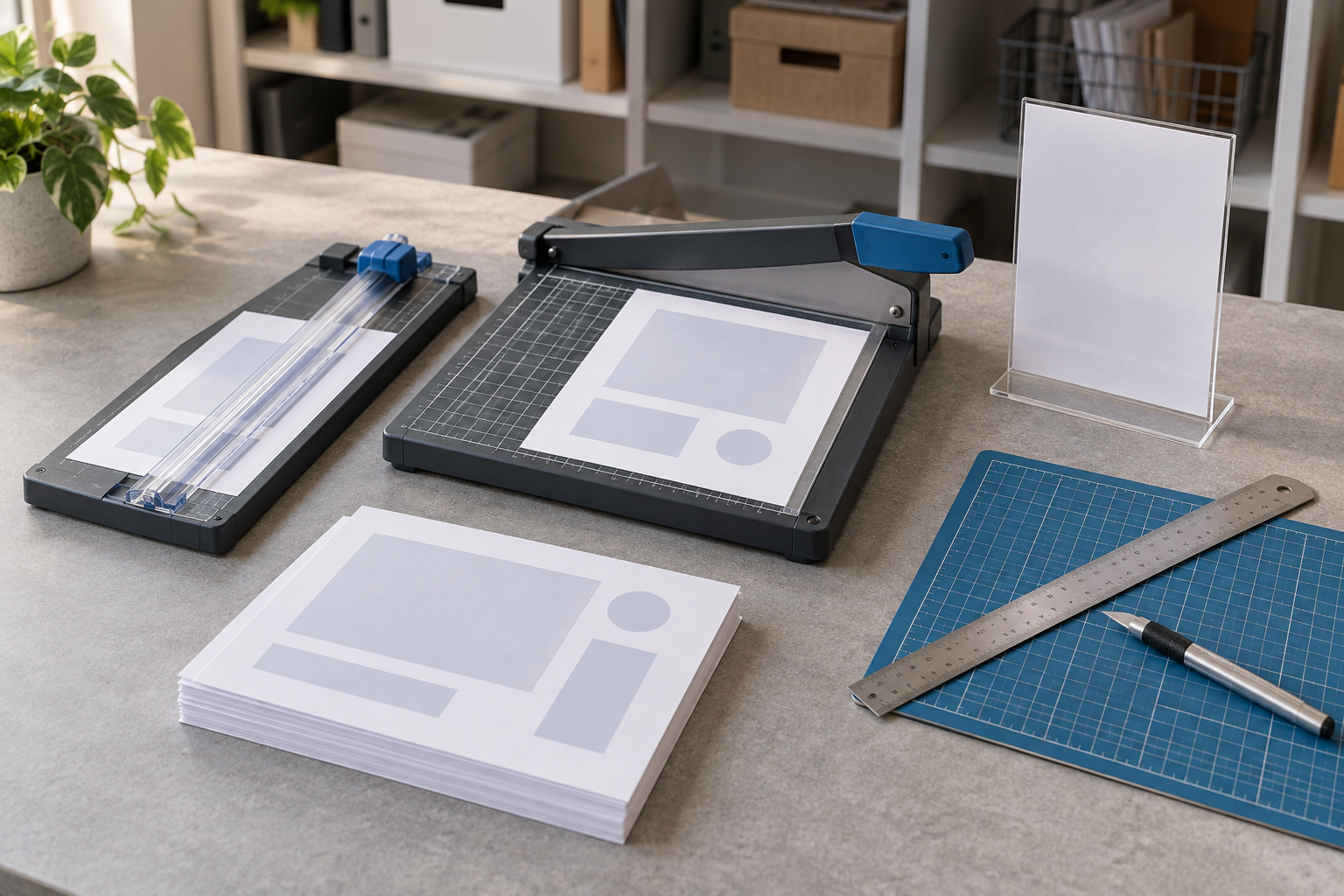
Compare trimmers only after proving the workflow
Make one full-size insert template, count recent cutting jobs, and check the exact product's supported media, dimensions, documented capacity, guides, blade or cutting mechanism, complete working footprint, storage controls, and current instructions.
The short answer: buy, delay, skip, or outsource
| Decision | When it fits | Next step |
|---|---|---|
| Buy | You make recurring compatible inserts in stable sizes and can give the tool a defined work and storage area. | Trial the exact paper or cardstock and inspect the finished sheet in its holder. |
| Delay | The holder, source material, finished dimensions, or update volume is still changing. | Use provider-cut sheets or a paper template while recording actual jobs. |
| Skip | Standard sheets fit, updates are occasional, or the proposed material is outside documented tool support. | Put the budget toward clearer artwork, a reusable holder, or correctly sized printing. |
| Outsource | You need infrequent batches, several unusual sizes, or finishing beyond the team's repeatable workflow. | Give the provider written finished dimensions and inspect one sample. |
Six criteria that decide the purchase
- Actual cut volume: count sheets trimmed in recent months and forecast known updates instead of relying on a vague future plan.
- Stable finished sizes: record the holder opening, visible area, and target insert dimensions. Constantly changing formats weaken the case for an in-house jig or guide setup.
- Supported media: compare the complete paper or cardstock with current manufacturer instructions. A paper trimmer is not a route for acrylic, metal, rigid plastic, or other unsupported sign material.
- Repeatable alignment: check whether the guides and scales support the needed measurement without placing critical text, borders, or QR-code clear space near the cut.
- Working and stored footprint: measure the tool both in use and put away, including moving arms, source sheets, finished-sheet stacking, and access around the workstation.
- Named ownership: decide who operates it, checks the first insert, handles scraps, stores it, and follows replacement-part and maintenance guidance.
Cost, setup, and maintenance tradeoffs
Compare the current purchase price and supplies with the whole workflow: staff setup time, test sheets, rejected cuts, workspace, cleanup, storage, and replacement parts. Do not justify the tool with an assumed sales increase. A provider may charge more per finished insert yet remain the better value when updates are rare or staff time is constrained.
Setup starts with the final holder—not the trimmer listing. Make the artwork at the correct size, mark one test sheet, follow the product's current operating instructions, and check the finished insert in the actual display. Keep guides and the cutting area clean as directed, follow documented blade or cutter replacement procedures, and stop using damaged or misaligning equipment.
Red flags and who should skip
- The listing does not state supported sheet sizes, materials, capacity, or operating instructions.
- The team plans to cut rigid sign material or another medium not covered by the maker's guidance.
- No one owns the template, quality check, scrap cleanup, storage, or maintenance routine.
- The counter holder already accepts a standard untrimmed sheet.
- Most signs are one-offs with different finished dimensions.
- The tool would be operated on a customer counter or another uncontrolled work surface.
- The buying case depends on promises of perfectly repeatable cuts or business results.
Choose an alternative by the constraint
- Very low volume: order finished-size inserts from a print provider or use its trimming service.
- Standard paper already fits: print from a locked template and use the full sheet.
- Messages change frequently: compare a printed insert with a dry-erase counter sign before investing in a cutting workflow.
- Protection is the real problem: choose a reusable clear sleeve or compatible holder rather than adding a finishing tool.
- Printed stock is unsettled: choose cardstock for the measured holder and documented printer limits first.
A low-cost proof before buying
- List the inserts produced during the last two or three update cycles.
- Record each source sheet, finished width and height, material, holder, and number of copies.
- Remove jobs that already use standard sheets or arrive cut by a provider.
- For the remaining jobs, create one full-size paper template and test it in the holder.
- Measure the available operating and storage space and name the responsible operator.
- Buy only when recurring compatible cuts remain and a current product explicitly supports the workflow.
Bottom line
Buy when the same compatible inserts recur, measurements are stable, and the team can own setup, checking, cleanup, storage, and maintenance. Delay while the sign system is changing. Skip or outsource when standard sheets work, volume is low, formats vary, or documented material support is missing.