 The Good Sign Company
Small tabletop support comparison
Mini easel vs wood slot stand: which fits a small sign?
Choose a mini easel when the card benefits from a visible display angle and the table has room for an open rear leg. Choose a wood slot stand when a known card thickness fits the slot and a low, compact base suits the layout. Neither format is automatically more stable: the finished card, contact geometry, footprint, and table activity decide the fit.
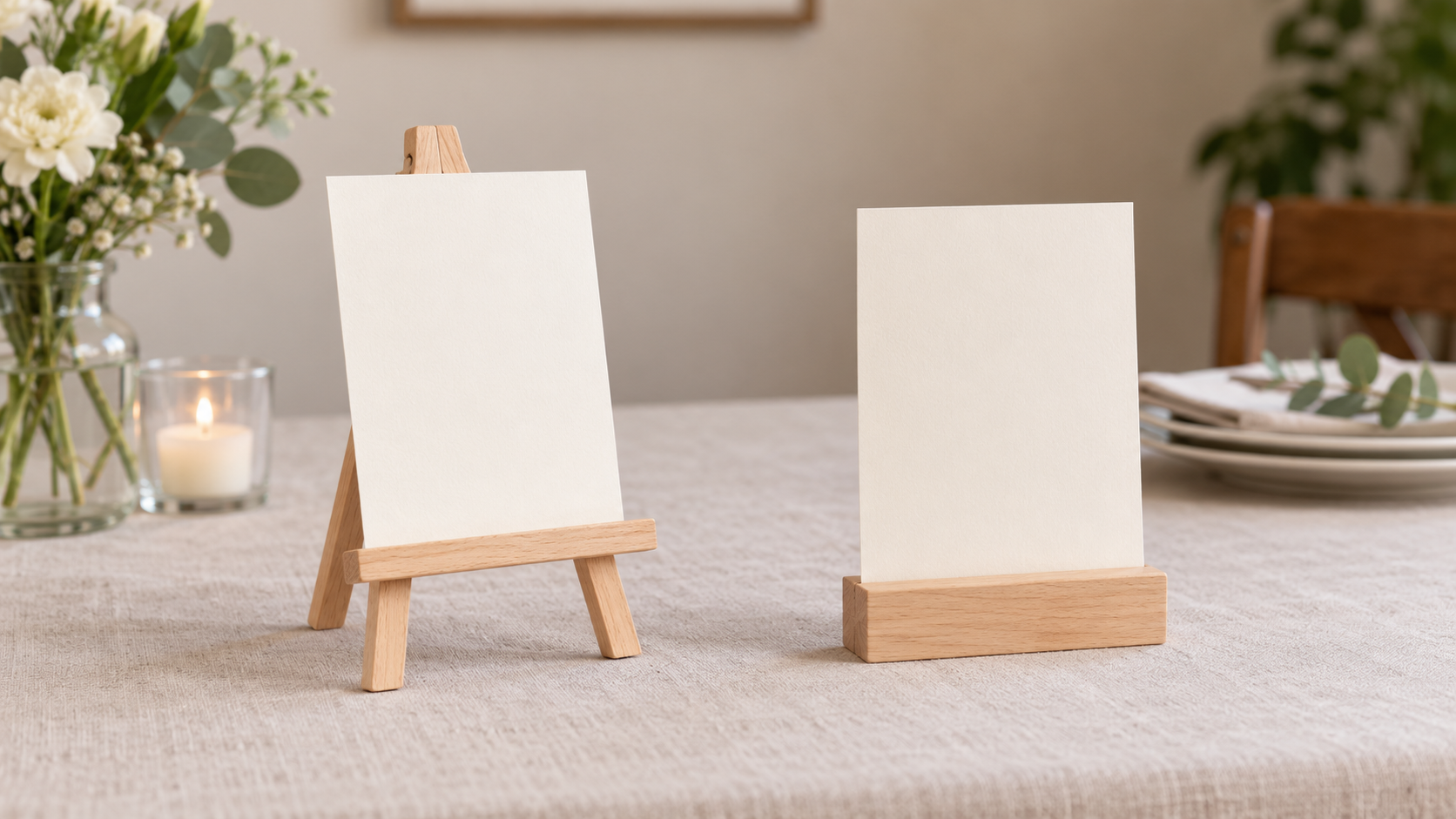
Compare both supports against one finished card
Measure the card after printing, backing, lamination, or decoration. Verify complete dimensions, card-thickness guidance, contact points, open footprint, viewing angle, package quantity, and intended indoor use.
Quick decision
- Lean toward a mini easel when several card sizes may rotate, the angle helps the sightline, and the rear-leg footprint fits.
- Lean toward a wood slot stand when one stiff card thickness is known, a low base fits the visual plan, and compact setup matters.
- Test one complete sample before ordering for several tables. Category names do not establish usable ledge, slot, angle, or stability.
- Skip both when the message needs edge-to-edge support, frequent sheet changes, a higher sightline, or outdoor placement.
Mini easel vs wood slot stand at a glance
| Decision | Mini easel | Wood slot stand |
|---|---|---|
| Support | A front ledge and upper support carry the card while a rear leg establishes the stance. | A narrow channel grips or cradles the card along its bottom edge. |
| Fit variable | Ledge depth, front-lip height, support height, and card dimensions. | Slot width, slot depth, card thickness, and bottom-edge condition. |
| Footprint | Open front-to-back depth can exceed the folded size. | Usually concentrated in the solid base, but exact depth and length still matter. |
| Updates | May accept varying cards if the documented ledge and support geometry fit. | Fast to load, but thickness changes can loosen the fit or prevent insertion. |
| Packing | A folding model may pack flat; hinges and cards still need protection. | The solid base remains compact while the card normally packs separately. |
Who each format fits
A mini easel fits when
- The sign is a stiff card or small rigid panel supported by the listed ledge.
- The display angle improves close-range reading from the normal approach.
- The table has enough depth for the fully opened stance.
- The visible support suits the presentation.
A wood slot stand fits when
- The finished card thickness matches the seller's slot guidance.
- A low base leaves enough card visible and simplifies the table composition.
- The card will not change to a materially different construction during use.
- Staff benefit from a support with no hinge or rear leg to open.
Setup tradeoffs to test before buying
Start with the longest real message and the finished card, not a blank paper size. Keep important copy above an easel's front lip and above the depth seated in a slot. A QR code or final line near the bottom edge may become partly hidden even when the outer dimensions fit.
Mark each support's complete footprint on the table. An easel needs room behind the card for its rear leg. A slot stand may use less depth, but a long base can still collide with place settings, merchandise, payment equipment, flowers, or serving space. View the mockup from the reader's approach, not only straight on.
Maintenance, updates, and storage
- Cleaning: follow the maker's instructions for the finished wood and the printed card.
- Updates: remeasure whenever backing, lamination, or card stock changes.
- Handling: protect the face and bottom edge; repeated insertion can matter when the edge carries print or decoration.
- Inventory: count stands, cards, and spares after each event. Pack hinged easels so their legs do not press into sign faces.
Who should skip each option?
- Skip a mini easel when its stance crowds the table, its lip covers content, or the card needs continuous edge support.
- Skip a wood slot stand when thickness is unknown, several card constructions must rotate, or the finished bottom edge should not enter a channel.
- Skip both when a flexible sheet needs enclosure; compare a table tent with an acrylic holder.
- Use a taller format when products or seated guests block the sightline. Start with the tabletop sign-stand guide.
- This indoor comparison does not establish wind, weather, food-service, venue, accessibility, or code suitability.
Bottom line
A mini easel is the adaptable starting point when angle and varying card dimensions matter, provided its open stance fits. A wood slot stand is the low-profile choice when exact card thickness and the bottom edge are settled. Make one finished card, test both footprints and sightlines, and buy a larger quantity only after the complete setup works.
Continue with the mini-easel buying guide, compare an acrylic holder with a wood slot stand, or choose table-number holders for a small event.