 The Good Sign Company
Changeable counter-sign comparison
Printed table tent vs tabletop chalkboard sign
Choose a printed table tent when the message is finalized, consistent reproduction matters, and you can print the quantity the setup needs. Choose a tabletop chalkboard when one local message changes often and someone can rewrite, clean, and reset it reliably. The real decision is fixed print versus an on-site writing routine—not paper versus wood in the abstract.
This comparison is for small indoor counter, café, reception, market, and event messages. It does not establish food-contact suitability, accessibility, emergency-message use, or compliance with venue or operational requirements.
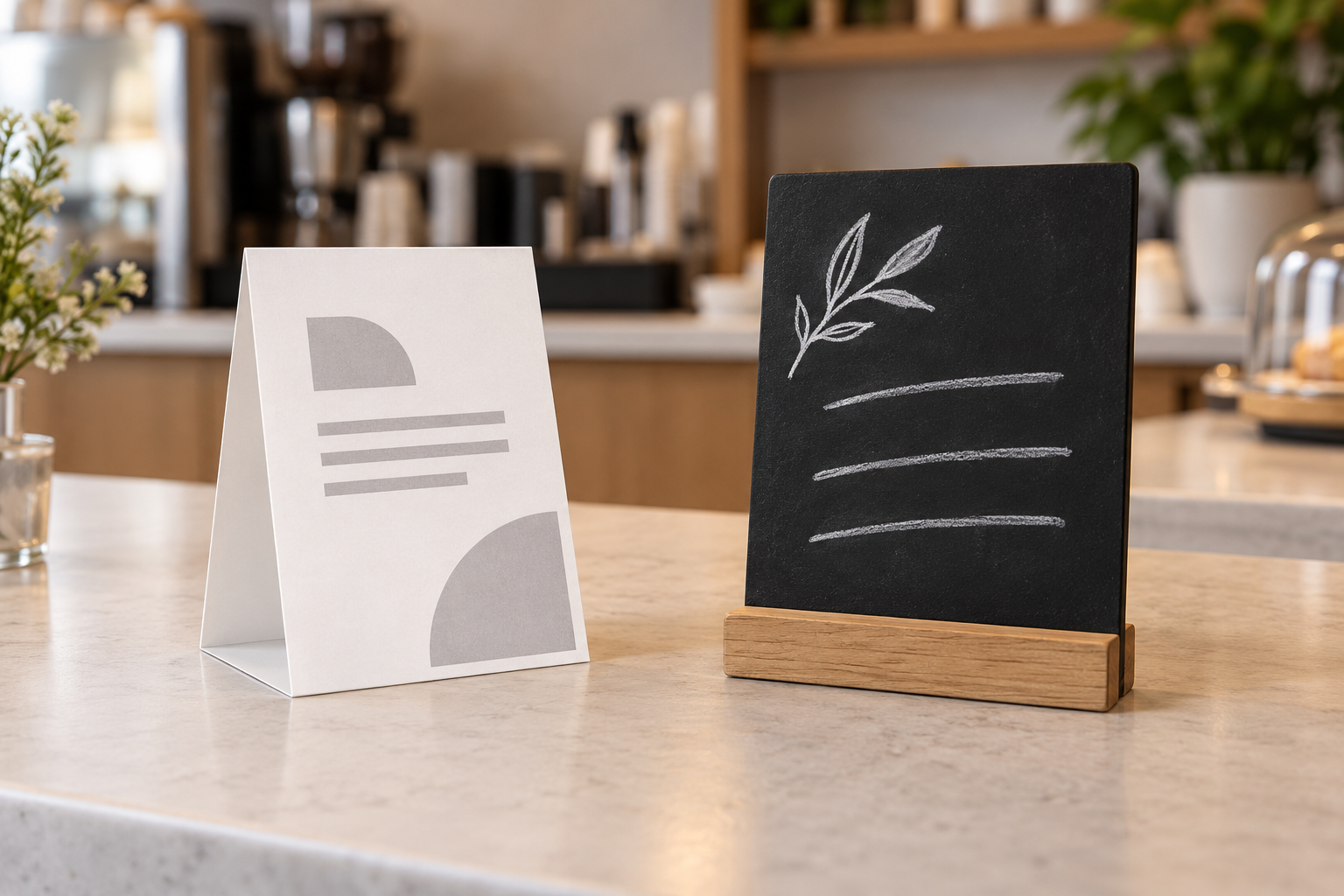
Compare the complete message system
Check current product details for finished dimensions, printable area, fold or base geometry, supported writing tools, cleaning directions, and storage needs. Build one full-size sample before ordering a quantity.
The short answer
- Printed table tent: fits a settled message that must look the same across several tables, counters, or event positions.
- Tabletop chalkboard: fits one or a few local positions where a short message changes and a named person owns the writing and cleaning routine.
- Skip both: when the message must be read from farther away, the counter has no safe footprint, the copy is long, or a mounted notice, digital display, or staffed explanation better fits the task.
Side-by-side tradeoffs
| Decision | Printed table tent | Tabletop chalkboard |
|---|---|---|
| Message workflow | Design, proof, print, trim or separate, fold, and place | Write, review in position, erase, clean, and rewrite |
| Consistency | Repeatable type, spacing, color, and wording when the same file and print process are used | Appearance depends on the writer, tool, available area, and each reset |
| Update speed | Requires a revised file and another print cycle | Can be changed locally after the surface is prepared as directed |
| Viewing faces | Can carry one or two printed faces depending on the template | May be one- or two-sided; verify the actual product and base |
| Care | Replace bent, stained, curled, or outdated pieces | Use only supported writing and cleaning supplies; inspect the base and surface |
| Storage | Flat stock and finished tents need protection from crushing and moisture | Boards, bases, and writing supplies need a labeled storage location |
Who each option fits
Choose printed tents for controlled, repeated messages
A table tent works well for a promotion, check-in instruction, table identifier, short menu note, or event prompt that has already passed review. It is especially useful when the same message appears in several positions and typography must remain consistent. Confirm the template, finished fold, visible panels, printer limits, paper weight, and complete footprint before producing a batch.
Printed tents also make handoff simpler: staff place the correct version rather than recreating the message. That advantage disappears when dates, prices, availability, or instructions change faster than the print workflow can keep up.
Choose a chalkboard for short local updates
A tabletop chalkboard fits a short daily message when the operator can write legibly, review the finished board from the customer approach, and maintain the surface. It can reduce reprinting for frequent changes, but only if the board, writing tool, cleaner, and update owner form a workable system.
Measure the writable area rather than the outside frame. Draft the message at actual size, allow margins around the frame, and test whether the lettering remains readable under the real lighting. Decorative handwriting is not a substitute for clear hierarchy.
Setup before buying a quantity
- Write the real message. Include the longest likely wording, required fallback information, and any date or owner line.
- Map the approaches. Note whether people arrive from one direction or two and whether another object blocks the face.
- Measure the footprint. Include the open paper fold or full chalkboard base, not just the sign face.
- Build one sample. Print and fold one tent, or write one board with the intended tool, then view it in position.
- Test the update. Time the complete reprint-and-placement or erase-and-rewrite routine, including approval.
- Assign ownership. Name who removes expired messages, checks condition, and stores supplies.
Maintenance and operating issues
Printed tents need version control. Put a revision date or internal identifier where staff can find it without cluttering the customer-facing message, store unused pieces flat, and remove old versions before replacements are distributed. A reusable template helps only when the correct file is easy to locate.
A chalkboard needs compatible writing tools and current cleaning directions. “Chalkboard” listings can describe different surfaces, and ordinary chalk, liquid markers, and cleaners are not automatically interchangeable. Test a small area if the maker directs it, keep supplies with the board, and replace the display when the writing surface or base no longer presents the message clearly.
Who should skip the printed table tent
- The message changes before a print batch will be used.
- The available printer, paper, or finishing method cannot produce the required fold and stable footprint.
- Staff cannot reliably distinguish current and expired versions.
- The location exposes paper to routine spills, heavy handling, or cleaning conditions the chosen stock is not intended to handle.
Who should skip the tabletop chalkboard
- No one owns writing quality, approvals, cleaning, or timely updates.
- The message is too long or detailed for the measured writing area.
- The product instructions do not identify compatible writing and cleaning supplies.
- Brand consistency or exact repeated wording across many locations matters more than local flexibility.
When another format is better
Choose a table tent or acrylic insert holder when a printed message changes but a rigid reusable holder may simplify setup. Compare a chalkboard with a dry-erase sign when both options are writable and the surface, marker, glare, and cleaning routine are still undecided. Use the printed insert vs dry-erase comparison when a protected insert system is the stronger fixed-message alternative.
Next steps
For fixed print, use the printable cardstock guide to check printer compatibility, finished size, fold direction, and sample output. For reusable writing, review chalkboard signs for pop-up menus and choose by actual writing area, base, placement, supplies, and storage. Return to the small-business sign planning pillar when message hierarchy, placement, or update ownership still needs work.
Bottom line
A printed table tent is the stronger route for approved copy that must repeat cleanly; a tabletop chalkboard is the stronger route for a short local message with a dependable rewrite routine. Decide from message life, quantity, update owner, viewing direction, footprint, and maintenance—not from style alone.