 The Good Sign Company
Worth-it decision
Is a clipboard sign holder worth it for a vendor table?
A clipboard sign holder is worth it when you replace a letter-size price sheet, menu, signup page, or notice every event—and especially when someone needs to write on that page. It is usually the wrong format when the message rarely changes, exposed paper looks too casual, customers approach from two directions, or the table cannot spare the base footprint.
This guide decides whether the clipboard workflow earns table space. If you are still choosing among all tabletop formats, start with the vendor-booth tabletop sign guide.
Disclosure: As an Amazon Associate, we may earn from qualifying purchases and approved partner referrals.
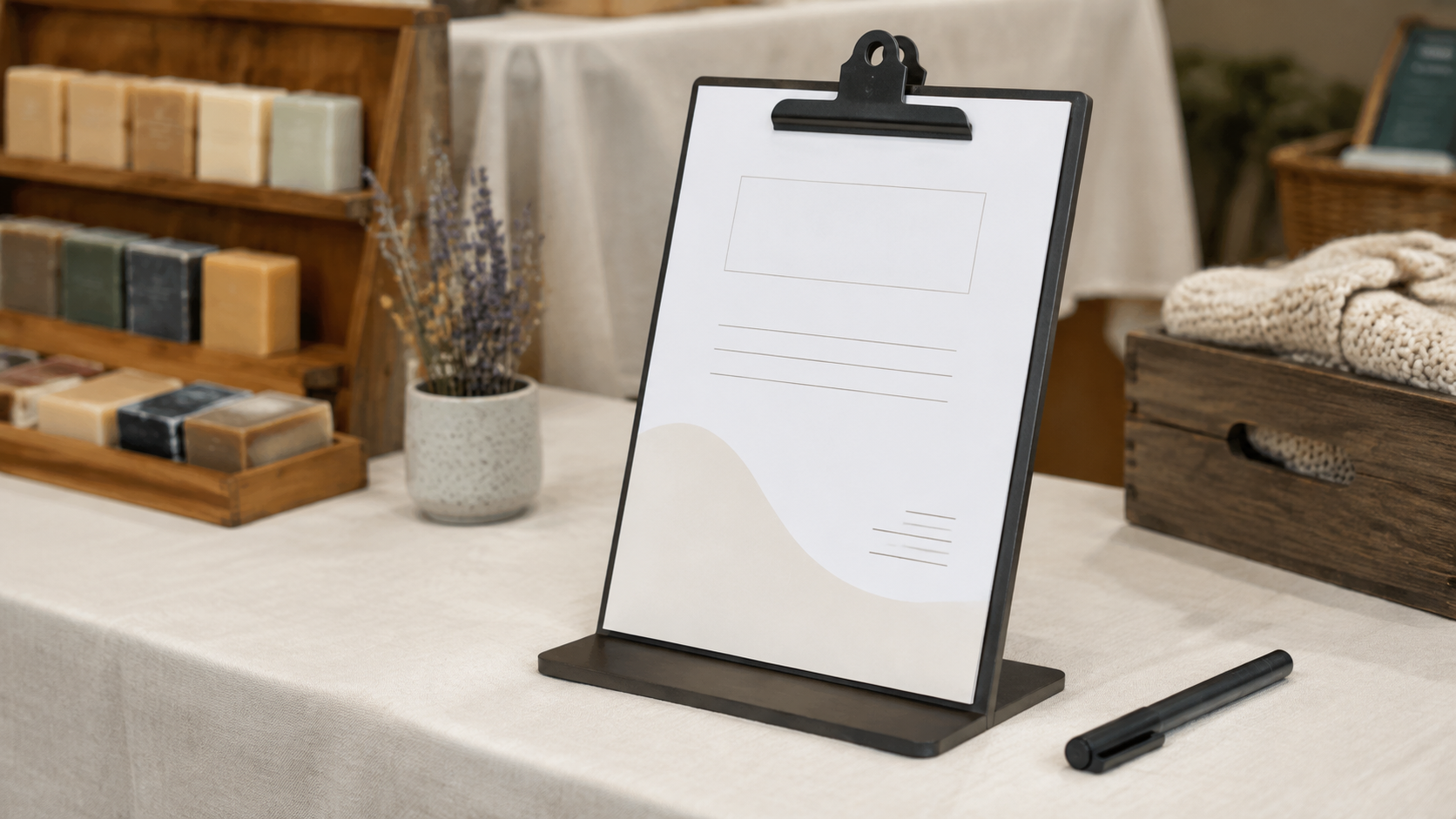
Compare holders after measuring the paper and table
Check the listed paper orientation and size, usable clip opening, complete height, base footprint, viewing angle, holder material, included parts, and indoor-use instructions. Confirm that the clip can hold your actual paper stack without covering important information.
Quick verdict: buy, trial, or skip
- Buy: the page changes at most events, staff need to annotate it, one viewing face is enough, and the measured base fits without crowding products or payment equipment.
- Trial first: prop your real sheet on a cardboard stand cut to the listed dimensions and run one event with the planned message.
- Choose acrylic instead: the page should sit behind a clear face, consistent presentation matters more than writing access, or two-sided visibility is useful.
- Skip: the message is stable, the table is already crowded, the exposed page will curl or get marked in the intended setting, or a wall, shelf, or digital route serves the job better.
The two questions that justify a clipboard
First, how often does the page change? Count the last six events rather than estimating. New prices, rotating inventory, workshop signup sheets, or event-specific instructions can make quick clipping valuable. If one printed card has served all season, a slot stand, frame, or acrylic holder may present it with less visible hardware.
Second, must anyone write on the displayed page? A clipboard keeps the face accessible for a tally, signup, order note, or temporary annotation. If the sign is view-only, exposed access provides little benefit. Protecting the print or showing a second face may matter more.
Run a paper-and-footprint test before buying
- Print the longest real page at its final type size and orientation.
- Mark the product's listed base depth and width on the table with removable paper.
- Place merchandise, packaging, and payment equipment around that rectangle.
- Prop the page at the listed overall height and view it from the normal customer approach.
- Try changing and writing on the sheet without moving nearby products.
The test exposes a common mismatch: a holder may accept letter-size paper yet place the bottom lines behind products or too low for a standing visitor. Use the visible page area and real sightline—not the paper size alone—to judge fit.
Clipboard vs acrylic holder vs table tent
- Clipboard holder: quickest access to a single exposed sheet and best when writing on the page is part of the task; the clip and paper edges remain visible.
- Acrylic holder: useful for a view-only insert and a cleaner enclosed presentation; reflections, insert loading, and cleaning still need review.
- Table tent: inexpensive and compact for short-lived printed messages, often with two viewing faces; less suitable when customers must write on the page.
- Slot stand: minimal hardware for a stiff finished card; it does not support flexible paper for writing.
For a direct view-only comparison, use the table tent vs acrylic sign holder guide. When customers arrive from both sides, first decide whether a double-sided counter sign is worth the extra face.
Check the clip, page, and writing motion
Manufacturer listings vary, so verify the clip opening and supported page format for the exact holder. A thick stack may not fit just because one sheet does. Check whether the clip covers a heading and whether its pressure marks paper you plan to reuse. Keep essential text outside the hardware area.
If people will write on the page, the stand must support normal pen pressure in your setup. Product photos alone cannot establish that. Follow the maker's setup instructions and test the exact holder on the actual table before relying on it with customers. If it shifts, flexes, or forces an awkward reach, use a flat clipboard for the writing task and a separate view-only sign.
Appearance and upkeep can change the answer
A visible clip communicates “working document.” That can suit a maker market, workshop, signup point, or frequently revised menu. It may feel too utilitarian for a formal reception desk or polished product launch. Print quality still matters: use deliberate margins, strong contrast, and enough blank space around the clip.
Exposed paper can pick up fingerprints, bends, and stray marks. Bring replacement sheets and store them flat. Follow the holder maker's cleaning guidance for the frame and base. This guide covers indoor or sheltered table use only and does not promise resistance to spills, wind, weather, or repeated transport.
Who should choose another format?
- Use an acrylic holder when the sign is view-only and you want the insert behind a clear face.
- Use a double-sided holder when the same message must face two customer approaches.
- Use a flat clipboard when writing comfort matters more than keeping the page upright.
- Use small price cards beside products when one large sheet forces customers to search for an item.
- Delay the purchase if venue rules, table dimensions, sightlines, or the final paper format are unknown.
Bottom line
A clipboard sign holder is worth buying for a vendor table when frequent sheet changes or writing access are real parts of the workflow, and a measured one-face stand fits the table and sightline. It is not automatically the most flexible holder: exposed paper, visible hardware, one-way viewing, and writing stability can all make a different format better. Run the paper mockup at one event, then compare the exact product dimensions and instructions.
If the buy-or-skip test points to a clipboard, compare clipboard holder formats for frequently changed notices by sheet fit, clip access, angle, placement, and writing support. Next, review the small-business sign planning pillar, compare price signs for craft-fair tables, or choose among tabletop sign formats for vendor booths.