 The Good Sign Company
Worth-it decision
Is a top-loading acrylic sign holder worth it for a crowded counter?
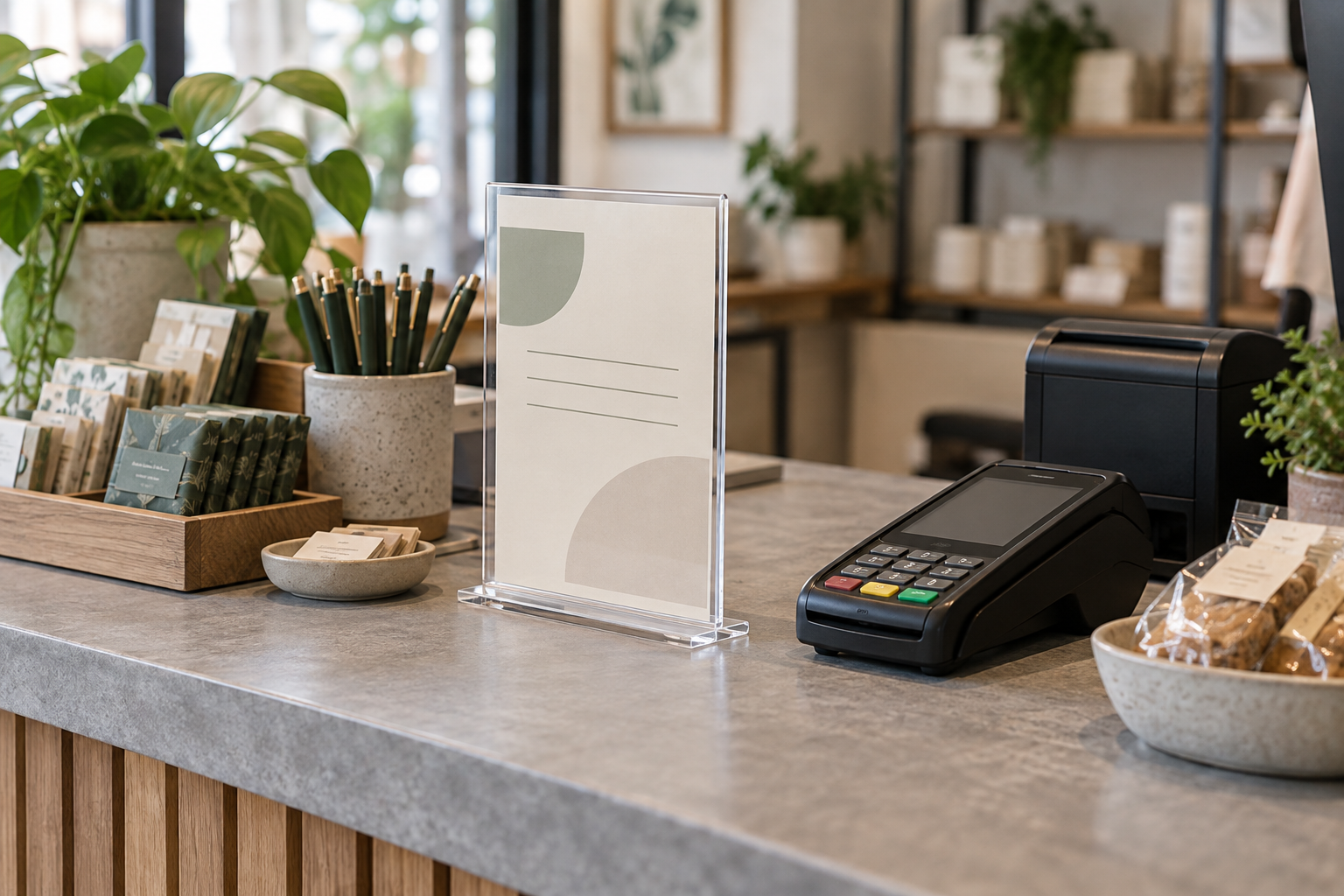
A top-loading acrylic sign holder is worth considering when side access is blocked, the full base fits outside payment and handoff zones, and there is enough clear space above the holder to lift the insert out. Skip it when overhead shelves or equipment interrupt that loading path, or when a smaller card, wall notice, or shelf-edge label can do the job with less counter space.
“Top loading” describes the insert path, not a universal paper size or footprint. Make a full-size mockup using the dimensions from a current listing, then rehearse the entire insert change at the real counter. Use the small-business sign planning guide to define the message and viewing position first.
Disclosure: As an Amazon Associate, we may earn from qualifying purchases and approved partner referrals.
Compare holders only after measuring
Check each current listing for paper orientation and dimensions, visible area, full base depth and width, loading opening, overall height, cleaning directions, and package quantity. Product photos alone cannot confirm whether the holder fits your counter.
Quick verdict: buy, skip, or delay
- Buy: the sign has a defined job, side access is genuinely blocked, and a measured vertical loading path stays clear during normal work.
- Skip: the holder would displace payment, packing, pickup, or accessibility-critical space, or the message works on a smaller format.
- Delay: the insert size, wording, orientation, counter layout, or update owner is still changing.
- Choose another format: use a side-loading holder when vertical clearance is tight, a wall or fixture display when the counter is full, or a flat card when the message rarely changes.
Measure the loading path, not only the holder
Start with the listing's complete outside dimensions. Mark the base on the counter with removable paper tape, then add the holder height. Above that, reserve the distance needed to grip and lift the complete insert. A paper sheet can need nearly its own height in clear space before it comes free, depending on the holder's construction.
Check the path for shelves, monitor arms, hanging merchandise, pendant fixtures, sneeze guards, and other fixed objects. Also watch how staff reach across the counter. A clear space in a still photograph may not stay clear during checkout.
Run a counter-zone test
Divide the counter into actual work zones before assigning space to a sign:
- Payment: keep the card terminal and the customer's approach to it clear.
- Handoff: preserve the space used for purchases, receipts, forms, or pickup items.
- Staff reach: avoid a position that forces repeated reaching around or over the holder.
- Message: place the sign where the intended reader sees it before the information is needed.
A holder can fit mathematically and still interfere with the sequence of work. Observe several normal transactions with a cardboard mockup in place before buying a multipack.
Confirm the insert and visible area
Do not treat a familiar paper label as proof of fit. Verify the stated insert dimensions, portrait or landscape orientation, and any covered edge area. Keep the headline and action away from the borders, where acrylic edges, reflections, or neighboring objects may compete with them.
Print the final message at full size. Read it from the customer's first approach, the decision point, and the closest standing position. If type must shrink to fit the holder, shorten the message or choose a larger readable format rather than relying on the clear frame to make crowded copy useful.
Glare can erase the message
Clear acrylic can reflect windows, ceiling fixtures, bright displays, and the payment screen. Test the proposed position during actual operating hours with a clear sleeve or sheet over the print. Shift the angle or location when reflections cross the most important words. Avoid assuming that a product described as clear will be readable in every lighting setup.
Follow the current maker's cleaning instructions. Some cleaners or rough materials may not be recommended for a particular holder, so do not generalize care advice across all acrylic products.
Update frequency sets the value
Top access matters most when a business changes a standard-size insert often enough for the easier loading route to save real counter rearrangement. A weekly promotion, rotating pickup instruction, or scheduled event message may justify a reusable holder. A permanent message may be better served by a smaller fixed sign, while several daily changes may point toward a writing surface or digital system.
Name the role responsible for replacing expired inserts and storing the current print file. Loading convenience does not prevent stale information.
Choose the alternative by the failed test
- Not enough overhead clearance: compare a side-loading holder, provided its side path stays accessible.
- Too much base depth: consider a shelf-edge, fixture-mounted, or wall format suited to the exact surface and permissions.
- Two customer approaches: compare a holder with two readable faces rather than duplicating a one-sided message.
- Message changes constantly: compare a clipboard sign holder with an acrylic holder or another update method that fits the workflow.
- Only orientation is unresolved: use the portrait vs landscape checkout holder guide.
A ten-minute mockup test
- Print the final insert at the listed size.
- Build a cardboard profile using the complete listed height, width, and base depth.
- Mark the vertical removal path for the full insert.
- Place the mockup outside payment and handoff zones.
- Read it from every real approach under normal lighting.
- Remove and replace the insert without moving neighboring equipment or merchandise.
If the mockup blocks a task, disappears behind counter equipment, or cannot be reloaded cleanly, the top-loading feature does not solve this layout.
Bottom line
A top-loading acrylic sign holder is worth it when it solves blocked side access without creating an overhead-clearance or footprint problem. Measure the entire holder and insert path, test the final message, and buy only after the mockup survives a normal counter workflow.
Continue with the table tent vs acrylic holder comparison, the retail checkout sign guide, or the small-business sign planning pillar.